


A coup of sorts is under way in dirt poor, Communist-ruled Laos: Contrary to dire predictions, it is staging the biggest sporting event in its history to rave reviews.
And in the process, it is hoping to hoist itself up a few rungs from its lowly position on the international sports ladder.
With the 11-nation Southeast Asian (SEA) Games in its final phase, assessments by coaches, athletes and officials of the event’s facilities, organization and sporting spirit have been uniformly positive, if not ecstatic.
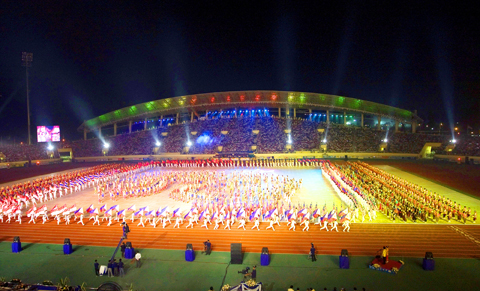
PHOTO: EPA
This in a country which ranks among the world’s poorest (No. 176 of 210 on the World Bank’s list), sent only four athletes to last year’s Beijing Olympics (the International Olympic Committee paid for their tracksuits and plane tickets) and where until not long ago runners trained in a dung-strewn stadium that doubled as a cattle grazing ground.
“Terrific. I can’t find any faults with these games,” said Frantisek Petrovic, the Slovak coach of Malaysia’s track team at the new 20,000-seat main stadium, ringed by forests and farms on Vientiane’s outskirts.
“It is natural they are apprehensive and nervous but at the same time they are so disciplined and open to change and advice,” said Rabi Rajkarnikar, a technical official with the Asian Athletics Association monitoring the games. “They listen and are willing to run around and make changes. They have all the equipment for other championships in the future. They are doing fantastically well.”
Doubts were initially expressed that Laos, starting with virtually no facilities or experience, could stage the 25th version of the biennial event. While hardly Olympian in scale, the games have brought together 4,800 athletes from a region of 600 million people.
To the ire of Malaysian Sports Minister Seri Ismail Sabri Yakob — who predicted the Vientiane games would turn into a “full-fledged circus” — Laos scaled down the number of sports to 28 from a bloated 43 at the last games in Thailand.
While the number conforms to the Olympic standard — 26 are currently recognized as official sports at summer games — it excludes such mainstream sports as basketball, gymnastics and sailing. Added were dubious ones like petanque, the French version of lawn bowls which harkens back to Laos’ colonial past. The landlocked nation retained beach volleyball, hauling sand in from the banks of the Mekong River.
Organizers then sought help from their friends. Vietnam financed the US$19 million athletes village, Thailand provided technical expertise and more funding came from Japan, South Korea and Brunei.
In a deal still shrouded by controversy and secrecy, China built the US$100 million main stadium complex in exchange for a lease on land near Vientiane to construct an entire satellite city. Angry rumors that thousands of Chinese would settle there forced the government to scale down the project.
“SEA Games fever leads me to believe Lao sports will improve,” said Somsavat Lengsavad, the organizing committee chairman, failing to mention that public enthusiasm for the games has far outstripped that exhibited at events staged to celebrate communism.

After letting another big lead slip with an error-strewn performance at the French Open on Wednesday, top-ranked Aryna Sabalenka felt like getting as far away from the courts as possible. “Just want to quit tennis right now,” Sabalenka said after wasting a lead of a set and two breaks in a 3-6, 7-5, 6-0 loss to Diana Shnaider in the women’s singles quarter-finals. “We’ll see in few days. Hopefully I’ll get back on track mentally.” Sabalenka’s wait for a first French Open title continues despite the four-time major winner leading 4-1 in the second set and being two points from victory while
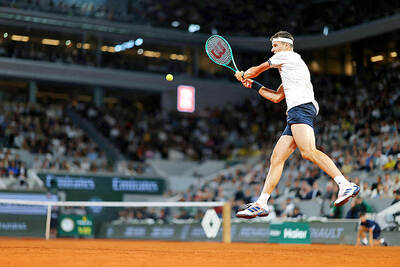
BIG NAMES GONE: Zverev is the clear favorite for a maiden Grand Slam title, reaching semi-finals for the fifth time in six years and finishing second on three occasions Alexander Zverev on Tuesday breezed past Rafael Jodar to stay on course for an elusive Grand Slam title at the French Open, while Jakub Mensik halted Joao Fonseca’s scintillating run in the quarter-finals. Zverev, the highest-ranked player left in the men’s draw, put an end to Spanish teenager Jodar’s impressive Roland Garros debut, easing into the semi-finals with a 7-6, (7/3), 6-1, 6-3 win. The 29-year-old Zverev is the clear favorite for a maiden Grand Slam title. He has finished runner-up on three occasions, including at the 2024 French Open. “I want to win the matches that are ahead of

For some, Cristiano Ronaldo remains the essential spearhead for Portugal’s FIFA World Cup bid, while others believe his presence would prevent Roberto Martinez’s strong side from flourishing. The debate around the five-time Ballon d’Or winner rages on, as it did at UEFA Euro 2024 and four years ago in Qatar — yet Ronaldo endures, ready to play in a record sixth World Cup. The 41-year-old remains a global superstar despite swapping the European elite for Saudi Arabia’s Al-Nassr, and is the leading men’s international goalscorer with 143 strikes. With 25 of those coming in 30 games under Martinez, the coach
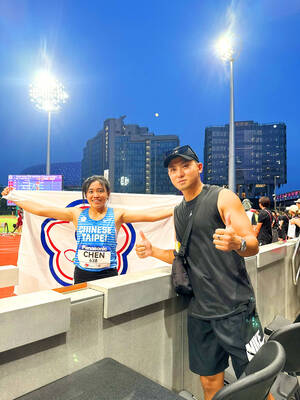
Taiwanese sprinter Chen Yi-cen on Friday won the silver medal in the women’s 400m final at the Asian U20 Athletics Championships in Hong Kong, with a time of 53.16 seconds. Chen, 15, was the youngest among the eight finalists, and her performance also met the qualifying standard of 53.50 seconds for the Nagoya Asian Games in Japan in September and October. Chen first made her mark at the National Games in Tainan in 2023, at the age of 13, winning the women’s 400m final in 55.55 seconds to become the youngest gold medalist in the history of the event. Meanwhile,


 RSS
RSS