


It now appears increasingly unlikely that US President Barack Obama will agree to sell advanced F-16 C/D fighter aircraft to Taiwan.
During a congressional hearing on Wednesday, Acting Deputy Assistant Secretary of State for Defense Trade Robert Kovac told Reuters that Obama was moving toward selling Taiwan UH-60 Black Hawk helicopters and design work on diesel-electric submarines.
Patriot Advanced Capability (PAC-3) missiles were still under consideration, he said.
But he made no mention of the fighters, which are the most controversial item on Taipei’s list of desired weapons to defend itself from a Chinese attack.
Assistant US Secretary of State Philip Crowley was asked on Thursday if he could confirm Kovac’s remarks, which were made exclusively to Reuters during a break in his testimony.
“Well, I’m not going to get into any detail on any kind of arms list. We obviously have ongoing discussions with Taiwan. The United States makes available to Taiwan defense articles and services that are necessary to enable Taiwan to maintain a sufficient self-defense capability,” Crowley said.
“And, you know, Taiwan has on an ongoing basis made requests of us, that we continue to evaluate them, and we’ve made no decisions,” he said.
A reporter asked Crowley if he had any comment on a Chinese statement that Beijing was opposed to selling any arms to Taiwan.
“On this particular issue, I doubt seriously that our position has changed and I doubt seriously that the Chinese position has changed,” Crowley said.
Later, at a State Department briefing on a wide range of issues, Crowley was asked: “Back to Taiwan, it seems like the F-16 C/Ds have been taken out of the shopping list.”
Crowley said firmly: “I’m not going down that shopping list.”
A number of Washington-based experts said later that they were fairly certain that Obama had decided not to sell the F-16s to Taiwan. They said they believed this was because such a sale would cause China to break off the military-to-military contacts it had recently re-established with the US, and that these contacts are a top priority for the Pentagon and Obama.
John Pike, head of the Global Security think tank in Washington, said that Obama was “kowtowing” to Beijing, but that it was also significant that Taipei had not raised a hue-and-cry about the F-16s even though it must have known for some time that it would not be getting them.
“They have not made a big issue out of this. They have just accepted it,” Pike said.
Earlier, at the House of Representatives Foreign Affairs subcommittee hearing involving Kovac, Representative Brad Sherman, a Democrat, said: “Taiwan has expressed an interest in purchasing F-16 aircraft. Given the violence done to the American economy by the illegal actions of China in so many economic spheres, for us to accede to Chinese concerns in not providing the F-16s to Taiwan seems to add not insult to injury but injury to injury.”
Kovac was asked during the hearing what effect the US sales of military aircraft, like F-22s to Japan and F-16s to Taiwan, would have on the security environment in the Pacific region.
“Well, in any export there is going to be a positive and negative effect — you increase your friends, decrease the enemy,” Kovac said. “And in each of those cases, when we receive the request, we look at it very seriously to balance both the national security and foreign policy of the US, of that country and the potential regional impacts.”
He was then asked: “So, if you had your druthers about this, you would say we need to move ahead and try to respond to Japan’s request for our F-22s and Taiwan for our F-16s?”
“Absolutely. The State Department isn’t in the trade advocacy business,” Kovac said.

The Tourism Administration yesterday announced that it would reward repeat international visitors with incentives of up to NT$8,000 to boost inbound tourism. The incentives are available to all international tourists, it said, adding that repeat visitors would be rewarded with NT$5,000 and would receive an additional NT$3,000 if they bring travel companions. The nation received 2,990,657 inbound visitors during the first quarter, marking a 3.8 percent increase from the same period last year, agency data showed. Japanese nationals are among groups visiting Taiwan the most. About 1.48 million Japanese tourists arrived last year, a year-on-year increase of more than 12
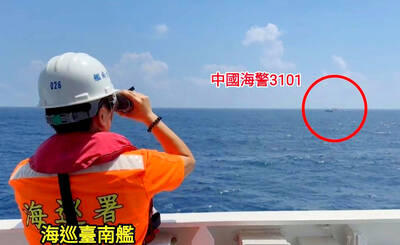
‘BRAZEN’: The holiday did not stop China from activities that infringe on Taiwan’s maritime jurisdiction, but the CGA is ready to defend the nation, Kuan Bi-ling said Beijing is intensifying maritime pressure on Taiwan, but the nation will never yield, Ocean Affairs Council Deputy Minister Sung Chen-en (宋承恩) said. The Coast Guard Administration (CGA) has adopted a “shadowing and monitoring” approach to avoid falling into a Chinese trap to escalate tensions and deepen the conflict, Sung said in an interview published yesterday in the Chinese-language Liberty Times (the Taipei Times’ sister newspaper). China Coast Guard formations patrolling waters east of Taiwan, as well as official Chinese vessels entering areas around Itu Aba Island (Taiping Island, 太平島) and Pratas Islands (Dongsha Islands, 東沙群島) show Beijing’s attempts to significantly step up
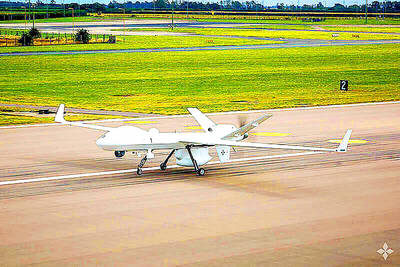
BOOST: By operating the same advanced systems as the US military, Taiwan would be better positioned to share and integrate intelligence with partners, an expert said The first batch of MQ-9B SkyGuardian drones has arrived in Taiwan, and is being assembled and tested by drone manufacturer General Atomics and the military ahead of flight trials as part of the air force’s acquisition to bolster its aerial surveillance capabilities, a source said yesterday. The air force allocated a budget of NT$21.7 billion (US$687 million) from 2022 to 2029 to procure four MQ-9B uncrewed aerial vehicles (UAVs) manufactured by General Atomics along with associated equipment such as ground control stations. The US has agreed to deliver the four MQ-9Bs to Taiwan in two batches this year and next
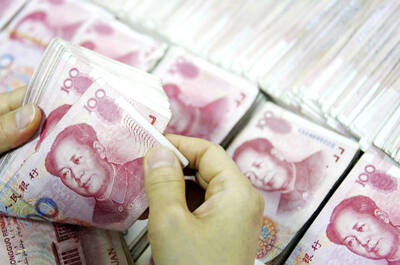
Taiwanese firms’ China investments have dwindled to less than 1 percent of their total foreign investments, putting China-based investments on track for a record low this year, Ministry of Economic Affairs data showed. Taiwan’s investments abroad in the first five months of this year reached US$35.92 billion, Department of Investment Review data showed. Investments outside China totaled US$35.61 billion, up 133.94 percent year-on-year, while investments in China totaled US$310.3 million, down 32.3 percent and about 0.86 percent of the total, data showed. Major overseas projects included Taiwan Semiconductor Manufacturing Co’s (TSMC, 台積電) US$30 billion capital injection into an overseas subsidiary,


 RSS
RSS