


Thousands of Japanese gathered in sweltering heat on the southern island of Okinawa yesterday to demand that a US Marine base be moved out of the region, days ahead of a visit by US President Barack Obama.
Meanwhile, Japanese Foreign Minister Katsuya Okada said yesterday that no deal on relocating US troops can be expected during Obama’s visit this week, saying the issue needs more time to resolve.
Okada said on TV Asahi that “an agreement between the heads of state holds heavy meaning,” but cannot be expected to be completed during Obama’s visit.
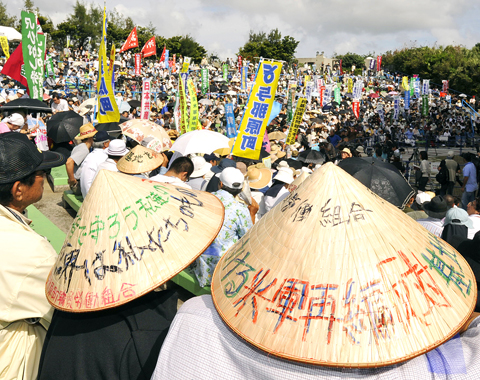
PHOTO: AFP
The row over the re-siting of the Futenma Air Base threatens to stall a realignment of the 47,000 US military personnel in Japan and sour defense ties between the two countries.
It could also prove a domestic headache for Japanese Prime Minister Yukio Hatoyama, whose support ratings have slipped since his landslide election victory in August.
“Okinawa’s future is for us, the Okinawan people to decide,” Ginowan Mayor Yoichi Iha told a supportive crowd, which spilled out of an open-air theater by the beach. “We cannot let America decide for us.”
Organizers put the number of protesters at 21,000. Police estimated the crowd at 6,000.
Under a 2006 US-Japan agreement, the Futenma Marine base in the center of Ginowan is set to be closed and replaced by a facility built partly on reclaimed land at Henoko, a less populated part of the island, by 2014.
The deal, which Washington wants to push through after years of what a military official called “painful” negotiations, is part of a wider plan to re-organize US troops and reduce the burden on Okinawa by moving up to 8,000 Marines to Guam.
US Secretary of Defense Robert Gates has urged Japan to approve the plan ahead of Obama’s visit, which is scheduled to start on Friday.
Hatoyama, who vowed to build a more equal relationship with the US, said in the run-up to his August election victory the base that should be moved off the island.
That view was supported by 70 percent of Okinawa residents in a poll published this month by the Mainichi Shimbun.
Okinawa, controlled by the US until 1972, makes up only 0.6 percent of Japan’s land mass, but hosts about half the US troops in Japan. Those who live near the bases complain of noise, crime, pollution and accidents.
Gushi also sees the row as potentially undermining Japan’s US-dependent security policy, leaving the country vulnerable.
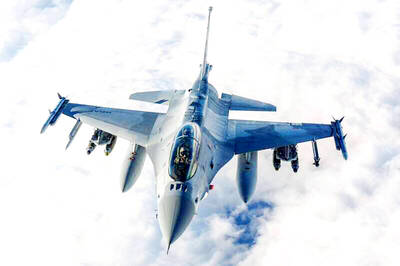
LONG FLIGHT: The jets would be flown by US pilots, with Taiwanese copilots in the two-seat F-16D variant to help familiarize them with the aircraft, the source said The US is expected to fly 10 Lockheed Martin F-16C/D Block 70/72 jets to Taiwan over the coming months to fulfill a long-awaited order of 66 aircraft, a defense official said yesterday. Word that the first batch of the jets would be delivered soon was welcome news to Taiwan, which has become concerned about delays in the delivery of US arms amid rising military tensions with China. Speaking on condition of anonymity, the official said the initial tranche of the nation’s F-16s are rolling off assembly lines in the US and would be flown under their own power to Taiwan by way

CHIP WAR: The new restrictions are expected to cut off China’s access to Taiwan’s technologies, materials and equipment essential to building AI semiconductors Taiwan has blacklisted Huawei Technologies Co (華為) and Semiconductor Manufacturing International Corp (SMIC, 中芯), dealing another major blow to the two companies spearheading China’s efforts to develop cutting-edge artificial intelligence (AI) chip technologies. The Ministry of Economic Affairs’ International Trade Administration has included Huawei, SMIC and several of their subsidiaries in an update of its so-called strategic high-tech commodities entity list, the latest version on its Web site showed on Saturday. It did not publicly announce the change. Other entities on the list include organizations such as the Taliban and al-Qaeda, as well as companies in China, Iran and elsewhere. Local companies need
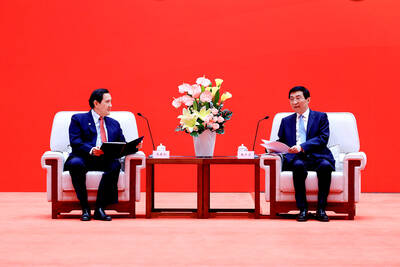
CRITICISM: It is generally accepted that the Straits Forum is a CCP ‘united front’ platform, and anyone attending should maintain Taiwan’s dignity, the council said The Mainland Affairs Council (MAC) yesterday said it deeply regrets that former president Ma Ying-jeou (馬英九) echoed the Chinese Communist Party’s (CCP) “one China” principle and “united front” tactics by telling the Straits Forum that Taiwanese yearn for both sides of the Taiwan Strait to move toward “peace” and “integration.” The 17th annual Straits Forum yesterday opened in Xiamen, China, and while the Chinese Nationalist Party’s (KMT) local government heads were absent for the first time in 17 years, Ma attended the forum as “former KMT chairperson” and met with Chinese People’s Political Consultative Conference Chairman Wang Huning (王滬寧). Wang
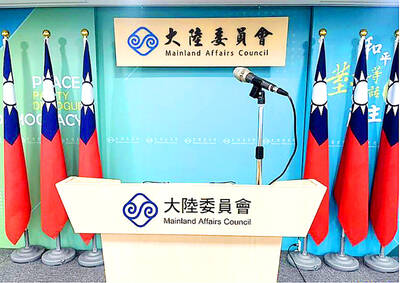
CROSS-STRAIT: The MAC said it barred the Chinese officials from attending an event, because they failed to provide guarantees that Taiwan would be treated with respect The Mainland Affairs Council (MAC) on Friday night defended its decision to bar Chinese officials and tourism representatives from attending a tourism event in Taipei next month, citing the unsafe conditions for Taiwanese in China. The Taipei International Summer Travel Expo, organized by the Taiwan Tourism Exchange Association, is to run from July 18 to 21. China’s Taiwan Affairs Office spokeswoman Zhu Fenglian (朱鳳蓮) on Friday said that representatives from China’s travel industry were excluded from the expo. The Democratic Progressive Party government is obstructing cross-strait tourism exchange in a vain attempt to ignore the mainstream support for peaceful development


 RSS
RSS