


The government’s decision to relax restrictions on imports of US beef came under fire yesterday, with Department of Health (DOH) Minister Yaung Chih-liang (楊志良) facing a particularly fierce barrage in the legislature.
Legislators from across party lines and consumer groups lined up to blast the government and threatened boycotts over last week’s announcement, while Taipei Mayor Hau Lung-bin (郝龍斌) announced the formation of a trade association that would boycott certain US beef products.
Executive Yuan Spokesman Su Jun-pin (蘇俊賓) said the central government would not prohibit local governments from boycotting US beef and beef products.
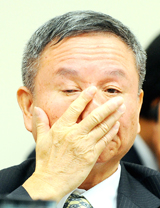
PHOTO: CHANG CHIA-MING, TAIPEI TIMES
“[The actions taken by Taipei City Government] to ensure the public’s health were understandable. We, too, always bear public health in mind. The DOH will implement the strictest inspections of US beef imports to make sure they will not harm health,” Su said.
In response to the concerns over lifting the ban on brains, eyes, skull and spinal cord from cattle less than 30 months of age, Su said the highest standards would be applied to ensure safety, adding that the government would adopt inspection procedures that would not violate the agreement with Washington.
“We believe that the international community will understand,” Su said.
Su said the DOH would take necessary measures to remind consumers of the potential risks of US beef and beef products and require importers to specify the place of origin on packages.
Speaking at a meeting at the legislature’s Social Welfare and Environmental Hygiene Committee to brief lawmakers on the talks that led to the lifting of restrictions on US beef, Yaung said he was disappointed that Taiwan was not able to secure a deal to open its market only to bone-in beef from cattle younger than 30 months.
“I am not happy with the result, but it is acceptable,” Yaung said.
The ban will be lifted to allow the entry of US bone-in beef, ground beef, some offal and processed beef from cattle younger than 30 months that have not been contaminated with “specific risk materials” beginning on Nov. 10. Washington had wanted Taiwan to open its market to all US beef products, he said.
The two sides managed to reach an initial consensus on the issue in June, agreeing that further talks should be held based on a South Korean formula, Yaung said.
The DOH announced on Friday that Taiwan would expand market access for US beef after officials of the two countries agreed the previous day in Washington to lift a partial ban on such imports.
“All negotiations involve concessions,” he said.
KMT Legislator Lin Hung-chih (林鴻池) said that the health minister should step down to take political responsibility for the new market-opening measures.
Democratic Progressive Party Legislator Huang Sue-ying (黃淑英) said the Taiwanese negotiators, led by DOH Vice Minister Hsiao Mei-ling (蕭美玲), fought a losing battle, adding that when Taiwan agreed in 2006 to open its doors to US boneless beef, it attached the condition that if a single case of bovine spongiform encephalopathy, or mad cow disease, occurred in the US, Taiwan could immediately halt imports.
“This time we have allowed bone-in beef and organs and we cannot reimpose the ban unless the World Organization for Animal Health [OIE] decides the US is an infected area. This is absurd and a humiliation to the nation,” Huang said.
DPP Legislator Wang Sing-nan (王幸男) said President Ma Ying-jeou (馬英九) and National Security Council Secretary-General Su Chi (蘇起) should be held accountable, accusing them of interfering with the decision-making process.
Meanwhile, Council of Agriculture (COA) Minister Chen Wu-hsiung (陳武雄) said at another legislative hearing that he and his family would eat US-imported beef and beef products, but he would not pressure the public to follow suit.
KMT Legislator Lu Shiow-yen (盧秀燕) asked Chen how the government would be able to screen the safety of cow offal if Taiwanese traders apply to import brains, skulls, eyes and spinal cords as there are technical difficulties involved.
“Japan has barred imports of such offal on the grounds that there are technical difficulties in screening their safety,” Lu said.
Chen said the COA “will make every effort to keep those kinds of offal at bay.”
He declined to elaborate.
Meanwhile, the Consumers’ Foundation panned the government and said it might launch a boycott if the government does not reverse its decision.
“We’re protesting against the government’s decision on behalf of all consumers,” the foundation’s secretary-general, Gaston Wu (吳家誠), told reporters before entering the Legislative Yuan to visit caucus offices. “Whichever government institute made the decision — the DOH, the Executive Yuan, the Presidential Office, or even the National Security Council [NSC] — our government should make our health its priority, instead of sacrificing it for political interests.”
He also said that as the government apparently does not side with the public, the public must look out for themselves.
“We will not rule out the possibility of calling on all consumers to refuse to buy US beef products, and if a boycott on US beef is not enough, we may also launch a boycott on all US products,” Wu said.
Both DPP and Chinese Nationalist Party (KMT) lawmakers supported Wu’s call.
“We will urge retailers not to sell US beef products and will mobilize the livestock industry and consumers to stage demonstrations to stop US beef from coming into the country,” Wang told a press conference after meeting with foundation representatives.
DPP caucus whip Chai Trong-rong (蔡同榮) panned the government for violating a legislative resolution proposed by the KMT caucus and adopted in January 2006 that requires the government to receive legislative approval before lifting the ban.
“The DPP caucus will refuse to review next year’s central government budget and refuse to take part in cross-party negotiations until the government acts according to [the resolution],” Chai said.
KMT caucus whip Lu Hsueh-chang (呂學樟) said he would push for a resolution to ask the government to renegotiate the issue with the US.
“If the legislature fails to adopt such a resolution, we will launch a boycott of US beef,” he said as he met the Consumers’ Foundation.
DPP headquarters later issued a statement saying the party would work with lawmakers from other parties to pass the resolution. It also called on Ma and Premier Wu Den-yih (吳敦義) to shoulder political responsibility and called on Su Chi to step down.
DPP Chairperson Tsai Ing-wen (蔡英文) also called for Su Chi’s resignation.
Tsai said the failed negotiations over US beef demonstrated the NSC’s inability to stand up to US pressure. She called for fresh negotiations.
The Kaohsiung City Government also issued a statement saying the deal should be renegotiated.
Chen Shun-sheng (陳順勝), a neurology professor at Chang Gung University, criticized Wu Den-yih and the DOH yesterday for giving the public “incorrect information” about brains, eyes, spinal cords and skulls from cattle less than 30 months old.
“The four products are not non-specific risk materials [non SRMs] and there is no promise in the protocol that they will be banned from import,” Chen said.
Chen urged the premier and DOH officials to explain why they had listed the four products as non SRMs as their risk coefficients are higher than cow tonsils and the distal ileum of the small intestine.
“According to the WHO and the OIE, the brains, eye, spinal cord, and skull are inedible, no matter what. Coefficient of variation risks for the products are higher than 25 percent or even between 60 percent and 70 percent, while those for tonsils and the distal ileum of the small intestine are less than between 1 percent and 2 percent,” Chen said.
Meanwhile, the Presidential Office said negotiations with Washington on beef were a matter of give-and-take, but stopped short of revealing exactly what the country had asked in exchange for partially lifting its ban.
Presidential Office Spokesman Wang Yu-chi (王郁琦) said Taiwan enjoys a trade surplus with the US and it is widely known that Washington wanted Taiwan to lift the ban on US beef.
“In negotiations, both sides have their own expectations,” he said. “We have been making a lot of money from the US over the years.”
Wang Yu-chi declined, however, to disclose the details of the negotiations, saying he was not in a position to do so. Speculation abounds that the liberalization was related to Washington’s willingness to resume talks on a Trade and Investment Framework Agreement, which Vice Premier Eric Chu (朱立倫) yesterday denied.
Wang Yu-chi said meeting participants agreed that government agencies should offer a clearer account of the rationale behind the decision, adding that the government used “stricter” standards than those adopted by the EU and the OIE.
While the opposition alleged that the Presidential Office or the NSC were behind the decision, Wang Yu-chi said it was a consensus and the “joint decision” of the Presidential Office, the NSC and the Executive Yuan, and that the liberalization would be conducive to bilateral trade.
ADDITIONAL REPORTING BY CNA AND JIMMY CHUANG
Also See: Mayor Hau says Taipei City to launch boycott against select US beef products

‘NO SECURITY RISK’: The Railway Bureau reassured the public that the technicians’ activities were limited to technical guidance and did not involve sensitive systems The Railway Bureau yesterday said it had invited eight Chinese technicians to assist with an airport MRT construction project. The bureau issued the confirmation after an Internet user said Chinese nationals had entered the construction zone of Taiwan Taoyuan International Airport’s Terminal 3 project. They asked why “individuals from an enemy state” were allowed access to such a major national infrastructure project, which raised serious concerns over Taiwan’s industrial safety, sensitive systems and information security. The bureau’s Northern Region Engineering Branch Office said subcontractor Taiwan Handle Industrial Co (台灣手把工業) of the Taoyuan airport MRT’s “Contract No. CU05 Project A14 Station Civil, MEP &

A US uncrewed surface vessel (USV) encountered multiple Chinese warships during an autonomous transit of the Taiwan Strait, US defense company Seasats said in a statement on Wednesday. Seasats announced that a Lightfish USV had completed the first autonomous transit of the Taiwan Strait. Over five days, the USV traversed the entire length of the Strait while constantly monitoring surface vessel traffic, the company said. The Lightfish encountered multiple Chinese warships, one of which was a Chinese People’s Liberation Army Navy (PLAN) Type 056 corvette, it said. The Chinese vessels were operating “well within Taiwan’s exclusive economic zone without transmitting their identity via the

Taiwan is still in the process of assessing the possibility of recruiting workers from Eswatini, the Ministry of Foreign Affairs said yesterday, adding that its goal is to help Eswatini upgrade its vocational training centers. If there are plans to recruit workers from Eswatini, safeguarding national security, protecting public health and ensuring the employment rights of Taiwanese would be prerequisites, Department of West Asian and African Affairs Director-General Yen Chia-liang (顏嘉良) told a news conference. Key considerations would also include filling labor shortages in specific industries, and fostering bilateral professional and technical exchanges, he said. Yen was asked about the progress of labor
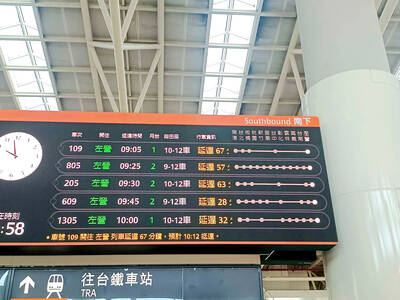
The nation’s usually punctual high-speed rail system yesterday was hit by major disruptions after all scheduled services were canceled and replaced with three hourly trains offering only non-reserved seating, affecting more than 200,000 passengers. Preliminary findings indicate the disruption was caused by a faulty power module in a track switch control cabinet, Taiwan High-Speed Rail Corp (THSRC) said, adding that as a full system inspection could only be conducted after operations end for the day, a decision on whether normal service would resume today would be announced before the first train departs. During a routine inspection early yesterday, a switch signal abnormality


 RSS
RSS