


While rescuers in Nantou County struggle to find the bodies of 15 people who were swept to their deaths when Typhoon Morakot hit the country, several bodies suspected to be among the victims have been discovered floating in the sea off northern Taiwan.
Early on the morning of Aug. 9, people in seven cars fell into the Chuoshuei River (濁水溪) in Nantou County when raging water from the torrential rain eroded the riverbank alongside Highway 16.
Nantou firefighters and rescuers only found six bodies and the wreckage of six cars on the riverbed after the water receded near Dacheng Township (大城) in neighboring Changhua County where the river flows into the sea.
As many as six bodies, however, have been discovered floating off the shores of northern Taiwan in recent days and police suspect they could be the bodies of the Nantou victims.
Police sources said that a body discovered in the sea about 20km off Yilan County on Wednesday was identified by Nantou victim Yeh Hsin-cheng’s (葉信承) wife.
Upon learning of the news, Yeh’s wife first checked a photo of the body at Jiji Township (集集) Police Headquarters and then went to Yilan on Saturday to confirm it was her husband’s body.
Although the face was unidentifiable, Yeh recognized tattoos of a tiger on the right arm, an eagle on the right thigh and a Japanese samurai on the left leg.
A Coast Guard officer said Yeh’s body had floated nearly 400km from where he fell into the water.
Coastal and Offshore Resources Research Center Director Wu Lung-ching (吳龍靜) said Yeh’s body could have been carried by the Kuroshio current that flows through the Taiwan Strait to the northeast coast.
Wu said the current, which comes from the south, divides into two, with one current flowing through the Taiwan Strait and the other along the Pacific coast.
Therefore, bodies floating along Taiwan’s western coast were very likely to end up on the northern or northeastern coast, Wu said.
Five other bodies — three male and two female — have been discovered in the sea off the coast of Bitoujiao (鼻頭角), Tamsui (淡水) and Yehliou (野柳) in Taipei County, as well as near Hsinchu and Keelung.
Family members of the Nantou victim Chang Hsiu-mei (張秀美) suspect that a body found near Bitoujiao could be Chang’s, but further confirmation is still required.
The corpse found floating near Tamsui yesterday was a female, about 40 years old and 160m tall. Police believe the body had been in the water since about Aug. 8 and could be the body of a Nantou victim.
Police authorities in Nantou said that they would collect DNA samples from the Nantou victims’ families so that it would be easier to confirm the identity of any bodies found in the future.

‘NO SECURITY RISK’: The Railway Bureau reassured the public that the technicians’ activities were limited to technical guidance and did not involve sensitive systems The Railway Bureau yesterday said it had invited eight Chinese technicians to assist with an airport MRT construction project. The bureau issued the confirmation after an Internet user said Chinese nationals had entered the construction zone of Taiwan Taoyuan International Airport’s Terminal 3 project. They asked why “individuals from an enemy state” were allowed access to such a major national infrastructure project, which raised serious concerns over Taiwan’s industrial safety, sensitive systems and information security. The bureau’s Northern Region Engineering Branch Office said subcontractor Taiwan Handle Industrial Co (台灣手把工業) of the Taoyuan airport MRT’s “Contract No. CU05 Project A14 Station Civil, MEP &
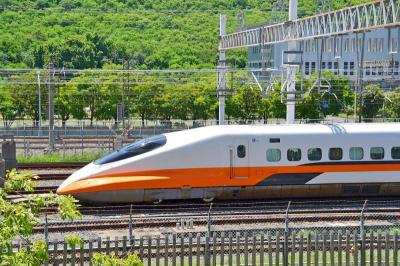
A signaling system malfunction disrupted high-speed rail (HSR) services beginning at 8am today, with trains temporarily reduced to three northbound and three southbound trains per hour as authorities conduct inspections. The malfunction occurred on a section of track in Miaoli County during pre-operation checks early this morning, forcing northbound and southbound trains to use a single track, the HSR operator said. The regular schedule has been replaced with three hourly trains offering only nonreserved seating in each direction, stopping at every station, it said, adding that business class cars would still have reserved seating. Departures from terminal stations are scheduled at the top
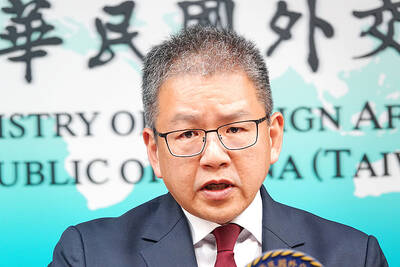
Taiwan is still in the process of assessing the possibility of recruiting workers from Eswatini, the Ministry of Foreign Affairs said yesterday, adding that its goal is to help Eswatini upgrade its vocational training centers. If there are plans to recruit workers from Eswatini, safeguarding national security, protecting public health and ensuring the employment rights of Taiwanese would be prerequisites, Department of West Asian and African Affairs Director-General Yen Chia-liang (顏嘉良) told a news conference. Key considerations would also include filling labor shortages in specific industries, and fostering bilateral professional and technical exchanges, he said. Yen was asked about the progress of labor

A US uncrewed surface vessel (USV) encountered multiple Chinese warships during an autonomous transit of the Taiwan Strait, US defense company Seasats said in a statement on Wednesday. Seasats announced that a Lightfish USV had completed the first autonomous transit of the Taiwan Strait. Over five days, the USV traversed the entire length of the Strait while constantly monitoring surface vessel traffic, the company said. The Lightfish encountered multiple Chinese warships, one of which was a Chinese People’s Liberation Army Navy (PLAN) Type 056 corvette, it said. The Chinese vessels were operating “well within Taiwan’s exclusive economic zone without transmitting their identity via the


 RSS
RSS