


President Ma Ying-jeou (馬英九) said yesterday he would shoulder all responsibility for the shortcomings in his government’s response to Typhoon Morakot.
“As president of the Republic of China, I will bear all responsibility. Please rest assured that we will do a good job,” Ma said while touring the disaster response center in Pingtung County.
Asked by CNN at a separate setting to elaborate on what he meant by “taking all responsibility,” Ma said it meant he would find out what’s wrong with the rescue system, correct the problems and discipline officials in charge.
During his visit to Pingtung yesterday, Ma said that while he did not expect the public to understand, or even forgive, what his government did, Taiwanese knew in their heart how things stood.
While the public has criticized the government for reacting too slowly to the emergency, Ma has blamed the sustained rain. Ma said he never blamed the victims of the typhoon, but rather that the government had learned a lesson from the disaster and that it should evacuate residents — even against their will — when an emergency of this magnitude occurs.
As more than 1,000 residents still refuse to leave their mountain settlements, Ma yesterday instructed the Ministry of the Interior to amend the Disaster Prevention and Protection Act (災害防救法) to include compulsory evacuation standards.
Ma asked local governments to take typhoon prevention drills seriously, urging them to pay more attention to disaster prevention than to disaster relief.
If they did not change their mentality, Ma said, the same mistakes would happen again.
During a visit to Neipu Township (內埔), Ma apologized to the victims for coming too late. He said that following a national security meeting on Friday, reconstruction efforts and the relocation of displaced individuals to emergency housing would begin soon.
As local governments have proposed contingency plans, Ma said the central government would play a supporting role.
In Hsinyuan Township (新園), Pingtung County, Ma said the government would consider expanding the flood prevention benchmark from 150 years to 200 years.
Ma made the remarks in response to complaints by typhoon victims that the flood was far more serious than the government had expected.
To show his compassion for the victims, Ma said he had personally replied to an e-mail from a person calling for help.
Ma also visited Fengshan City (鳳山), Kaohsiung County, to pay his respects to Wang Tsung-li (王宗立) who was one of three crew members on a UH-1H helicopter that crashed on Tuesday in the Yila Valley in Wutai Township (霧台), Pingtung County, during relief operations.
ADDITIONAL REPORTING BY STAFF WRITER

‘NO SECURITY RISK’: The Railway Bureau reassured the public that the technicians’ activities were limited to technical guidance and did not involve sensitive systems The Railway Bureau yesterday said it had invited eight Chinese technicians to assist with an airport MRT construction project. The bureau issued the confirmation after an Internet user said Chinese nationals had entered the construction zone of Taiwan Taoyuan International Airport’s Terminal 3 project. They asked why “individuals from an enemy state” were allowed access to such a major national infrastructure project, which raised serious concerns over Taiwan’s industrial safety, sensitive systems and information security. The bureau’s Northern Region Engineering Branch Office said subcontractor Taiwan Handle Industrial Co (台灣手把工業) of the Taoyuan airport MRT’s “Contract No. CU05 Project A14 Station Civil, MEP &
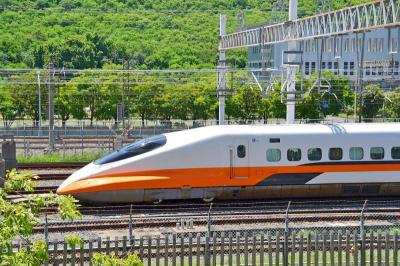
A signaling system malfunction disrupted high-speed rail (HSR) services beginning at 8am today, with trains temporarily reduced to three northbound and three southbound trains per hour as authorities conduct inspections. The malfunction occurred on a section of track in Miaoli County during pre-operation checks early this morning, forcing northbound and southbound trains to use a single track, the HSR operator said. The regular schedule has been replaced with three hourly trains offering only nonreserved seating in each direction, stopping at every station, it said, adding that business class cars would still have reserved seating. Departures from terminal stations are scheduled at the top
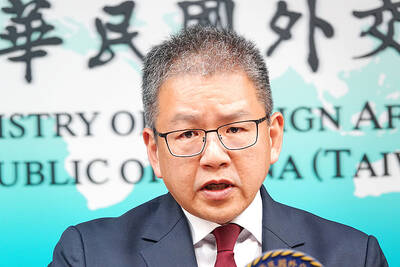
Taiwan is still in the process of assessing the possibility of recruiting workers from Eswatini, the Ministry of Foreign Affairs said yesterday, adding that its goal is to help Eswatini upgrade its vocational training centers. If there are plans to recruit workers from Eswatini, safeguarding national security, protecting public health and ensuring the employment rights of Taiwanese would be prerequisites, Department of West Asian and African Affairs Director-General Yen Chia-liang (顏嘉良) told a news conference. Key considerations would also include filling labor shortages in specific industries, and fostering bilateral professional and technical exchanges, he said. Yen was asked about the progress of labor

A US uncrewed surface vessel (USV) encountered multiple Chinese warships during an autonomous transit of the Taiwan Strait, US defense company Seasats said in a statement on Wednesday. Seasats announced that a Lightfish USV had completed the first autonomous transit of the Taiwan Strait. Over five days, the USV traversed the entire length of the Strait while constantly monitoring surface vessel traffic, the company said. The Lightfish encountered multiple Chinese warships, one of which was a Chinese People’s Liberation Army Navy (PLAN) Type 056 corvette, it said. The Chinese vessels were operating “well within Taiwan’s exclusive economic zone without transmitting their identity via the


 RSS
RSS