


The Chinese Nationalist Party (KMT) government yesterday restored dictator Chiang Kai-shek’s (蔣介石) name to National Taiwan Democracy Memorial Hall in Taipei, reversing a move two years ago by the then-Democratic Progressive Party (DPP) administration to remove relics of authoritarianism.
The replacement of the plaque began at about 8:10am after some 300 police officers secured the hall with barricades overnight and put up an official document stating that the hall would be closed for 24 hours for “official business.”
Workers cut the granite plaque bearing the title “National Taiwan Democracy Memorial Hall” that hung over the main building into pieces. The removal was completed by noon, after which workers proceeded to reinstate the Chiang plaque.
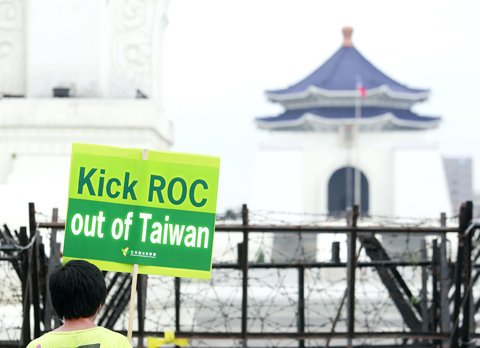
PHOTO: NICKY LOH, REUTERS
The replacement project is expected to have cost NT$1.1 million (US$33,000), said the Ministry of Education, which is in charge of the restauration.
In 2007, the DPP administration renamed the memorial National Taiwan Democracy Memorial Hall. It also changed the inscription dazhong zhizheng (大中至正) to “Liberty Square” (自由廣場) and redecorated the hall.
At the time, the pan-blue camp called the removal of Chiang’s plaque illegal, as the legislature had not abolished the Organic Act of CKS Memorial Hall (中正紀念堂組織條例) or passed a proposed act concerning the organization of the Taiwan Democracy Memorial Hall.
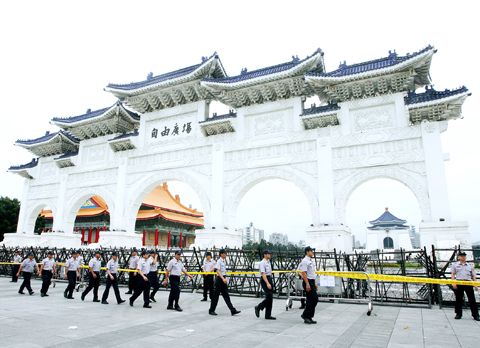
PHOTO: CNA
The removal of Chiang’s plaque led to physical clashes between the pan-blue and pan-green camps.
During the pan-blue-dominated legislature’s review of government budget proposals in January, lawmakers passed a resolution saying that the ministry should complete reinstatement of the Chiang plaque as soon as possible.
“We decided to reinstate the Chiang Kai-shek plaque today in accordance with the law. We also decided, after gauging the views of opinionmakers in different sectors, to retain the ‘Liberty Square’ inscription,” Vice Minister of Education Lu Mu-lin (呂木琳) told a press conference yesterday.
Lu was referring to the three forums in which academics and experts on politics, sociology, community management and urban development deliberated over how to resolve the controversy surrounding the name of the hall.
“This compromise should contribute to social harmony,” he said.
Lu said the ministry had done everything it could to properly plan and execute the plaque change, adding that on many occasions the ministry had told the public the replacement would take place this month.
“We understand that people have different memories of and emotional reactions to [Chiang], but we also hope that everyone will respect and tolerate different opinions and promote social harmony,” Lu said.
In a press release, the ministry said it supported the creation of a hall to showcase the nation’s efforts at democratization.
“But replacing the Chiang plaque with National Taiwan Democracy Memorial Hall in an illegal and undemocratic fashion was not a manifestation of Taiwan’s democracy. Instead, it was ironic,” it said.
DPP Taipei City Councilor Chuang Ruei-hsiung (莊瑞雄) was forcefully evicted after he slipped through the barbed wire barricades. A small number of pro-independence supporters shouted “police violence” and “death to Dictator Ma” as police took him away.
At 2pm, only 11 protesters remained at the sit-in, including two Buddhist monks, an elderly man and a small child.
Screaming anti-Ma slogans, protesters compared Ma to Adolf Hitler and said the KMT government was no different from the Nazi Party in its oppression of Taiwanese.
“If the KMT really believes that what it is doing is righteous, then why does it have to remove the plaque like a thief in the middle of the night?” said Peter Wang (王獻極), a leading member of the Taiwan Nation Alliance.
The protesters laid out banners showing pictures of the execution orders signed off by Chiang during his reign.
Two American tourists who declined to give their names asked why there were so few protesters Chiang was the cruel dictator many have accused him of being.
“If someone was to erect a statue of a Ku Klux Klan leader in the US, you bet you would for sure see a huge turn out of demonstrators, both black and white folks,” one said.
Wang said he rushed to the memorial after learning about the change on TV, adding that this probably accounted for the low protester turnout.
Executive Yuan Spokesman Su Jun-pin (蘇俊賓) said that the Executive Yuan respected due procedure and differing opinions.
KMT Legislator Shuai Hua-ming (帥化民) lauded the ministry’s move, saying it was following legislative resolution.
DPP Chairperson Tsai Ing-wen (蔡英文) condemned the change, saying the party could not condone a “measure under which the nation’s public assets are used to commemorate a dictator who slaughtered his own people.”
Chiang was responsible for the massacre that began on Feb. 28, 1947 — known as the 228 Massacre — in which as many as 20,000 people were killed by KMT troops.
“President Ma Ying-jeou (馬英九) said renaming CKS Memorial Hall was a public issue that should be decided by the public. But his government … replaced the hall name in sneaky fashion,” Tsai said.
DPP Legislator Wang Sing-nan (王幸男) told a separate press conference that Ma’s paying tribute to Chiang and restoring the name to CKS Memorial Hall would spark ethnic controversy and rub salt on Taiwan’s historical wounds.
Chuang criticized the Taipei City Police Department for wasting public resources by mobilizing at least 600 officers to fend off protesters.
Aside from 600 officers deployed at the hall, Zhongzheng First Police District Director Chen Ming-cheng (陳銘政) said there were around 300 others in the nearby area, including all MRT exits.
Chen said that the number of officers deployed was “completely in line with protocol.”
“Out of concern over possible riots, CKS hall management asked Taipei City police provide the necessary assistance,” he said, confirming that the district had received the request on Sunday.
Taipei Mayor Hau Lung-bin (郝龍斌) said later yesterday that the police deployment was one-tenth the size deployed when then DPP government renamed the hall, although police in 2007 said there were around 600 officers deployed. Hau also said the hall was under the jurisdiction of the Ministry of Education and city police were merely responding to a request.
Japanese tourist Emi Fukuda and her companions said yesterday they were disappointed when they realized tourists were barred from entering the memorial.
ADDITIONAL REPORTING BY RICH CHANG AND STAFF REPORTER
NO RECIPROCITY: Taipei has called for cross-strait group travel to resume fully, but Beijing is only allowing people from its Fujian Province to travel to Matsu, the MAC said The Mainland Affairs Council (MAC) yesterday criticized an announcement by the Chinese Ministry of Culture and Tourism that it would lift a travel ban to Taiwan only for residents of China’s Fujian Province, saying that the policy does not meet the principles of reciprocity and openness. Chinese Deputy Minister of Culture and Tourism Rao Quan (饒權) yesterday morning told a delegation of Chinese Nationalist Party (KMT) lawmakers in a meeting in Beijing that the ministry would first allow Fujian residents to visit Lienchiang County (Matsu), adding that they would be able to travel to Taiwan proper directly once express ferry

FAST RELEASE: The council lauded the developer for completing model testing in only four days and releasing a commercial version for use by academia and industry The National Science and Technology Council (NSTC) yesterday released the latest artificial intelligence (AI) language model in traditional Chinese embedded with Taiwanese cultural values. The council launched the Trustworthy AI Dialogue Engine (TAIDE) program in April last year to develop and train traditional Chinese-language models based on LLaMA, the open-source AI language model released by Meta. The program aims to tackle the information bias that is often present in international large-scale language models and take Taiwanese culture and values into consideration, it said. Llama 3-TAIDE-LX-8B-Chat-Alpha1, released yesterday, is the latest large language model in traditional Chinese. It was trained based on Meta’s Llama-3-8B

STUMPED: KMT and TPP lawmakers approved a resolution to suspend the rate hike, which the government said was unavoidable in view of rising global energy costs The Ministry of Economic Affairs yesterday said it has a mandate to raise electricity prices as planned after the legislature passed a non-binding resolution along partisan lines to freeze rates. Chinese Nationalist Party (KMT) lawmakers proposed the resolution to suspend the price hike, which passed by a 59-50 vote. The Taiwan People’s Party (TPP) voted with the KMT. Legislative Speaker Han Kuo-yu (韓國瑜) of the KMT said the resolution is a mandate for the “immediate suspension of electricity price hikes” and for the Executive Yuan to review its energy policy and propose supplementary measures. A government-organized electricity price evaluation board in March

NOVEL METHODS: The PLA has adopted new approaches and recently conducted three combat readiness drills at night which included aircraft and ships, an official said Taiwan is monitoring China’s People’s Liberation Army (PLA) exercises for changes in their size or pattern as the nation prepares for president-elect William Lai’s (賴清德) inauguration on May 20, National Security Bureau (NSB) Director-General Tsai Ming-yen (蔡明彥) said yesterday. Tsai made the comment at a meeting of the Legislative Yuan’s Foreign Affairs and National Defense Committee, in response to Democratic Progressive Party (DPP) Legislator Wang Ting-yu’s (王定宇) questions. China continues to employ a carrot-and-stick approach, in which it applies pressure with “gray zone” tactics, while attempting to entice Taiwanese with perks, Tsai said. These actions aim to help Beijing look like it has


 RSS
RSS