


A 51-year-old cab driver set himself on fire outside the Ministry of Justice (MOJ) building yesterday.
At about 3:30pm yesterday, Chen Pao-kuo (陳寶國) drove his taxi to the front of the MOJ building.
A security guard who had been at the front door thought the driver was dropping someone off, but when he went to open the car door, he discovered that the driver had poured liquid on himself and set himself on fire, police officers said.
Because Chen’s car had caught fire as well, he jumped out of his car, screaming and crying and rolling on the ground.
The guard used a fire extinguisher to douse the flames on the burning man before extinguishing the fire in the car.
By the time the fire had been put out, the man’s clothes had burned almost completely off, with layers of burnt skin hanging off as well. He suffered second-degree burns to 80 percent of his body, police said.
He was taken by ambulance to National Taiwan University Hospital where he remained in critical condition at press time.
An initial search of Chen’s car found a 3 liter gasoline container, which had about 1 liter of gas left after the incident. Chen left no message, police said.
“We have contacted his family and they said they have no idea why he would do such a thing,” said Lai Cheng-kuan (賴正寬), deputy director of the Taipei City Police Department’s Zhongzheng First Police District.
Lai said Chen Pao-kuo had spent 10 years and three months in jail for manslaughter, and his family said he had been paranoid and depressed ever since he got out of jail last month.
Because the MOJ building is connected to the Taipei District Court, where former president Chen Shui-bian’s (陳水扁) detention hearing had been held in the morning, the police asked Chen Pao-kuo’s family about his political views in an effort to determine his motives.
However, Chen Pao-kuo’s older sister said her brother did not have any particular political leanings or attend political events, Lai said.

‘NO SECURITY RISK’: The Railway Bureau reassured the public that the technicians’ activities were limited to technical guidance and did not involve sensitive systems The Railway Bureau yesterday said it had invited eight Chinese technicians to assist with an airport MRT construction project. The bureau issued the confirmation after an Internet user said Chinese nationals had entered the construction zone of Taiwan Taoyuan International Airport’s Terminal 3 project. They asked why “individuals from an enemy state” were allowed access to such a major national infrastructure project, which raised serious concerns over Taiwan’s industrial safety, sensitive systems and information security. The bureau’s Northern Region Engineering Branch Office said subcontractor Taiwan Handle Industrial Co (台灣手把工業) of the Taoyuan airport MRT’s “Contract No. CU05 Project A14 Station Civil, MEP &

A US uncrewed surface vessel (USV) encountered multiple Chinese warships during an autonomous transit of the Taiwan Strait, US defense company Seasats said in a statement on Wednesday. Seasats announced that a Lightfish USV had completed the first autonomous transit of the Taiwan Strait. Over five days, the USV traversed the entire length of the Strait while constantly monitoring surface vessel traffic, the company said. The Lightfish encountered multiple Chinese warships, one of which was a Chinese People’s Liberation Army Navy (PLAN) Type 056 corvette, it said. The Chinese vessels were operating “well within Taiwan’s exclusive economic zone without transmitting their identity via the
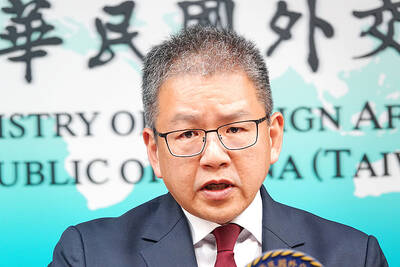
Taiwan is still in the process of assessing the possibility of recruiting workers from Eswatini, the Ministry of Foreign Affairs said yesterday, adding that its goal is to help Eswatini upgrade its vocational training centers. If there are plans to recruit workers from Eswatini, safeguarding national security, protecting public health and ensuring the employment rights of Taiwanese would be prerequisites, Department of West Asian and African Affairs Director-General Yen Chia-liang (顏嘉良) told a news conference. Key considerations would also include filling labor shortages in specific industries, and fostering bilateral professional and technical exchanges, he said. Yen was asked about the progress of labor
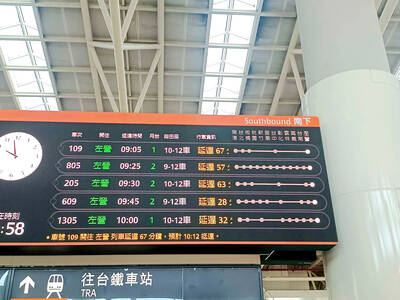
The nation’s usually punctual high-speed rail system yesterday was hit by major disruptions after all scheduled services were canceled and replaced with three hourly trains offering only non-reserved seating, affecting more than 200,000 passengers. Preliminary findings indicate the disruption was caused by a faulty power module in a track switch control cabinet, Taiwan High-Speed Rail Corp (THSRC) said, adding that as a full system inspection could only be conducted after operations end for the day, a decision on whether normal service would resume today would be announced before the first train departs. During a routine inspection early yesterday, a switch signal abnormality


 RSS
RSS