

The US Marine Corps is considering a controversial plan to use a detachment of Marine security guards to protect the new American Institute in Taiwan (AIT) headquarters that will be built in Neihu District (內湖), Taipei City.
If the plan goes through, the Marine guards would be the first US military forces stationed in Taiwan since the US switched diplomatic recognition from Taipei to Beijing in 1979.
It would be “a politically sensitive decision that could raise the ire of neighboring China,” the Marine Corps Times reported earlier this week.
A Washington source told the Taipei Times last month it was “highly unlikely” that Marines would replace the local guards used by the AIT.
However, a senior US government source told the Taipei Times that the Marine Corps — which is assigned to protect US government facilities abroad — held a special meeting with US State Department officials earlier this month in Washington to discuss proposals for protecting a number of new US embassy buildings.
The Marines had put the soon-to-be-built AIT headquarters in Taipei on the list.
The meeting ended before the matter could be addressed. It is now on the agenda for a future meeting.
Nevertheless, the fact that the AIT building was on the Marines’ list indicated that the idea may have support within the military.
“For 30 years, the US has operated what is widely described as a ‘de facto embassy’ in Taiwan, carrying out official business while functioning without a major piece of a US Embassy’s security plan: Marines. Soon, that could change,” the Marine Corps Times said.
“The Marine Corps and State Department may move forward with a plan to place a detachment of Marine security guards in Taiwan,” it said.
Almost a year ago, the Taipei Times reported there was a “possibility” that a barracks for US Marine security forces would be built at the new AIT headquarters, but at the time there were no plans to station Marines at the complex.
“There are discussions about having a new compound or new complex built to replace the existing AIT structure in Taipei,” US State Department spokesman Tom Casey said at the time.
“The notices that have gone out have included the broadest possible kinds of elements that might be included in there. But at this point I’m not aware that there are any plans to station US Marines at AIT in Taipei,” he said.
“Again, this is a request for proposals on a range of options for a new building and for a new compound. And again, there certainly would be a security element to that. There’s a security element in AIT there right now, though it isn’t US Marines that are providing it,” Casey said.
After the State Department gave the financial go-ahead last month to build a US$170 million new office complex for the AIT, the announcement of the phase one contract made no mention of a Marine facility, but said that the new complex would include “guard quarters.”
The Marine Corps Times quoted Richard Bush, director of the Center for Northeast Asian Policy Studies at the Brookings Institute and who served as chair of AIT’s Washington office from 1997 to 2002, as saying: “Taiwan would be somewhat happy because [having Marines assigned] is a sign of officiality, but China would protest.”
The article also said that the Marine Corps Embassy Security Group had provided it with a list of 10 new duty stations “expected to open around the world in coming years” and that Taipei was on it.
Walter Lohman, director of the Asian Studies Center at the Heritage Foundation in Washington, told the Marine Corps Times that while the move would probably chafe the Chinese, “it just shouldn’t be a big deal.”
“If it’s OK to have Marine guards in Hong Kong in our consulate there, there shouldn’t be any problem with this,” he said.
Attempts by the Taipei Times to obtain a response from the US Marine Corps were not successful.
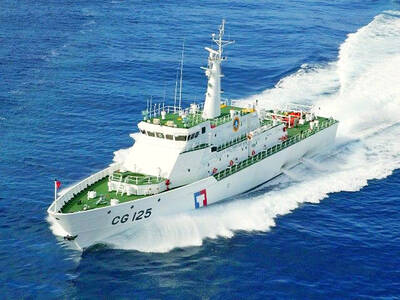
GEOPOLITICAL SIGNIFICANCE: The CGA’s nonmilitary role makes it a tool to avert diplomatic issues, an official said, while confirming the donation of a ship to Manila Coast Guard Administration (CGA) ships are scheduled to sail to the Philippines bearing the words “Taiwan Coast Guard” in a high-profile visit in October next year, the first such visit by a Taiwanese maritime law enforcement vessel to the Southeast Asian nation, the agency said yesterday. The CGA also confirmed that it had donated one of its decommissioned patrol vessels to the Philippines in a rare transfer of a retired ship to a nondiplomatic ally. The Republic of China (ROC) Navy last made such a visit in 1974, shortly before the Philippines switched diplomatic recognition to the People’s Republic of China in

SOFT TENNIS: Yu Kai-wen and Huang Shih-yuan narrowly defeated their Japanese rivals to capture Taiwan’s first gold at the Asian Games in Nagoya Yu Kai-wen (余凱文) and Huang Shih-yuan (黃詩媛) won Taiwan’s first gold of this year’s Asian Games, defeating a Japanese duo in a nail-biter in the soft tennis mixed doubles final in Nagoya, Japan, while Johnny Sun (孫家閎) won silver in wushu and Shih Cheng-chung (石政中) won bronze in men’s kumite. Yu and Huang narrowly defeated Japan’s Toshiki Uematsu and Rena Temma 5-4 (2-4, 5-3, 4-2, 1-4, 1-4, 4-0, 1-4, 4-1, 7-5) to give Taiwan its first gold in soft tennis mixed doubles at an Asian Games since 2018. Sun secured Taiwan’s first wushu medal at this year’s game, with a combined score
CALL FOR CHANGE: They urged the UN to facilitate Taiwan’s involvement in the body, recognize its peace efforts and to work with members in preventing military conflict Representatives to the UN from five of Taiwan’s diplomatic allies sent a joint letter to UN Secretary-General Antonio Guterres on Friday, calling for the country’s inclusion in the body. Allies in the letter sent ahead of the 81st session of the UN General Assembly General Debate made three demands in support of Taiwan: inclusion, recognition and camaraderie. They implored the UN to seek an appropriate way to facilitate Taiwan’s meaningful involvement in the world governing body, saying that UN Resolution 2758, which accepted the People’s Republic of China (PRC) as a member of the UN, does not exclude Taiwan. Beijing claims that the
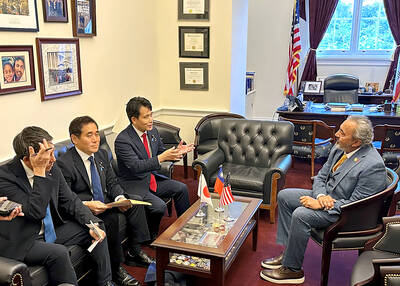
WASHINGTON MEETING: Japan’s Hirofumi Takinami said participants rejected the idea that the US should limit its defensive perimeter to the Second Island Chain US and Japanese lawmakers agree that the US must defend the First Island Chain, including Taiwan, and should not fall back to the Second Island Chain, while “a Taiwan contingency is a Japan contingency and therefore a US-Japan alliance contingency,” media reported after a meeting between officials of the two nations in Washington on Tuesday. A delegation of Japanese lawmakers from the Liberal Democratic Party met with US Senator Thom Tillis, co-chair of the Senate Taiwan Caucus, and US Representative Ami Bera, co-chair of the US Congressional Taiwan caucus, to discuss issues concerning East Asia and the Taiwan Strait. The Japanese and


 RSS
RSS