


The government has been in contact with China on the economic cooperation framework agreement (ECFA) and is considering the addition of an “opt out” clause in the trade pact, Minister of Economic Affairs Yiin Chii-ming (尹啟銘) said at a forum in Taipei yesterday.
Yiin did not provide further information about the agreement for fear that revealing too many details could jeopardize the cross-strait trade talks.
At present, the two sides are engaged in “independent analyses,” Yiin told the ECFA discussion forum hosted by the Ministry of Economic Affairs and the Mainland Affairs Council (MAC).
Yiin had previously said that government contacts with China would happen sometime next month after independent assessments are concluded by both sides. His comment yesterday showed that cross-strait talks have proceeded at a much faster pace than anticipated.
Yiin said the government welcomed differing voices and said there was more work to be done.
Yiin said he expected the ECFA would increase Taiwan's GDP growth by 1.374 percentage points.
He promised to take various suggestions into consideration, including more public disclosure and the possibility of an “opt out” clause in the ECFA.
“Once ECFA talks get underway, the potential addition of an opt out clause will be considered [to protect us] if China fails to follow the guidelines or to demonstrate good faith in the execution,” Yiin said.
Tu Jenn-hwa (杜震華), an associate professor at National Taiwan University's Graduate Institute of National Development, echoed Yiin’s remarks on an “opt out” clause, saying that many international trade agreements have such clauses.
“This measure aims to protect countries under special circumstances. A country possesses the right to inform a counterparty of its desire to terminate all talks effective one year after date of notification,” Tu said.
Former vice premier Wu Rong-i (吳榮義) said any cross-strait trade agreement needed to be signed in good faith.
“China has more than 1,000 missiles targeted at Taiwan. With all this hostility, there is no foundation of trust,” Wu said.
As any trade agreement has its pros and cons, Wu said the government should show Taiwanese the nuts and bolts of the agreement so people can assess the potential benefits and disadvantages of an ECFA.
“Signing an ECFA with China will no doubt immediately benefit industries in the petrochemical, machinery and automobile parts sectors, but for many more domestic traditional industries, small to medium enterprises as well as laborers, such an arrangement will severely jeopardize their survival,” he said.
A recent study conducted by the Chung-Hua Institution for Economic Research showed that proceeding with an ECFA with China would put 120,000 Taiwanese out of work. Workers in the electronics, agriculture and non-metal industries would be the most severely hit, it said.
Yen Ching-chang (顏慶章), former minister of finance and former chief representative to the WTO, also expressed doubts at the forum, saying that Taiwan would not necessarily be marginalized if it did not proceed with an ECFA immediately.
“We are not the EU. We are not members of the North American Free Trade Agreement … For the longest time, Taiwan has not been part of any regional economic organization,” Yen said.
“Now with the Association of Southeast Asian Nations and its free-trade zone coming into being, I feel we are jumping to conclusions when we say that Taiwan will become a fringe economy if it does not act now,” Yen said.
MAC Vice Chairman Fu Don-cheng (傅棟成) told the forum that signing an ECFA with China was a necessary step to normalize cross-strait trade relations.
However, Fu said the country needed more than a trade pact with China.
“Grander vision and better action plans are required for Taiwan's long-term economic development. An ECFA with China is not enough,” he said.
Meanwhile, President Ma Ying-jeou (馬英九) yesterday welcomed public input about an ECFA with China, saying the more opinions that were voiced, the better the government could serve public interest.
Ma said he realized there were different opinions regarding the ECFA, with some expressing concern over its potential negative impact on traditional industries.
He encouraged the public to “speak without reserve,” adding that he paid equal attention to both the high-tech and traditional industries.
“The more opinions, the better the job the government will do,” he said while visiting Hsilo Township (西螺), Yunlin County, where he held talks with young people as part of an activity to encourage young people to return to their hometown to work.
Protesters from different townships held banners along the route taken by Ma's motorcade. They urged the government to pay attention to their plight and address the problem at Chuoshui River (濁水溪), which has long been plagued by drifting sand.
Ma is bent on forging ahead with the accord and hopes to see concrete results by the end of the year. He has also ruled out holding a referendum on whether to sign the agreement, saying it was costly and took time to publicize.
While Ma said he would like to see both sides discuss the accord during the third cross-strait talks scheduled for the first half of this year, the Straits Exchange Foundation (SEF) said it was still awaiting MAC authorization to discuss the issue with Beijing.
Democratic Progressive Party (DPP) Chairperson Tsai Ing-wen (蔡英文) has said that Ma is not qualified to be president of the country because of his stubbornness in signing an ECFA with China despite strong opposition from the public.
Bowing to mounting pressure, Premier Liu Chao-shiuan (劉兆玄) has vowed that the government would be cautious in pursuing the agreement with China, adding that the government would not negotiate an ECFA under a political framework set out by Beijing.

SILENCING CRITICS: In addition to blocking Taiwan, China aimed to prevent rights activists from speaking out against authoritarian states, a Cabinet department said The Ministry of Foreign Affairs (MOFA) yesterday condemned transnational repression by Beijing after RightsCon, a major digital human rights conference scheduled to be held in Zambia this week, was abruptly canceled due to Chinese pressure over Taiwanese participation. This year’s RightsCon, the world’s largest conference discussing issues “at the intersection of human rights and technology,” was scheduled to take place from tomorrow to Friday in Lusaka, and expected to draw 2,600 in-person attendees from 150 countries, along with 1,100 online participants. However, organizers were forced to cancel the event due to behind-the-scenes pressure from China, the ministry said, expressing its “strongest condemnation”
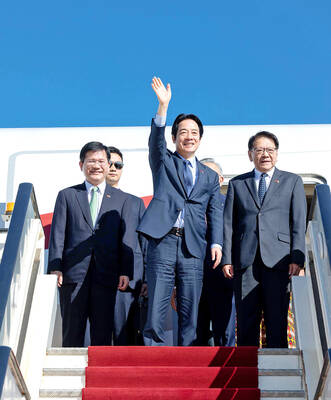
DELAYED BUT DETERMINED: The president’s visit highlights Taiwan’s right to international engagement amid regional pressure from China President Willaim Lai (賴清德) yesterday arrived in Eswatini, more than a week after his planned visit to Taiwan’s sole African ally was suspended because of revoked overflight permits. “The visit, originally scheduled for April 22, was postponed due to unforeseen external factors,” Lai wrote on social media. “After several days of careful arrangements by our diplomatic and national security teams, we successfully arrived today.” Lai said he looked forward to further deepening Taiwan-Eswatini relations through closer cooperation in the economy, agriculture, culture and education, as well as advancing the nation’s international partnerships. The president was initially scheduled to arrive in time to celebrate
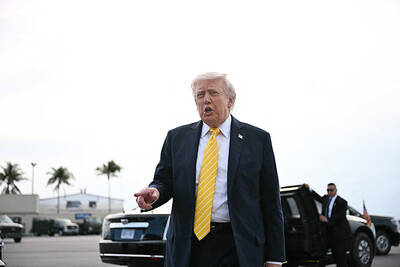
Iran’s Islamic Revolutionary Guard Corp (IRGC) yesterday said the US faced a choice between an “impossible” military operation or a “bad deal” with Tehran, after US President Donald Trump disparaged Iran’s latest peace proposal. Negotiations between the two countries have been deadlocked since a ceasefire came into effect on April 8, with only one round of direct peace talks held so far. Iran’s Tasnim and Fars news agencies reported that Tehran had submitted a 14-point proposal to mediator Pakistan, but Trump was quick to cast doubt on it. “I will soon be reviewing the plan that Iran has just sent to us, but
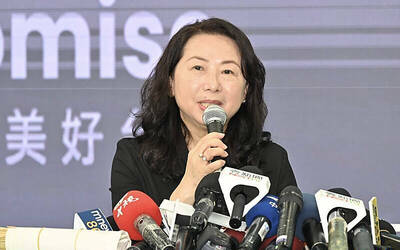
A group affiliated with indicted Chinese immigrant Xu Chunying (徐春鶯) is to be dissolved for monitoring Chinese immigrants in Taiwan, a source said yesterday. Xu, the secretary-general of the Cross-Strait Marriage and Family Service Alliance, was indicted on March 24 on charges of violating the Anti-Infiltration Act (反滲透法). The alliance “illegally monitored" Chinese immigrants living in Taiwan on behalf of the Chinese Communist Party (CCP) and the Ministry of the Interior is expected to dissolve the organization in the coming days under provisions of the Civil Associations Act (人民團體法), the source said. Xu, who married a Taiwanese in 1993 and became a Republic


 RSS
RSS