


US President Barack Obama was to unveil yesterday a new offensive against militants in Afghanistan and Pakistan, aiming to deal a death blow to al-Qaeda more than seven years after the Sept. 11 attacks.
To win a war aides said was “adrift,” the new president would dispatch 4,000 extra troops to train the Afghan army, on top of 17,000 deployments already authorized and in the face of critics who have warned of a quagmire.
Obama will also send hundreds more civilian officials into Afghanistan and stump up billions of dollars of extra aid to help Pakistan secure its democracy, senior administration officials said.
“It is a clear, concise, attainable goal, and that goal is to disrupt, dismantle and defeat al-Qaeda in its safe havens in Afghanistan and Pakistan,” one official said on condition of anonymity.
The strategy establishes clear benchmarks to judge the effort by the US and its allies in Pakistan and Afghanistan, another official said.
The officials accused the previous administration of leaving US policy “adrift” in the two nations and said they would approach China, India and even US foe Iran to ease the situation.
“Seven-and-a-half years after September 11, the al-Qaeda core leadership, Osama bin Laden and others, have moved from Kandahar, Afghanistan, to a location unknown, somewhere in Pakistan,” one official said.
“We know they are plotting new attacks against the United States, against our allies, against our forces in Afghanistan, against our Pakistani friends as well,” the official said.
The officials discounted critics who oppose escalating the US role in the conflict, warning that given a vacuum, the Taliban would return in force, and bring al-Qaeda along.
The officials also said the Taliban had made a “very significant comeback in the last two years” that could not be allowed to take root.
Pakistan was rocked by another blast yesterday, as a suicide bomber blew himself up in a packed mosque at Friday prayers, killing 48 people and wounding dozens in one of the deadliest attacks in the nuclear-armed nation.
The bombing took place on the weekly Muslim day of rest in the town of Jamrud in the restive Khyber tribal region, which is located on a key road used to ferry supplies to Western troops across the border in Afghanistan.
It came just hours before Obama was to unveil his new offensive against terror havens.
“Forty-eight bodies have been pulled out of the debris and many others may still be trapped under the rubble,” Tariq Hayat, the top administration official in Khyber, said by telephone.
“More than 70 people were wounded. There may be many more dead,” he said.
“The bomber was present inside the mosque and blew himself up when Friday prayers began,” Hayat said.
“The entire building collapsed,” a top security official said, referring to the temporary mosque, which had been set up by local police and paramilitary troops who have a camp in the surrounding area of remote, mountainous Khyber.
It was the deadliest bomb blast in Pakistan since 60 people died in a suicide truck bomb at the five-star Marriott Hotel in Islamabad last September.

‘NO SECURITY RISK’: The Railway Bureau reassured the public that the technicians’ activities were limited to technical guidance and did not involve sensitive systems The Railway Bureau yesterday said it had invited eight Chinese technicians to assist with an airport MRT construction project. The bureau issued the confirmation after an Internet user said Chinese nationals had entered the construction zone of Taiwan Taoyuan International Airport’s Terminal 3 project. They asked why “individuals from an enemy state” were allowed access to such a major national infrastructure project, which raised serious concerns over Taiwan’s industrial safety, sensitive systems and information security. The bureau’s Northern Region Engineering Branch Office said subcontractor Taiwan Handle Industrial Co (台灣手把工業) of the Taoyuan airport MRT’s “Contract No. CU05 Project A14 Station Civil, MEP &

A US uncrewed surface vessel (USV) encountered multiple Chinese warships during an autonomous transit of the Taiwan Strait, US defense company Seasats said in a statement on Wednesday. Seasats announced that a Lightfish USV had completed the first autonomous transit of the Taiwan Strait. Over five days, the USV traversed the entire length of the Strait while constantly monitoring surface vessel traffic, the company said. The Lightfish encountered multiple Chinese warships, one of which was a Chinese People’s Liberation Army Navy (PLAN) Type 056 corvette, it said. The Chinese vessels were operating “well within Taiwan’s exclusive economic zone without transmitting their identity via the
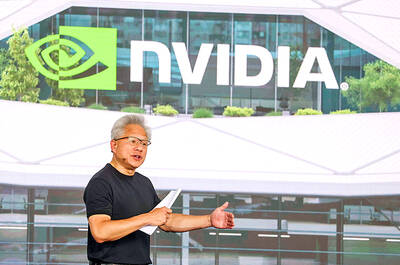
‘BOOMING’: ’ The number of partners we have here is incredible. You can see from their stock prices. They’re doing so well, they’re so happy,’ Jensen Huang said Nvidia Corp’s spending in Taiwan has ballooned to about US$150 billion a year, 10 times the US$10 billion to US$15 billion the company spent five years ago, Nvidia chief executive officer Jensen Huang (黃仁勳) said yesterday, suggesting Taiwan’s strategic importance in the global artificial intelligence (AI) supply chain. “Taiwan is the epicenter of the AI revolution. This is where the chips come, packaging comes. This is where the systems are made. This is where AI supercomputers were created,” Huang said at a meeting for the company’s employees in Beitou-Shilin Technology Park (北投士林科技園區) in Taipei, the planned site of Nvidia’s Taipei headquarters. “Taiwan
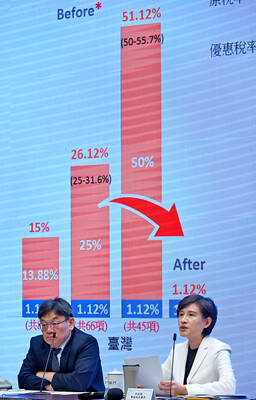
GREATER REACH? Auto parts and wood products would face tariffs of up to 15%, matching those targeting the EU, Japan and South Korea, Vice Premier said The US has announced that preferential tariff treatment for Taiwan’s non-semiconductor Section 232 goods would take effect retroactively from May 1, the Executive Yuan said yesterday. The US government yesterday posted a notice on the Federal Register’s public inspection Web site previewing tariff concessions for Taiwan under a memorandum of understanding (MOU) on Taiwan-US investment after two months of negotiations. The MOU signed on Jan. 15 stipulated three major preferential tariff arrangements: a 15 percent “reciprocal” tariff rate for Taiwan without stacking most-favored nation (MFN) rates; preferential Section 232 treatment for semiconductors and related products; and preferential Section 232 treatment for non-semiconductor


 RSS
RSS