


Taiwan has renewed a drive to buy advanced US-built F-16 fighter aircraft, confronting US President Barack Obama with a delicate decision.
Detailing its arms shopping list for the first time since Obama took office, the Taipei Economic and Cultural Representative Office (TECRO) — Taiwan’s representative office in Washington — said its current fighter force was inadequate to a potential threat from China across the 177km-wide Taiwan Strait.
The largest part of Taiwan’s air force, F-5 fighters, have been in service for more than 34 years, a TECRO spokesman said.
“The planes now are obsolete and spare parts are difficult to obtain,” said TECRO spokesman Vance Chang (張鷹) in an e-mail response to questions about Taiwan’s arms requests.
China has built increasingly advanced fighters, the statement said, “therefore our air superiority capability is at a serious disadvantage.”
“Taiwan’s determination to defend itself is indisputable,” it said.
Taiwan has been trying for 12 years to buy F-16C/D models built by Lockheed Martin Corp of Bethesda, Maryland.
The US government is required by the Taiwan Relations Act of 1979 to provide Taiwan sufficient arms to defend itself.
Successive US administrations have managed the weapons flow to minimize fallout with China — a major trading partner and the biggest foreign holder of US Treasury bonds.
In its final years, the administration of former US president George W. Bush would not even accept a formal request for the advanced F-16s, said the US-茅aiwan Business Council, which represents about 100 companies, including Lockheed Martin.
The US “has an obligation to assist Taiwan to maintain a credible defense of its air space, which includes modern fighters,” council president Rupert Hammond-Chambers said.
Taiwan wants 66 F-16C/Ds valued at up to US$4.9 billion to bolster 150 F-16A/B models it bought in 1992.
The US State Department had no immediate comment on the statement from TECRO.
Beijing has vowed to bring Taiwan under its rule, by force if necessary, and opposes US arms sales as interference in its domestic affairs.
In October, the Bush administration notified US Congress of possible arms sales to Taiwan of up to US$6.4 billion, including Patriot Advanced Capability antimissile batteries, Apache attack helicopters and Harpoon anti-ship missiles.
“We were eager to achieve a golden mean — a robust package of arms sales that met Taiwan’s immediate defense needs but was not perceived in Beijing as undermining the progress in cross- strait relations,” said Dennis Wilder, senior director for East Asian affairs on Bush’s White House National Security Council.
“I believe we achieved that goal,” he added in an e-mail response to Reuters.
In its statement to Reuters, TECRO made clear President Ma Ying-jeou’s (馬英九) administration was still seeking UH-60 Black Hawk utility helicopters built by United Technologies Corp’s Sikorsky unit and design work on modern diesel-electric submarines.
These two items were cleared for release to Taiwan by Bush as part of a landmark arms offer in April 2001, but left out of the October notification to Congress. The deals were held up for years, largely by partisan hurdles to funding in Taiwan.
Funds to start acquiring the work on submarines, Black Hawk helicopters and the F-16C/Ds now have been approved by the legislature, TECRO said.
Wilder said the Bush administration had told Taiwan that it was not denying it any of the weapons approved in 2001, but would leave the decision to Obama.
“We wanted to leave the door open for the next US administration to do its own review in consultation with Taiwan to decide on future arms sales,” he said.
In Taipei yesterday, panelists attending a forum hosted by the Institute for Taiwan Defense and Strategic Studies urged the government to continue to develop a short-range missile program initiated under the former Democratic Progressive Party (DPP) government.
In 2002, Taiwan successfully test-fired the Hsiung Feng-II anti-ship missile, developed by the military-run Chungshan Institute of Science and Technology.
The missile has a range exceeding 150km and can be fired from land, sea or air. Taiwan was also developing the Hsiung Feng-III, with a range of 300km that would make China’s southern and eastern coasts possible targets. The missiles were developed with the aim of deterring the People’s Liberation Army navy, the government said at the time.
Since taking office in May, the Ma administration has been accused by DPP lawmakers of appeasing China by shying away from developing offensive weapons.
Former deputy minister of national defense Michael Tsai (蔡明憲) yesterday said he was concerned the Ma government could mothball the programs.
Former DPP legislator Lee Wen-chung (李文忠), another panelist at the forum, said Ma and the National Security Council seemed to have adopted the view, expounded by US Naval War College professor William Murray in an article last year, that Taiwan should build a strong homeland defense capability with less emphasis on air and sea power.
“Without appropriate air force and naval capabilities, public will would collapse on the first or second day [of an invasion],” Lee said.
“Military experts have said that the military balance [in the Taiwan Strait] tipped in China’s favor in 2007 and that from that year on, Taiwan would not be able to catch up. Taiwan should therefore quickly develop a military strategy for asymmetric warfare,” he said.
Lee added that one of the most effective strategies in such a scenario was the use of surgical missile strikes.
The military should also develop cruise missiles with a range of 1,000km and request Joint Direct Attack Munition (JDAM) and High-speed Anti-Radiation Missiles (HARM) from the US, Lee said.
Additional Reporting by Rich Chang
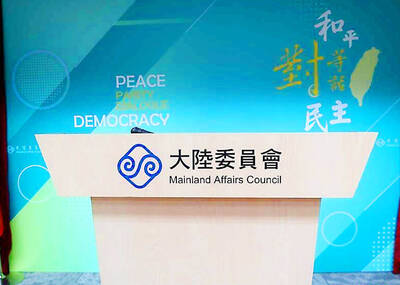
NO RECIPROCITY: Taipei has called for cross-strait group travel to resume fully, but Beijing is only allowing people from its Fujian Province to travel to Matsu, the MAC said The Mainland Affairs Council (MAC) yesterday criticized an announcement by the Chinese Ministry of Culture and Tourism that it would lift a travel ban to Taiwan only for residents of China’s Fujian Province, saying that the policy does not meet the principles of reciprocity and openness. Chinese Deputy Minister of Culture and Tourism Rao Quan (饒權) yesterday morning told a delegation of Chinese Nationalist Party (KMT) lawmakers in a meeting in Beijing that the ministry would first allow Fujian residents to visit Lienchiang County (Matsu), adding that they would be able to travel to Taiwan proper directly once express ferry

FAST RELEASE: The council lauded the developer for completing model testing in only four days and releasing a commercial version for use by academia and industry The National Science and Technology Council (NSTC) yesterday released the latest artificial intelligence (AI) language model in traditional Chinese embedded with Taiwanese cultural values. The council launched the Trustworthy AI Dialogue Engine (TAIDE) program in April last year to develop and train traditional Chinese-language models based on LLaMA, the open-source AI language model released by Meta. The program aims to tackle the information bias that is often present in international large-scale language models and take Taiwanese culture and values into consideration, it said. Llama 3-TAIDE-LX-8B-Chat-Alpha1, released yesterday, is the latest large language model in traditional Chinese. It was trained based on Meta’s Llama-3-8B

STUMPED: KMT and TPP lawmakers approved a resolution to suspend the rate hike, which the government said was unavoidable in view of rising global energy costs The Ministry of Economic Affairs yesterday said it has a mandate to raise electricity prices as planned after the legislature passed a non-binding resolution along partisan lines to freeze rates. Chinese Nationalist Party (KMT) lawmakers proposed the resolution to suspend the price hike, which passed by a 59-50 vote. The Taiwan People’s Party (TPP) voted with the KMT. Legislative Speaker Han Kuo-yu (韓國瑜) of the KMT said the resolution is a mandate for the “immediate suspension of electricity price hikes” and for the Executive Yuan to review its energy policy and propose supplementary measures. A government-organized electricity price evaluation board in March

NOVEL METHODS: The PLA has adopted new approaches and recently conducted three combat readiness drills at night which included aircraft and ships, an official said Taiwan is monitoring China’s People’s Liberation Army (PLA) exercises for changes in their size or pattern as the nation prepares for president-elect William Lai’s (賴清德) inauguration on May 20, National Security Bureau (NSB) Director-General Tsai Ming-yen (蔡明彥) said yesterday. Tsai made the comment at a meeting of the Legislative Yuan’s Foreign Affairs and National Defense Committee, in response to Democratic Progressive Party (DPP) Legislator Wang Ting-yu’s (王定宇) questions. China continues to employ a carrot-and-stick approach, in which it applies pressure with “gray zone” tactics, while attempting to entice Taiwanese with perks, Tsai said. These actions aim to help Beijing look like it has


 RSS
RSS