


US President Barack Obama was to announce yesterday that he plans to withdraw the bulk of US troops from Iraq by August next year, but wants to leave tens of thousands behind to advise Iraqi forces and protect US interests, congressional officials said.
Obama, who campaigned on ending the unpopular Iraq war within 16 months of taking office, has been largely focused in his first weeks as president on turning around the collapsing US economy.
Yesterday’s expected Iraq announcement comes a day after he unveiled an ambitious budget that promises a major overhaul of the US’ costly healthcare system and sets aside an additional US$750 billion to help rescue the US troubled financial system.
TIMETABLE
The Iraq withdrawal timetable would stretch over 19 months from his inauguration last month, three more months than he promised during his campaign. He is expected to announce the new strategy during a trip to the Marine Corps base at Camp Lejeune, North Carolina.
In a sign of the shifting war debate in Washington, Obama is not facing scrutiny over the exact timing of the withdrawal, but rather how deep it really is.
Obama told a closed-door meeting on Thursday with Republican and Democratic leaders that 35,000 to 50,000 troops would remain in Iraq after the bulk of troops are withdrawn, congressional officials said. The maintenance of a residual force for a period of time is not a surprise, but some leaders of Obama’s own party pushed back on just how big it will be.
“When they talk about 50,000, that’s a little higher number than I had anticipated,” Senate Majority Leader Harry Reid, a Democrat, said before the briefing.
An existing US-Iraq agreement, negotiated under former US president George W. Bush, calls for US combat troops to withdraw from Baghdad and other cities by the end of June, with all US forces out of the country by the end of 2011.
More than 4,250 US military members have died since the war began in March 2003, though US military deaths plunged by two-thirds last year from the previous year, a reflection of improving security after a troop buildup in 2007.
The US$750 billion bailout fund is in addition to the US$700 billion bank bailout passed by Congress last October.
Obama has pointedly said he has inherited the deficit from his predecessor and sought to draw a clear distinction with the former Bush administration, saying “the time has come to usher in a new era — a new era of responsibility” both in government and the private sector.
“This budget is an honest accounting of where we are and where we intend to go,” the president said at a ceremony to present the spending plan.
He was referring to former president George W. Bush’s practice of excluding the cost of wars in Iraq and Afghanistan in budget accounting.
AGRICULTURE SUBSIDIES
Obama also promises to phase out direct payments to farming operations with revenues above US$500,000 a year. US farm subsidies have been a point of contention in global trade talks, as critics believe they give US farmers an unfair advantage in world markets.
It is not clear yet whether Obama’s promise to bring combat troops home from Iraq will carry a cost saving in the near term. The US has been spending about US$11 billion to US$12 billion per month fighting two wars.

‘NO SECURITY RISK’: The Railway Bureau reassured the public that the technicians’ activities were limited to technical guidance and did not involve sensitive systems The Railway Bureau yesterday said it had invited eight Chinese technicians to assist with an airport MRT construction project. The bureau issued the confirmation after an Internet user said Chinese nationals had entered the construction zone of Taiwan Taoyuan International Airport’s Terminal 3 project. They asked why “individuals from an enemy state” were allowed access to such a major national infrastructure project, which raised serious concerns over Taiwan’s industrial safety, sensitive systems and information security. The bureau’s Northern Region Engineering Branch Office said subcontractor Taiwan Handle Industrial Co (台灣手把工業) of the Taoyuan airport MRT’s “Contract No. CU05 Project A14 Station Civil, MEP &

A US uncrewed surface vessel (USV) encountered multiple Chinese warships during an autonomous transit of the Taiwan Strait, US defense company Seasats said in a statement on Wednesday. Seasats announced that a Lightfish USV had completed the first autonomous transit of the Taiwan Strait. Over five days, the USV traversed the entire length of the Strait while constantly monitoring surface vessel traffic, the company said. The Lightfish encountered multiple Chinese warships, one of which was a Chinese People’s Liberation Army Navy (PLAN) Type 056 corvette, it said. The Chinese vessels were operating “well within Taiwan’s exclusive economic zone without transmitting their identity via the
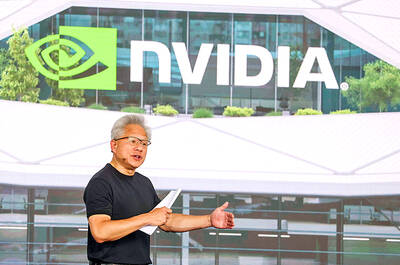
‘BOOMING’: ’ The number of partners we have here is incredible. You can see from their stock prices. They’re doing so well, they’re so happy,’ Jensen Huang said Nvidia Corp’s spending in Taiwan has ballooned to about US$150 billion a year, 10 times the US$10 billion to US$15 billion the company spent five years ago, Nvidia chief executive officer Jensen Huang (黃仁勳) said yesterday, suggesting Taiwan’s strategic importance in the global artificial intelligence (AI) supply chain. “Taiwan is the epicenter of the AI revolution. This is where the chips come, packaging comes. This is where the systems are made. This is where AI supercomputers were created,” Huang said at a meeting for the company’s employees in Beitou-Shilin Technology Park (北投士林科技園區) in Taipei, the planned site of Nvidia’s Taipei headquarters. “Taiwan
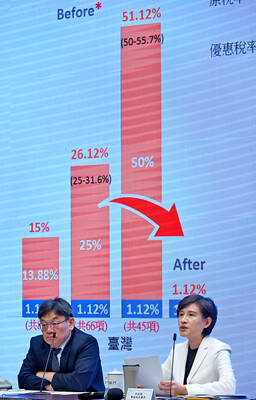
GREATER REACH? Auto parts and wood products would face tariffs of up to 15%, matching those targeting the EU, Japan and South Korea, Vice Premier said The US has announced that preferential tariff treatment for Taiwan’s non-semiconductor Section 232 goods would take effect retroactively from May 1, the Executive Yuan said yesterday. The US government yesterday posted a notice on the Federal Register’s public inspection Web site previewing tariff concessions for Taiwan under a memorandum of understanding (MOU) on Taiwan-US investment after two months of negotiations. The MOU signed on Jan. 15 stipulated three major preferential tariff arrangements: a 15 percent “reciprocal” tariff rate for Taiwan without stacking most-favored nation (MFN) rates; preferential Section 232 treatment for semiconductors and related products; and preferential Section 232 treatment for non-semiconductor


 RSS
RSS