


Seven leading human rights groups urged in a joint statement US Secretary of State Hilary Clinton to make human rights a prominent topic in her upcoming trip to Beijing.
Clinton will leave today for her first overseas trip in her capacity as Washington’s top diplomat. She is to visit Japan, Indonesia, South Korea and China on her week-long tour.
In a letter signed by Amnesty International USA, Reporters without Borders, Freedom House, Human Rights Watch, Human Rights in China, International Campaign of Tibet and Human Rights First, the groups urged the US to send a signal to China that “the quality of its relationship with the US will depend in part on whether it lives by universally accepted human rights norms in its domestic and foreign policies.”
“Sending such a signal in Beijing will be especially important given the US’ unfortunate absence from China’s Universal Periodic Review on Feb. 9 at the UN Human Rights Council in Geneva,” said the letter, dated Thursday.
Holding Clinton to her own pledges, the groups said 13 years ago in Beijing she spoke about the “duty of all governments to respect the fundamental human rights of women and men,” the groups said, adding that contrary to public opinion, China does respond to external pressure on improving its human rights record. They said authorities agreed to move Chinese dissident Hu Jia (胡佳) to a prison closer to his family because of US intervention.
“We strongly urge that you raise these issues early in your tenure as Secretary. We are acutely aware that the US’ agenda with China is a broad one, but we believe that the desired economic, security and diplomatic progress can be reinforced through more vigorous and public defense of human rights,” the letter said.
Speaking at the Asia Society in New York on Friday, Clinton said relations with the countries she will be visiting and those in Asia and the Pacific are vital to US security and interests and that the administration is keen to strengthen ties with the region.
Recent reports from Washington showed that Beijing was ready to pounce on Clinton over arms sales to Taiwan and to use possible greenhouse gas emission reductions to further its position on the Tibet and Taiwan issues.

‘NO SECURITY RISK’: The Railway Bureau reassured the public that the technicians’ activities were limited to technical guidance and did not involve sensitive systems The Railway Bureau yesterday said it had invited eight Chinese technicians to assist with an airport MRT construction project. The bureau issued the confirmation after an Internet user said Chinese nationals had entered the construction zone of Taiwan Taoyuan International Airport’s Terminal 3 project. They asked why “individuals from an enemy state” were allowed access to such a major national infrastructure project, which raised serious concerns over Taiwan’s industrial safety, sensitive systems and information security. The bureau’s Northern Region Engineering Branch Office said subcontractor Taiwan Handle Industrial Co (台灣手把工業) of the Taoyuan airport MRT’s “Contract No. CU05 Project A14 Station Civil, MEP &

The National Chungshan Institute of Science and Technology yesterday showcased its locally developed variants of the Vision 60 robotic patrol dog, which it plans to deploy on the nation’s outlying territories in the South China Sea. The variants were produced under the Joint Lab project — created by the institute and domestic companies — and assembled with domestically produced motors, lenses and artificial intelligence (AI) systems alongside licensed tech from the US, Missile and Rocket Systems Research Division deputy director Jen Kuo-kang (任國光) told the media event at a military base in Taipei’s Dazhi (大直) area. Taiwan has built up its strengths
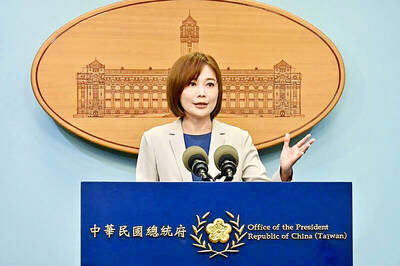
TIT-FOR-TAT: The US allegedly revoked the visa of a Chinese national working at Xinhua News Agency in the US in response to Beijing’s expulsion of Vivian Wang The Presidential Office yesterday condemned China for expelling a New York Times correspondent from Beijing following the newspaper’s interview with President William Lai (賴清德), saying the move highlighted Beijing’s suppression of press freedom and its threat to international news media. Taiwan has noted a series of recent incidents in which Beijing used similar tactics to “threaten and pressure international media outlets and journalists,” Presidential Office spokeswoman Karen Kuo (郭雅慧) said in a statement. “This concerns not only press freedom and freedom of expression, but also the safety of journalists, and Taiwan and relevant partners are paying close attention to the situation,” she

NOT IMMEDIATE: Taiwan has a chance to appeal the proposed 10 percent tariff before it starts, while other countries face a 12.5 percent tariff from the trade office Taiwan is among 60 economies determined by the US to have failed to impose or enforce a ban on the importation of goods produced with forced labor, according to a notice released on Tuesday by the Office of the US Trade Representative (USTR), which proposed imposing an additional 10 percent or more tariff on them. The USTR in a statement said that following an investigation, it had determined under Section 301 of the Trade Act of 1974 that the failure of the 60 economies to impose and effectively enforce a prohibition on the importation of goods produced with forced labor is


 RSS
RSS