


Former president Lee Teng-hui (李登輝) yesterday urged the government to focus on increasing the nation's exports to boost the economy.
Lee made the comments during a visit by President Ma Ying-jeou (馬英九), with the two discussing numerous topics during the one-hour meeting, said a presidential aide who wished to remain anonymous.
During the meeting, Lee expressed his concerns about the current economic situation and suggested that Ma take measures to boost the nation's exports.
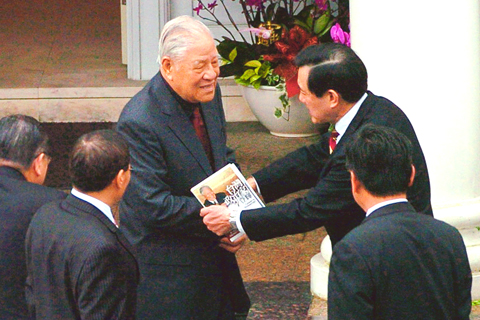
PHOTO: CHIEN JONG-FENG, TAIPEI TIMES
Lee also presented Ma with two books, one of which was titled The One China Black Hole (一個中國黑洞).
Lee told the president that he had also given his recommendations to Vice President Vincent Siew (蕭萬長), who visited Lee earlier yesterday.
Lee urged Ma to take his suggestions into consideration and fight for the nation's economy.
Another Presidential Office official said that Siew told Lee during their meeting at 9:30am that the government's primary goal was to stabilize the financial sector.
Lee told Siew that he was not against the government's policy to promote cross-strait ties, but added that the nation's economy should not be wholly dependent on the Chinese market.
Instead, Taiwan should develop its own economy, Lee said.
The former president said the government should focus on how to promote Taiwan's economic competitiveness so as to improve living conditions in Taiwan.
In response, Siew said the government's short-term measures to tackle a rising unemployment rate had been effective, adding that the government would soon propose more mid-term and long-term solutions.
The vice president said the nation should focus on developing industries such as agricultural economics, green power generation and medical, cultural and innovative industries.
During the meeting with Siew, Lee also mentioned the importance of enriching one's mind in the face of the current economic turmoil.
Lee also said he planned to pay a visit to theological schools around the country.
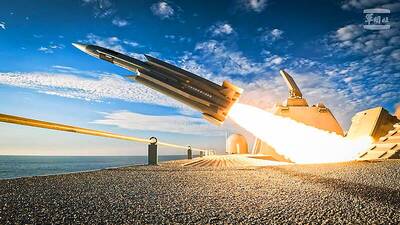
DETERRENCE: With 1,000 indigenous Hsiung Feng II and III missiles and 400 Harpoon missiles, the nation would boast the highest anti-ship missile density in the world With Taiwan wrapping up mass production of Hsiung Feng II and III missiles by December and an influx of Harpoon missiles from the US, Taiwan would have the highest density of anti-ship missiles in the world, a source said yesterday. Taiwan is to wrap up mass production of the indigenous anti-ship missiles by the end of year, as the Chungshan Institute of Science and Technology has been meeting production targets ahead of schedule, a defense official with knowledge of the matter said. Combined with the 400 Harpoon anti-ship missiles Taiwan expects to receive from the US by 2028, the nation would have

POSSIBILITIES EMERGE: With Taiwan’s victory and Japan’s narrow win over Australia, Taiwan now have a chance to advance if South Korea also beat the Aussies Taiwan has high hopes that the national baseball team would advance to the World Baseball Classic (WBC) quarter-finals after clinching a crucial 5-4 victory over South Korea in a nail-biting extra-inning game at the Tokyo Dome yesterday. Boosted by three home runs — two solo shots by Yu Chang (張育成) and Cheng Tsung-che (鄭宗哲) and a two-run homer by Stuart Fairchild — the triumph gave Taiwan a much-needed second victory in the five-team Pool C, where only the top two finishers would advance to the knockout stage in Miami, Florida. Entering extra innings with the game tied at four apiece, Taiwan scored
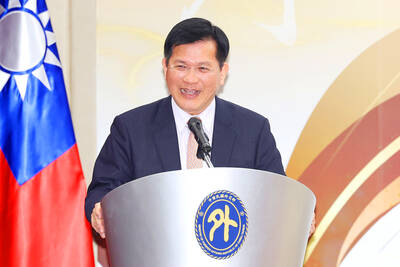
MISSION OF PEACE: The foreign minister urged Beijing to respect Taiwan’s existence as an independent nation, and work together to ensure peace and stability in the region Minister of Foreign Affairs Lin Chia-lung (林佳龍) yesterday rejected Chinese Minister of Foreign Affairs Wang Yi’s (王毅) comments about Taiwan, criticizing China as a “troublemaker” in the international community and a disruptor of cross-strait peace. Speaking at a news conference on the sidelines of the Chinese National People’s Congress, Wang said that Taiwan has always been a territory of China and that it would be impossible for it to become its own country. The “return” of Taiwan to China was the natural outcome of the Chinese people’s resistance against Japan in World War II, and that any pursuit of independence was “doomed

‘UNWAVERING FRIENDSHIP’: A representative of a Japanese group that co-organized a memorial, said he hopes Japanese never forget Taiwan’s kindness President William Lai (賴清德) yesterday marked the 15th anniversary of the Tohoku earthquake and tsunami, urging continued cooperation between Taiwan and Japan on disaster prevention and humanitarian assistance. Lai wrote on social media that Taiwan and Japan have always helped each other in the aftermath of major disasters. The magnitude 9 earthquake struck northeastern Japan on March 11, 2011, triggering a massive tsunami that claimed more than 19,000 lives, according to data from Japanese authorities. Following the disaster, Taiwan donated more than US$240 million in aid, making it one of the largest contributors of financial assistance to Japan. In addition to cash donations and


 RSS
RSS