


in his New Year's address yesterday, President Ma Ying-jeou (馬英九) vowed to protect the sovereignty and dignity of the Republic of China (ROC) during the course of improving business relations with Beijing.
Ma said that it should be the common objective of the governing and opposition parties to protect peace in the Taiwan Strait and lead the way in developing sound cross-strait relations.
Saying the government valued public oversight, Ma said he would never ignore the voice of the people and all parties and would continue to communicate the government's policies and goals with them to promote national development.
In the address, which focused more on the economy than on cross-strait relations, Ma urged the opposition parties to help salvage the nation's economy. The president also asked companies to refrain from cutting jobs as the domestic economy likely slipped into a recession in the last quarter.
“As people are a company's greatest assets, I am calling on employers to try to avoid layoffs as much as possible,” Ma said.
The government will soon introduce a special budget for spending on public infrastructure and transportation and land conservation projects that will improve the quality of life and the business environment, Ma said.
He also urged civil servants to walk out of their offices and get in touch with the public to be able to help them find solutions to their problems.
He also encouraged them to be flexible and bear public interest in mind, adding that he hoped every civil servant would be as compassionate as Kuanyin, the bodhisattva of compassion.
Ma vowed to push the amendments to the Organic Act of the Executive Yuan (行政院組織法) to build a leaner, more adaptable and effective government. Establishing a government that is administratively neutral is also high on the agenda, he said.
As both sides of the Strait develop closer ties, Ma said it was an opportunity and challenge for Taiwan.
Taiwan must not only upgrade its status in the world economy, but also protect the sovereignty of the ROC and Taiwan's dignity as both sides develop closer business ties, he said.
Taiwan must effectively display its political, social and cultural strengths, so it can play a leading role in the long-term development of cross-strait relations, he added.
While urging companies to take advantage of the warming ties with China, Ma said Taiwan must boost domestic consumption and not rely solely on improving cross-strait relations.
In addition to overcoming the economic challenges, Ma said it was equally important to upgrade the country's international competitiveness and that the cultivation of talent was key. For a country with limited resources, human resources are a valuable asset and the foundation of national competitiveness in a knowledge-based era, he said.
Chinese Nationalist Party (KMT) caucus deputy secretary-general Lo Shu-lei (羅淑蕾), yesterday lauded Ma's New Year's address for touching on topics such as “Taiwan's democracy, tolerance and open-mindedness.”
KMT Legislator Wu Yu-sheng (吳育昇) called the address “pragmatic, useful and not too fancy,” as it focused on how to boost the economy and public confidence.
Prior to the speech, Ma and other government officials attended an early morning flag-raising ceremony to welcome the new year.
Despite the cold weather, the event attracted about 40,000 people to the square in front of the Presidential Office.
About 20 students from the Wild Strawberry Student Movement, however, criticized the administration for stopping them from participating in the ceremony wearing masks of Chen Yunlin (陳雲林), chairman of China's Association for Relations Across the Taiwan Strait.
The students originally planned to put on Chen masks and hold up placards that read “Human Rights and Dignity,” when the master of ceremonies led participants in chanting “Long Live the Republic of China” during the flag-raising.
They said the plan was meant to highlight the government's move to stop activists from displaying the national flag during Chen's visit.
But they were prevented by police officers from the Zhongzheng First Precinct from entering Ketagalan Boulevard in front of the Presidential Office.
Police stopped the students on the grounds that they had not obtained a permit for their rally in accordance with the Assembly and Parade Act (集會遊行法).
The student movement has been demanding an immediate amendment to the Act since Chen's visit in early November, saying it violates the public's constitutional rights to freedom of assembly.
“They [the authorities] are even afraid of several pieces of paper [Chen masks],” said Hsieh Sheng-yu (謝昇佑), a spokesman for the movement.
ADDITIONAL REPORTING BY BLOOMBERG

SILENCING CRITICS: In addition to blocking Taiwan, China aimed to prevent rights activists from speaking out against authoritarian states, a Cabinet department said The Ministry of Foreign Affairs (MOFA) yesterday condemned transnational repression by Beijing after RightsCon, a major digital human rights conference scheduled to be held in Zambia this week, was abruptly canceled due to Chinese pressure over Taiwanese participation. This year’s RightsCon, the world’s largest conference discussing issues “at the intersection of human rights and technology,” was scheduled to take place from tomorrow to Friday in Lusaka, and expected to draw 2,600 in-person attendees from 150 countries, along with 1,100 online participants. However, organizers were forced to cancel the event due to behind-the-scenes pressure from China, the ministry said, expressing its “strongest condemnation”
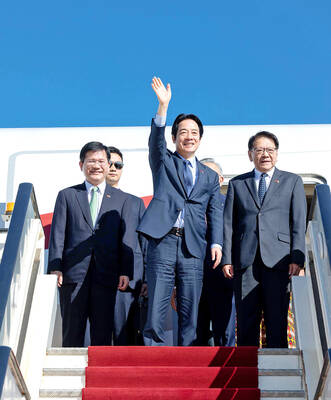
DELAYED BUT DETERMINED: The president’s visit highlights Taiwan’s right to international engagement amid regional pressure from China President Willaim Lai (賴清德) yesterday arrived in Eswatini, more than a week after his planned visit to Taiwan’s sole African ally was suspended because of revoked overflight permits. “The visit, originally scheduled for April 22, was postponed due to unforeseen external factors,” Lai wrote on social media. “After several days of careful arrangements by our diplomatic and national security teams, we successfully arrived today.” Lai said he looked forward to further deepening Taiwan-Eswatini relations through closer cooperation in the economy, agriculture, culture and education, as well as advancing the nation’s international partnerships. The president was initially scheduled to arrive in time to celebrate
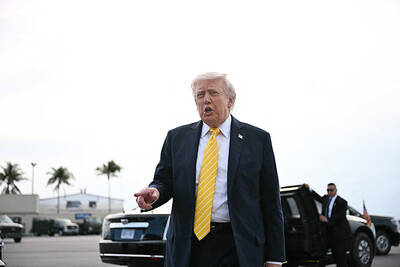
Iran’s Islamic Revolutionary Guard Corp (IRGC) yesterday said the US faced a choice between an “impossible” military operation or a “bad deal” with Tehran, after US President Donald Trump disparaged Iran’s latest peace proposal. Negotiations between the two countries have been deadlocked since a ceasefire came into effect on April 8, with only one round of direct peace talks held so far. Iran’s Tasnim and Fars news agencies reported that Tehran had submitted a 14-point proposal to mediator Pakistan, but Trump was quick to cast doubt on it. “I will soon be reviewing the plan that Iran has just sent to us, but

A group affiliated with indicted Chinese immigrant Xu Chunying (徐春鶯) is to be dissolved for monitoring Chinese immigrants in Taiwan, a source said yesterday. Xu, the secretary-general of the Cross-Strait Marriage and Family Service Alliance, was indicted on March 24 on charges of violating the Anti-Infiltration Act (反滲透法). The alliance “illegally monitored" Chinese immigrants living in Taiwan on behalf of the Chinese Communist Party (CCP) and the Ministry of the Interior is expected to dissolve the organization in the coming days under provisions of the Civil Associations Act (人民團體法), the source said. Xu, who married a Taiwanese in 1993 and became a Republic


 RSS
RSS