


The nation bid a collective farewell to a tumultuous year and welcomed the new year with fireworks and pop music.
Despite the drizzle and the chilly wind, the MRT Taipei City Hall station was packed yesterday evening as more than half a million revelers were set to attend the city's annual New Year's Eve Concert and watch the Taipei 101 fireworks show.
Traffic was already heavy in Xinyi District (信義) early yesterday afternoon as many tried to secure a spot with the best view of the evening's entertainment.
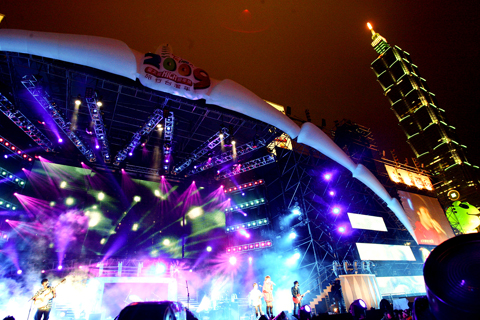
PHOTO: WANG WEN-LIN, TAIPEI TIMES
Convenience stores around the district were prepared to greet the crowd by taking down their automatic glass doors. Some even put tea eggs, steamed buns and other snacks outside store fronts, so customers could simply pay the cashiers outside.
Popular performers, such as the girl band S.H.E, Sodagreen (蘇打綠), Cheer Chen (陳綺貞) and May Day (五月天), were scheduled to perform at the concert. At 11:59pm, Taipei Mayor Hau Lung-bin (郝龍斌) was to join the singers and the spectators in a countdown and watch the fireworks show.
Now perceived as the nation's New Year's Eve highlight, the 188-second Taipei 101 firework spectacle was to display the word “Taiwan” and four colored hearts shown on each side of the building.
Chunghwa Telecom (CHT, 中華電信) said yesterday that the company had added 38 mobile base stations nationwide to ensure quality mobile communications during New Year's Eve.
Eleven of them were placed around Taipei City Hall.
Shih Mu-piao (石木標), vice president of CHT's mobile business group, said yesterday that Taipei City Hall was expected to have the highest communication traffic nationwide on New Year's Eve. Both data and voice communication were forecast to surge at around 10pm before easing at around 2am.
Shih said approximately 18 million text messages were sent on New Year's Eve in 2007. He estimated that more than 20 million would be sent yesterday, or up by about 15 percent to 20 percent from the previous year.
Aside from the concert in Taipei City, counties nationwide hosted similar celebrations, including concerts in Taichung and Kaohsiung. The Taichung County Government's New Year's Party promised to be a raucous affair, as the county planned to have a live simulcast with revelers in China's Xiamen.
Part of the deal involved an agreement to ban the display of national flags, which upset members of the Democratic Progressive Party's (DPP) Taichung Chapter.
As a sign of protest, DPP members planned to distribute more than 3,000 national flags and mobilize supporters in the crowd to wave the flags and shout “long-live the Republic of China.”
The county government has deployed 400 police officers to maintain order.

‘NO SECURITY RISK’: The Railway Bureau reassured the public that the technicians’ activities were limited to technical guidance and did not involve sensitive systems The Railway Bureau yesterday said it had invited eight Chinese technicians to assist with an airport MRT construction project. The bureau issued the confirmation after an Internet user said Chinese nationals had entered the construction zone of Taiwan Taoyuan International Airport’s Terminal 3 project. They asked why “individuals from an enemy state” were allowed access to such a major national infrastructure project, which raised serious concerns over Taiwan’s industrial safety, sensitive systems and information security. The bureau’s Northern Region Engineering Branch Office said subcontractor Taiwan Handle Industrial Co (台灣手把工業) of the Taoyuan airport MRT’s “Contract No. CU05 Project A14 Station Civil, MEP &

A US uncrewed surface vessel (USV) encountered multiple Chinese warships during an autonomous transit of the Taiwan Strait, US defense company Seasats said in a statement on Wednesday. Seasats announced that a Lightfish USV had completed the first autonomous transit of the Taiwan Strait. Over five days, the USV traversed the entire length of the Strait while constantly monitoring surface vessel traffic, the company said. The Lightfish encountered multiple Chinese warships, one of which was a Chinese People’s Liberation Army Navy (PLAN) Type 056 corvette, it said. The Chinese vessels were operating “well within Taiwan’s exclusive economic zone without transmitting their identity via the
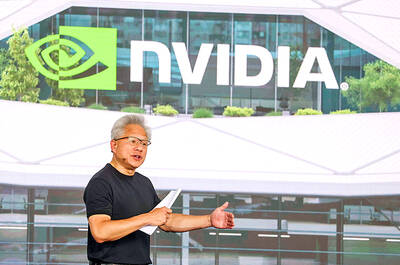
‘BOOMING’: ’ The number of partners we have here is incredible. You can see from their stock prices. They’re doing so well, they’re so happy,’ Jensen Huang said Nvidia Corp’s spending in Taiwan has ballooned to about US$150 billion a year, 10 times the US$10 billion to US$15 billion the company spent five years ago, Nvidia chief executive officer Jensen Huang (黃仁勳) said yesterday, suggesting Taiwan’s strategic importance in the global artificial intelligence (AI) supply chain. “Taiwan is the epicenter of the AI revolution. This is where the chips come, packaging comes. This is where the systems are made. This is where AI supercomputers were created,” Huang said at a meeting for the company’s employees in Beitou-Shilin Technology Park (北投士林科技園區) in Taipei, the planned site of Nvidia’s Taipei headquarters. “Taiwan
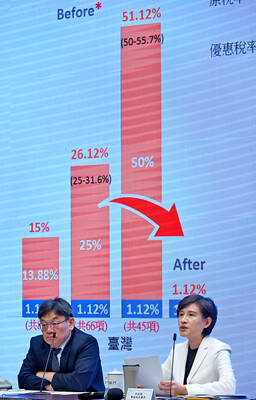
GREATER REACH? Auto parts and wood products would face tariffs of up to 15%, matching those targeting the EU, Japan and South Korea, Vice Premier said The US has announced that preferential tariff treatment for Taiwan’s non-semiconductor Section 232 goods would take effect retroactively from May 1, the Executive Yuan said yesterday. The US government yesterday posted a notice on the Federal Register’s public inspection Web site previewing tariff concessions for Taiwan under a memorandum of understanding (MOU) on Taiwan-US investment after two months of negotiations. The MOU signed on Jan. 15 stipulated three major preferential tariff arrangements: a 15 percent “reciprocal” tariff rate for Taiwan without stacking most-favored nation (MFN) rates; preferential Section 232 treatment for semiconductors and related products; and preferential Section 232 treatment for non-semiconductor


 RSS
RSS