


Israel’s air force obliterated symbols of Hamas power on the third day of its overwhelming Gaza assault yesterday, striking a house next to the Hamas prime minister’s home, devastating a security compound and flattening a five-story building at a university closely linked to the Islamic group.
The three-day death toll rose to 315 by yesterday morning, including seven children under the age of 15 who were killed in two separate strikes overnight, medics said. Israel launched its campaign on Saturday in retaliation for rocket fire aimed at southern Israeli towns.
The strikes appear to have gravely damaged Hamas’ ability to launch rockets, but barrages continued. One medium-range rocket fired at the Israeli city of Ashkelon killed an Arab construction worker there yesterday. He was the second Israeli killed since the beginning of the offensive, and the first person ever to be killed by a rocket in Ashkelon, a city of 120,000.
On Sunday, Hamas missiles struck for the first time near the city of Ashdod, twice as far from Gaza as Ashkelon and only 40km from Israel’s heart in Tel Aviv.
At first light yesterday, strong winds blew black smoke from the bombed sites in Gaza City over deserted streets. The air hummed with the buzz of pilotless drones and the roar of jets, punctuated by the explosions of new airstrikes.
Most of those killed since Saturday were members of Hamas security forces, though the precise numbers remain unclear. A Hamas police spokesman, Ehab Ghussen, said 180 members of the Hamas security forces were among the dead, and the UN agency in charge of Palestinian refugees said at least 51 of the dead were civilians.
Israel’s intense bombings reduced dozens of buildings to rubble. The military said naval vessels also bombarded targets from the sea.
One strike destroyed a five-story building in the women’s wing at Islamic University, one of the most prominent Hamas symbols in Gaza.
Other attacks ravaged a compound controlled by Preventive Security, one of the group’s chief security arms, and destroyed a house next to the residence of Ismail Haniyeh, the Hamas prime minister.
Late on Sunday, Israeli aircraft attacked a building in the Jebaliya refugee camp next to Gaza City, killing a woman, a toddler and three teenage girls, Gaza Health Ministry official Moaiya Hassanain said.
In the town of Rafah, a toddler and his two teenage brothers were killed in an airstrike, Hassanain said. In Gaza City, another attack killed a man and his wife.
The assault has sparked diplomatic fallout. Syria suspended its indirect peace talks with Israel, and the UN Security Council called on both sides to halt the fighting and asked Israel to allow humanitarian supplies into Gaza. Israel opened one of Gaza’s border crossings yesterday.
The prime minister of Turkey, one of the few Muslim countries to have relations with Israel, called the air assault a “crime against humanity” and French President Nicolas Sarkozy condemned “the provocations that led to this situation as well as the disproportionate use of force.”
Palestinian President Mahmoud Abbas issued his strongest condemnation yet of the operation, calling it a “sweeping Israeli aggression against Gaza.”

‘NO SECURITY RISK’: The Railway Bureau reassured the public that the technicians’ activities were limited to technical guidance and did not involve sensitive systems The Railway Bureau yesterday said it had invited eight Chinese technicians to assist with an airport MRT construction project. The bureau issued the confirmation after an Internet user said Chinese nationals had entered the construction zone of Taiwan Taoyuan International Airport’s Terminal 3 project. They asked why “individuals from an enemy state” were allowed access to such a major national infrastructure project, which raised serious concerns over Taiwan’s industrial safety, sensitive systems and information security. The bureau’s Northern Region Engineering Branch Office said subcontractor Taiwan Handle Industrial Co (台灣手把工業) of the Taoyuan airport MRT’s “Contract No. CU05 Project A14 Station Civil, MEP &

A US uncrewed surface vessel (USV) encountered multiple Chinese warships during an autonomous transit of the Taiwan Strait, US defense company Seasats said in a statement on Wednesday. Seasats announced that a Lightfish USV had completed the first autonomous transit of the Taiwan Strait. Over five days, the USV traversed the entire length of the Strait while constantly monitoring surface vessel traffic, the company said. The Lightfish encountered multiple Chinese warships, one of which was a Chinese People’s Liberation Army Navy (PLAN) Type 056 corvette, it said. The Chinese vessels were operating “well within Taiwan’s exclusive economic zone without transmitting their identity via the

‘BOOMING’: ’ The number of partners we have here is incredible. You can see from their stock prices. They’re doing so well, they’re so happy,’ Jensen Huang said Nvidia Corp’s spending in Taiwan has ballooned to about US$150 billion a year, 10 times the US$10 billion to US$15 billion the company spent five years ago, Nvidia chief executive officer Jensen Huang (黃仁勳) said yesterday, suggesting Taiwan’s strategic importance in the global artificial intelligence (AI) supply chain. “Taiwan is the epicenter of the AI revolution. This is where the chips come, packaging comes. This is where the systems are made. This is where AI supercomputers were created,” Huang said at a meeting for the company’s employees in Beitou-Shilin Technology Park (北投士林科技園區) in Taipei, the planned site of Nvidia’s Taipei headquarters. “Taiwan
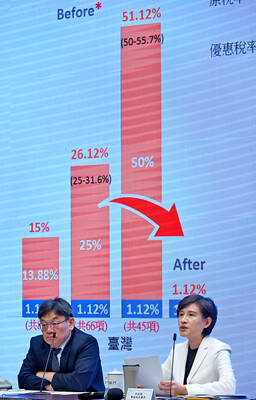
GREATER REACH? Auto parts and wood products would face tariffs of up to 15%, matching those targeting the EU, Japan and South Korea, Vice Premier said The US has announced that preferential tariff treatment for Taiwan’s non-semiconductor Section 232 goods would take effect retroactively from May 1, the Executive Yuan said yesterday. The US government yesterday posted a notice on the Federal Register’s public inspection Web site previewing tariff concessions for Taiwan under a memorandum of understanding (MOU) on Taiwan-US investment after two months of negotiations. The MOU signed on Jan. 15 stipulated three major preferential tariff arrangements: a 15 percent “reciprocal” tariff rate for Taiwan without stacking most-favored nation (MFN) rates; preferential Section 232 treatment for semiconductors and related products; and preferential Section 232 treatment for non-semiconductor


 RSS
RSS