


Former Chinatrust Financial Holding Co (中信金控) vice chairman Jeffrey Koo Jr (辜仲諒) returned to Taiwan yesterday after being on the run for almost two years. He was immediately handcuffed and escorted to the Supreme Prosecutor Office’s Special Investigation Panel (SIP) for questioning.
All investigations involving Koo, who returned to Taiwan from Japan on his private plane around 9:45am, will now be handled by the SIP, a chief investigator said.
SIP spokesman Chen Yun-nan (陳雲南) said that after talking to State Public Prosecutor-General Chen Tsung-ming (陳聰明), it was decided that the probes, including one into Koo’s suspected role in a questionable financial deal and another into his possible role in alleged corruption involving the former first family, would be handled by the SIP.
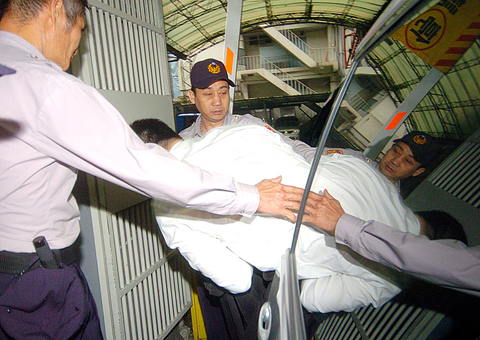
PHOTO: CHANG CHIA-MING, TAIPEI TIMES
Koo has been on the Taipei District Prosecutors’ Office wanted list since December 2006 after twice failing to appear to answer questions regarding his role in Chinatrust Financial’s investment in Mega Financial Holding Co (兆豐金控) through its Hong Kong branch.
Chen Yun-nan said that Koo had “turned himself in voluntarily” as a defendant, which meant he had to be handcuffed in accordance with legal procedure.
The SIP spokesman denied that there had been any “under the table deal” facilitating Koo’s return from Japan.
“We did not make any deal with him,” Chen Yun-nan said. “He decided to come back to help us.”
Prosecutors were also anxious to talk to Koo about the sale of a piece of land in Taoyuan County owned by a development company controlled by Koo and his family, through which former president Chen Shui-bian’s (陳水扁) wife, Wu Shu-jen (吳淑珍), is alleged to have received NT$400 million (US$12 million) in kickbacks.
Jeffrey Koo Jr’s alleged involvement in the deal came to light on Nov. 14, when Taiwan Cement Corp (台泥) chairman Leslie Koo (辜成允), his uncle, told prosecutors that his nephew had introduced him to the former first lady’s friend Tsai Ming-cher (蔡明哲), who instructed Leslie Koo on where to wire a NT$400 million “commission” on the land purchase.
At press time yesterday, prosecutors were still questioning Jeffrey Koo Jr.
His father, Chinatrust Financial chairman Jeffrey Koo (辜濂松), was summoned late last month as a witness over the firm’s suspected role in the case against the former first family.
SIP prosecutors yesterday also questioned former vice premier Lin Hsin-yi (林信義) and former presidential aide Lin Teh-hsun (林德訓).
After Lin Hsin-yi left, prosecutors applied to release Lin Teh-hsun on NT$200,000 bail, a request that was immediately granted by the Taipei District Court.
The court barred Lin Teh-hsun, who had been in detention since Oct. 3, from moving house or leaving the country.
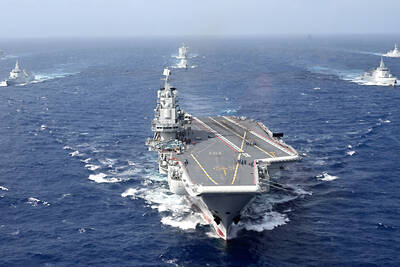
PROVOCATIVE: Chinese Deputy Ambassador to the UN Sun Lei accused Japan of sending military vessels to deliberately provoke tensions in the Taiwan Strait China denounced remarks by Japan and the EU about the South China Sea at a UN Security Council meeting on Monday, and accused Tokyo of provocative behavior in the Taiwan Strait and planning military expansion. Ayano Kunimitsu, a Japanese vice foreign minister, told the Council meeting on maritime security that Tokyo was seriously concerned about the situation in the East China and South China seas, and reiterated Japan’s opposition to any attempt to change the “status quo” by force, and obstruction of freedom of navigation and overflight. Stavros Lambrinidis, head of the EU delegation to the UN, also highlighted South China Sea
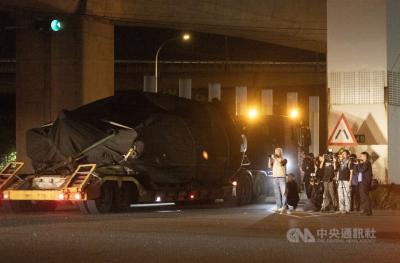
The final batch of 28 M1A2T Abrams tanks purchased from the US arrived at Taipei Port last night and were transported to the Armor Training Command in Hsinchu County’s Hukou Township (湖口), completing the military’s multi-year procurement of 108 of the tanks. Starting at 12:10am today, reporters observed more than a dozen civilian flatbed trailers departing from Taipei Port, each carrying an M1A2T tank covered with black waterproof tarps. Escorted by military vehicles, the convoy traveled via the West Coast Expressway to the Armor Training Command, with police implementing traffic control. The army operates about 1,000 tanks, including CM-11 Brave Tiger
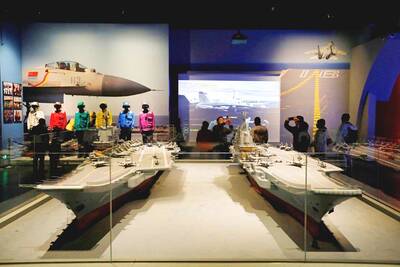
China on Wednesday teased in a video an aircraft carrier that could be its fourth, and the first using nuclear power, while making an allusion to Taiwan and vowing to further build up its islands, as it looks to boost maritime power, secure resources and bolster territorial claims. The video, issued on the eve of the 77th founding anniversary of the Chinese People’s Liberation Army Navy, featured fictional officers with names that are homophones of three commissioned aircraft carriers, the Liaoning (遼寧), Shandong (山東) and Fujian (福建). Titled Into the Deep, it showed a 19-year-old named “Hejian” (何劍) joining the group, sparking
Taiwan Semiconductor Manufacturing Co (TSMC, 台積電), the world’s largest contract chipmaker, said it expects its 2-nanometer (2nm) chip capacity to grow at a compound annual rate of 70 percent from this year to 2028. The projection comes as five fabs begin volume production of 2-nanometer chips this year — two in Hsinchu and three in Kaohsiung — TSMC senior vice president and deputy cochief operating officer Cliff Hou (侯永清) said at the company’s annual technology symposium in Silicon Valley, California, last week. Output in the first year of 2-nanometer production, which began in the fourth quarter of last year, is expected to


 RSS
RSS