


Premier Liu Chao-shiuan (劉兆玄) yesterday demanded an apology from China for allowing products contaminated with melamine to be exported to Taiwan.
“I hereby demand that the Chi-nese government apologize to us for the panic that the food safety problem in China has caused in Taiwan,” the premier said during a question-and-answer session at the legislature.
Liu made the remarks in re-sponse to a question from Demo-cratic Progressive Party Legislator Lee Chun-yee (李俊毅) on whether the government would demand an apology from China over the issue.
It was discovered two weeks ago that 25 tonnes of milk pow-der imported from China’s Sanlu Group in June as an ingredient for food manufacturing con-tained dangerously high levels of melamine.
Last week, offi cials discov-ered that some Chinese non-dairy creamers and malt extract imports were also contaminated with the chemical, resulting in a massive recall of products.
Liu said the government had taken several steps to ensure food safety in the wake of the dairy product scare, including dispatch-ing a delegation of health experts to China in a bid to establish a cross-strait food emergency chan-nel as well as food safety mecha-nisms that would be acceptable to both sides of the Taiwan Strait.
“The government’s policy is clear,” he said. “That is, the safety of all products on the nation’s store shelves must be ensured.”
The delegation returned home on Monday after a three-day trip to Beijing.
Liu vowed to help local busi-nesses that have suffered losses because of the milk powder scan-dal seek compensation from the Chinese manufacturers through negotiation between the Mainland Affairs Council (MAC) and China’s Association for Relations Across the Taiwan Strait (ARATS).
He said the government was still compiling information on the losses incurred by domestic busi-nesses, but estimated the losses could add up to between NT$7 billion (US$217.6 million) and NT$8 billion if all of the products that have been pulled off shelves needed to be destroyed.
The government was still con-ducting a thorough investigation into the Chinese products that have been seized by the Depart-ment of Health to determine the extent of the Chinese manufactur-ers’ liability, Liu said.
Department of Health Minister Yeh Ching-chuan (葉金川) said at the question-and-answer session that about 1,000 bags of dairy in-gredients seized by her depart-ment had been confi rmed to have been contaminated by melamine.
However, she said, the depart-ment needed more proof that the tainted ingredients came from Chi-na’s Zhongshi Duqing (Shandong) Biotech Co before the government could seek compensation.
MAC Chairwoman Lai Shin-yuan (賴幸媛) said yesterday the government would establish with ARATS an offi cial food-safety alert channel for health offi cials within one week.
Also See: DOH, experts fail to reach agreement on melamine、China arrests 27 over melamine

‘NO SECURITY RISK’: The Railway Bureau reassured the public that the technicians’ activities were limited to technical guidance and did not involve sensitive systems The Railway Bureau yesterday said it had invited eight Chinese technicians to assist with an airport MRT construction project. The bureau issued the confirmation after an Internet user said Chinese nationals had entered the construction zone of Taiwan Taoyuan International Airport’s Terminal 3 project. They asked why “individuals from an enemy state” were allowed access to such a major national infrastructure project, which raised serious concerns over Taiwan’s industrial safety, sensitive systems and information security. The bureau’s Northern Region Engineering Branch Office said subcontractor Taiwan Handle Industrial Co (台灣手把工業) of the Taoyuan airport MRT’s “Contract No. CU05 Project A14 Station Civil, MEP &

The National Chungshan Institute of Science and Technology yesterday showcased its locally developed variants of the Vision 60 robotic patrol dog, which it plans to deploy on the nation’s outlying territories in the South China Sea. The variants were produced under the Joint Lab project — created by the institute and domestic companies — and assembled with domestically produced motors, lenses and artificial intelligence (AI) systems alongside licensed tech from the US, Missile and Rocket Systems Research Division deputy director Jen Kuo-kang (任國光) told the media event at a military base in Taipei’s Dazhi (大直) area. Taiwan has built up its strengths
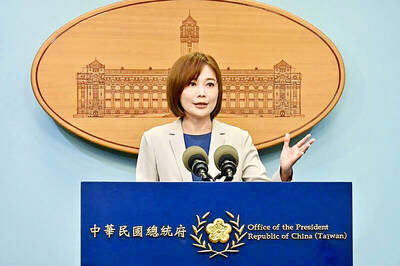
TIT-FOR-TAT: The US allegedly revoked the visa of a Chinese national working at Xinhua News Agency in the US in response to Beijing’s expulsion of Vivian Wang The Presidential Office yesterday condemned China for expelling a New York Times correspondent from Beijing following the newspaper’s interview with President William Lai (賴清德), saying the move highlighted Beijing’s suppression of press freedom and its threat to international news media. Taiwan has noted a series of recent incidents in which Beijing used similar tactics to “threaten and pressure international media outlets and journalists,” Presidential Office spokeswoman Karen Kuo (郭雅慧) said in a statement. “This concerns not only press freedom and freedom of expression, but also the safety of journalists, and Taiwan and relevant partners are paying close attention to the situation,” she
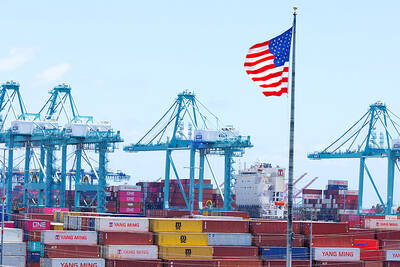
NOT IMMEDIATE: Taiwan has a chance to appeal the proposed 10 percent tariff before it starts, while other countries face a 12.5 percent tariff from the trade office Taiwan is among 60 economies determined by the US to have failed to impose or enforce a ban on the importation of goods produced with forced labor, according to a notice released on Tuesday by the Office of the US Trade Representative (USTR), which proposed imposing an additional 10 percent or more tariff on them. The USTR in a statement said that following an investigation, it had determined under Section 301 of the Trade Act of 1974 that the failure of the 60 economies to impose and effectively enforce a prohibition on the importation of goods produced with forced labor is


 RSS
RSS