


“Eleven hundred” is usually the answer John Nixon will give when asked how many children he and his wife have.
Surrounded by students’ artwork in his office, the soft-spoken British educator pointed at an exquisite oversized painting of a traditional Japanese woman hanging across from his desk.
“A Japanese student did that,” he said, admiring the picture like one showing off a masterpiece by his own child.
“I think young adults today can be really pressured by their peers and by the commercial world, and not all that pressure is positive. One thing the school and I try to encourage them [to realize] is that they have the right to make the right choices for themselves,” Nixon said.
The son of shipyard workers in the UK, the CEO of the Taipei European School (TES) paid tribute to his parents for instilling a thirst for knowledge in him at an early age.
Despite his family’s struggle with money, Nixon considers himself lucky.
“My stepfather had always been very keen for me to go college, get an education and have the chance he did not have,” he said. “My parents would buy me any books I wanted.”
Young Nixon, however, had to do various odd jobs to support himself, including driving a truck to sell tea door-to-door and, after he turned 20, being hired as a window repairman for a skyscraper.
Since then, the avid mountaineer has conquered some of the world’s toughest peaks, including the Himalayas and Mount Kenya.
“Sometimes you learn from jobs that you don’t like. I knew I didn’t want to work on a building site, but now I build schools,” he chuckled.
Affectionately known as “Bob the Builder” among students because of his frequent donning of a yellow hard hat around school construction sites, in the last eight years Nixon has overseen the expansion of his school, both in size and number of students.
The high school campus at Yangmingshan was completed in 2002, while the new Swire European Primary Campus in Shilin District was inaugurated in August last year.
Both campuses are fully equipped with state-of-the-art technology that facilitates interaction between students and teachers.
The primary campus consists of three main buildings: an Infant Wing, a Junior Wing and a Central Resource Area. The school’s Web site says that a sports center will be built later as part of a second phase of development
But for the former geology teacher, the hardware found at the school is of secondary importance, with the holistic development of students the school’s raison d’etre.
Nixon stresses that his main commitment is not only helping students excel academically, but also looking after the children’s well-being under what he described as “pastoral care” promoting health, social and moral education.
“Some of the students we teach will become very important leaders in the future. I want them to have a humanistic approach [and] to learn to be considerate, understanding and tolerant,” he said.
Children, he said, learn better when they feel comfortable and happy.
Acknowledging that the majority of TES students are from privileged families, Nixon said the school has set up many programs to involve them in local charity work.
Many of the high school students also travel to Cambodia each year to build houses for those in need, he said.
It is Nixon’s unwavering dedication to education in Taiwan that has earned him a chance to be made a Member of the Order of the British Empire last year, one of the most prestigious honors meted out by Queen Elizabeth II to recognize stellar achievements, contributions and acts of bravery by British subjects.
“I don’t know and I don’t think I will ever know who nominated me, but it is very special honor for me,” he said.
TES is the second international school Nixon has worked at, after serving as vice-principal of a school in Qatar for 11 years.
“I don’t know where I will go next after Taipei, but I do know it will be somewhere I can be challenged,” he said.

‘NO SECURITY RISK’: The Railway Bureau reassured the public that the technicians’ activities were limited to technical guidance and did not involve sensitive systems The Railway Bureau yesterday said it had invited eight Chinese technicians to assist with an airport MRT construction project. The bureau issued the confirmation after an Internet user said Chinese nationals had entered the construction zone of Taiwan Taoyuan International Airport’s Terminal 3 project. They asked why “individuals from an enemy state” were allowed access to such a major national infrastructure project, which raised serious concerns over Taiwan’s industrial safety, sensitive systems and information security. The bureau’s Northern Region Engineering Branch Office said subcontractor Taiwan Handle Industrial Co (台灣手把工業) of the Taoyuan airport MRT’s “Contract No. CU05 Project A14 Station Civil, MEP &

A US uncrewed surface vessel (USV) encountered multiple Chinese warships during an autonomous transit of the Taiwan Strait, US defense company Seasats said in a statement on Wednesday. Seasats announced that a Lightfish USV had completed the first autonomous transit of the Taiwan Strait. Over five days, the USV traversed the entire length of the Strait while constantly monitoring surface vessel traffic, the company said. The Lightfish encountered multiple Chinese warships, one of which was a Chinese People’s Liberation Army Navy (PLAN) Type 056 corvette, it said. The Chinese vessels were operating “well within Taiwan’s exclusive economic zone without transmitting their identity via the
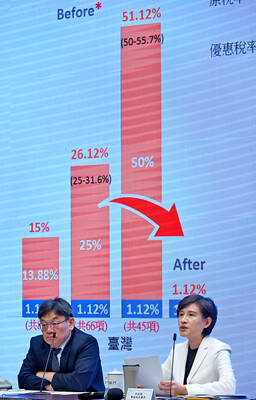
GREATER REACH? Auto parts and wood products would face tariffs of up to 15%, matching those targeting the EU, Japan and South Korea, Vice Premier said The US has announced that preferential tariff treatment for Taiwan’s non-semiconductor Section 232 goods would take effect retroactively from May 1, the Executive Yuan said yesterday. The US government yesterday posted a notice on the Federal Register’s public inspection Web site previewing tariff concessions for Taiwan under a memorandum of understanding (MOU) on Taiwan-US investment after two months of negotiations. The MOU signed on Jan. 15 stipulated three major preferential tariff arrangements: a 15 percent “reciprocal” tariff rate for Taiwan without stacking most-favored nation (MFN) rates; preferential Section 232 treatment for semiconductors and related products; and preferential Section 232 treatment for non-semiconductor
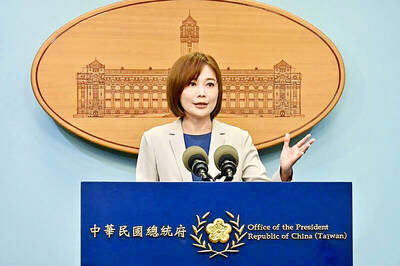
TIT-FOR-TAT: The US allegedly revoked the visa of a Chinese national working at Xinhua News Agency in the US in response to Beijing’s expulsion of Vivian Wang The Presidential Office yesterday condemned China for expelling a New York Times correspondent from Beijing following the newspaper’s interview with President William Lai (賴清德), saying the move highlighted Beijing’s suppression of press freedom and its threat to international news media. Taiwan has noted a series of recent incidents in which Beijing used similar tactics to “threaten and pressure international media outlets and journalists,” Presidential Office spokeswoman Karen Kuo (郭雅慧) said in a statement. “This concerns not only press freedom and freedom of expression, but also the safety of journalists, and Taiwan and relevant partners are paying close attention to the situation,” she


 RSS
RSS