


Britain has come under fire in a UN report that raises concerns over counterterrorism laws, legislation that limits free speech and the use of the Indian Ocean territory of Diego Garcia in the extraordinary rendition of terror suspects.
The UN Human Rights Committee report also singled out Britain’s Official Secrets Act — legislation enacted during the Cold War to safeguard national security information — as a means of silencing whistle-blowers and keeping information out of the public domain. The act was used last year to convict a British civil servant of leaking a classified memo about a meeting between US President George W. Bush and former British prime minister Tony Blair over Iraq.
Since the suicide bombings that killed 52 rush-hour commuters in 2005, Britain has pushed through a raft of counterterrorism measures. The human rights committee issues its reports every three years after countries offer their own assessments.
“The UK has a proud record in human rights,” the British Home Office said in a statement. “We see the country reviews ... as a process based on collaboration and co-operation, and above all, a commitment to improving human rights on the ground.”
Britain has been in the spotlight over measures that rights groups say go beyond what is needed to protect against terrorism. Already one of the leading countries in surveillance, it also has some of the most impenetrable secrecy laws.
“The committee remains concerned that powers under the Official Secrets Act 1989 have been exercised to frustrate former employees of the crown from bringing into the public domain issues of genuine public interest, and can be exercised to prevent the media from publishing such matters,” the UN report said.
The committee also urged a full probe into alleged rights abuses at Diego Garcia, the British territory leased by the US military, where at least two terror suspects were taken on extraordinary rendition flights.
There have been allegations that suspects were also interrogated there.

CROSS-STRAIT COLLABORATION: The new KMT chairwoman expressed interest in meeting the Chinese president from the start, but she’ll have to pay to get in Beijing allegedly agreed to let Chinese Nationalist Party (KMT) Chairwoman Cheng Li-wun (鄭麗文) meet with Chinese President Xi Jinping (習近平) around the Lunar New Year holiday next year on three conditions, including that the KMT block Taiwan’s arms purchases, a source said yesterday. Cheng has expressed interest in meeting Xi since she won the KMT’s chairmanship election in October. A source, speaking on condition of anonymity, said a consensus on a meeting was allegedly reached after two KMT vice chairmen visited China’s Taiwan Affairs Office Director Song Tao (宋濤) in China last month. Beijing allegedly gave the KMT three conditions it had to

‘BALANCE OF POWER’: Hegseth said that the US did not want to ‘strangle’ China, but to ensure that none of Washington’s allies would be vulnerable to military aggression Washington has no intention of changing the “status quo” in the Taiwan Strait, US Secretary of Defense Pete Hegseth said on Saturday, adding that one of the US military’s main priorities is to deter China “through strength, not through confrontation.” Speaking at the annual Reagan National Defense Forum in Simi Valley, California, Hegseth outlined the US Department of Defense’s priorities under US President Donald Trump. “First, defending the US homeland and our hemisphere. Second, deterring China through strength, not confrontation. Third, increased burden sharing for us, allies and partners. And fourth, supercharging the US defense industrial base,” he said. US-China relations under

The Chien Feng IV (勁蜂, Mighty Hornet) loitering munition is on track to enter flight tests next month in connection with potential adoption by Taiwanese and US armed forces, a government source said yesterday. The kamikaze drone, which boasts a range of 1,000km, debuted at the Taipei Aerospace and Defense Technology Exhibition in September, the official said on condition of anonymity. The Chungshan Institute of Science and Technology and US-based Kratos Defense jointly developed the platform by leveraging the engine and airframe of the latter’s MQM-178 Firejet target drone, they said. The uncrewed aerial vehicle is designed to utilize an artificial intelligence computer
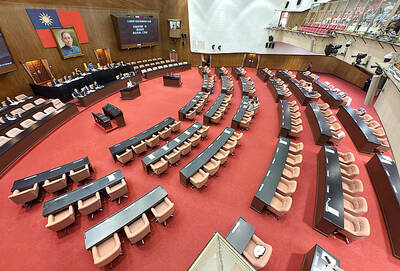
The Chinese Nationalist Party (KMT) caucus yesterday decided to shelve proposed legislation that would give elected officials full control over their stipends, saying it would wait for a consensus to be reached before acting. KMT Legislator Chen Yu-jen (陳玉珍) last week proposed amendments to the Organic Act of the Legislative Yuan (立法院組織法) and the Regulations on Allowances for Elected Representatives and Subsidies for Village Chiefs (地方民意代表費用支給及村里長事務補助費補助條例), which would give legislators and councilors the freedom to use their allowances without providing invoices for reimbursement. The proposal immediately drew criticism, amid reports that several legislators face possible charges of embezzling fees intended to pay


 RSS
RSS