


The danger of a Chinese military attack on Taiwan has increased materially in the past few years as the balance of force in the Taiwan Strait continues to tilt toward Beijing, and it is not clear whether the efforts of President Ma Ying-jeou’s (馬英九) government to draw closer to China has offset the rising danger, a senior Pentagon official told Congress on Wednesday.
US Assistant Secretary of Defense for East Asia James Shinn told a hearing of the House Armed Services Committee that Ma’s decision to open discussions with Beijing “at least appears to have reduced the threat and the probability of the use of force,” but added that he’s not sure “if you add [the Chinese buildup and Ma’s efforts] together, what the net effect is.”
In any event, Shinn said: “We’d have to conclude that as the balance has shifted toward the mainland [sic], it has materially increased the danger across the Strait.”
Shinn became the first official in President George W. Bush’s administration to publicly comment on the US action in freezing the sale of some US$12 billion in arms sales to Taiwan, saying the move was initiated by the Ma administration, not the US.
“I don’t believe that we made a decision to put things in abeyance,” he said in response to a question. “This was driven, as far as I understand, by Taiwanese domestic politics.”
Shinn did not elaborate and refused to answer questions from the Taiwanese media after the hearing.
His testimony contradicts assertions by others that the US decision predated Ma’s election as president and reflects concerns over China’s opposition to the arms sales and Bush’s anger over actions by former president Chen Shui-bian (陳水扁), which China tagged as steps toward independence and top US officials branded as provocative.
Advocates in Washington of that view say that the Bush administration, buoyed by Ma’s cross-strait policies, merely concurred with the Chinese Nationalist Party (KMT) government’s request in line with the US’ domestic and foreign policy needs.
Pressed by committee members, however, Shinn said that US policy on arms sales to Taiwan has not changed and that Washington remains committed to fulfill the language of the Taiwan Relations Act of 1979, with the US pledging to sell sufficient arms to Taiwan to defend itself against a Chinese attack.
In written testimony presented before the hearing, Shinn chastised China for doing little to reduce its hostility toward Taiwan.
“There is much more that Beijing can do to support reducing cross-strait tension, demonstrate flexibility with respect to Taiwan’s international space and to reduce the threat to Taiwan presented by the PLA’s [People’s Liberation Army] sustained military buildup opposite the island,” Shinn said.
“On these counts, we have seen little progress from Beijing. We continue to see growth in PLA capabilities deployed opposite Taiwan, and we will watch closely for signs of Chinese steps to shift the balance further even as we encourage Beijing to work with Taiwan on more positive actions to reduce tensions,” he said.
While Shinn looked favorably on Ma’s moves toward Beijing, he did so with a caveat from the military perspective.
“It has certainly been a positive political development that the Taiwanese are engaging in what appears to be constructive discussions or negotiations with Beijing,” he said.
But from a military point of view, “it doesn’t alter our focus on our job with respect to both deterring coercion in that part of the world and responding to possible changes in Chinese political intent over the longer run,” he said.
One major source of Shinn’s comments on China’s increasing edge in the Taiwan Strait was the Pentagon’s latest annual report to Congress on China’s military might, released in March.
Shinn pointed to annexes in the report showing that China has 100 major warships and 33 submarines in its fleet near Taiwan, compared with 42 and 4 respectively for Taiwan.
China also has 440,000 military personnel in the area compared with 130,000 for all of Taiwan, and 530 major warplanes within cross-strait range, compared with 430 for Taiwan.
In addition, China has 2,800 tanks and 2,900 artillery pieces in the area, as well as more than 1,000 missiles, Shinn said.
Also See: China firms violating UN sanctions: US
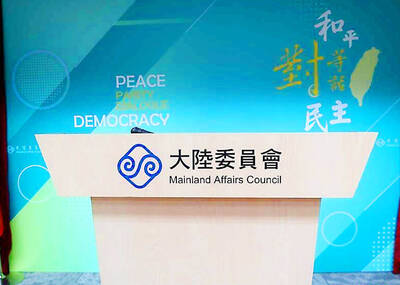
NO RECIPROCITY: Taipei has called for cross-strait group travel to resume fully, but Beijing is only allowing people from its Fujian Province to travel to Matsu, the MAC said The Mainland Affairs Council (MAC) yesterday criticized an announcement by the Chinese Ministry of Culture and Tourism that it would lift a travel ban to Taiwan only for residents of China’s Fujian Province, saying that the policy does not meet the principles of reciprocity and openness. Chinese Deputy Minister of Culture and Tourism Rao Quan (饒權) yesterday morning told a delegation of Chinese Nationalist Party (KMT) lawmakers in a meeting in Beijing that the ministry would first allow Fujian residents to visit Lienchiang County (Matsu), adding that they would be able to travel to Taiwan proper directly once express ferry

FAST RELEASE: The council lauded the developer for completing model testing in only four days and releasing a commercial version for use by academia and industry The National Science and Technology Council (NSTC) yesterday released the latest artificial intelligence (AI) language model in traditional Chinese embedded with Taiwanese cultural values. The council launched the Trustworthy AI Dialogue Engine (TAIDE) program in April last year to develop and train traditional Chinese-language models based on LLaMA, the open-source AI language model released by Meta. The program aims to tackle the information bias that is often present in international large-scale language models and take Taiwanese culture and values into consideration, it said. Llama 3-TAIDE-LX-8B-Chat-Alpha1, released yesterday, is the latest large language model in traditional Chinese. It was trained based on Meta’s Llama-3-8B

STUMPED: KMT and TPP lawmakers approved a resolution to suspend the rate hike, which the government said was unavoidable in view of rising global energy costs The Ministry of Economic Affairs yesterday said it has a mandate to raise electricity prices as planned after the legislature passed a non-binding resolution along partisan lines to freeze rates. Chinese Nationalist Party (KMT) lawmakers proposed the resolution to suspend the price hike, which passed by a 59-50 vote. The Taiwan People’s Party (TPP) voted with the KMT. Legislative Speaker Han Kuo-yu (韓國瑜) of the KMT said the resolution is a mandate for the “immediate suspension of electricity price hikes” and for the Executive Yuan to review its energy policy and propose supplementary measures. A government-organized electricity price evaluation board in March

NOVEL METHODS: The PLA has adopted new approaches and recently conducted three combat readiness drills at night which included aircraft and ships, an official said Taiwan is monitoring China’s People’s Liberation Army (PLA) exercises for changes in their size or pattern as the nation prepares for president-elect William Lai’s (賴清德) inauguration on May 20, National Security Bureau (NSB) Director-General Tsai Ming-yen (蔡明彥) said yesterday. Tsai made the comment at a meeting of the Legislative Yuan’s Foreign Affairs and National Defense Committee, in response to Democratic Progressive Party (DPP) Legislator Wang Ting-yu’s (王定宇) questions. China continues to employ a carrot-and-stick approach, in which it applies pressure with “gray zone” tactics, while attempting to entice Taiwanese with perks, Tsai said. These actions aim to help Beijing look like it has


 RSS
RSS