


Zimbabwe’s opposition leader yesterday sought assurances for his safety from his shelter in the Dutch embassy as President Robert Mugabe’s regime seemed set to defy the world and hold a run-off vote.
Morgan Tsvangirai, who took refuge in the mission on Sunday night after announcing he would not challenge Mugabe in the run-off, said by phone he would leave when he was “satisfied that it’s safe to do so.”
“I am not being chased away and my hosts have said I can stay for as long as I don’t feel it’s safe to leave ... probably within the next two days,” he said.
Tsvangirai cited pre-poll violence against his supporters as the reason for withdrawing from Friday’s election, in which he had vowed to end Mugabe’s 28-year rule.
Mugabe has not directly responded to Tsvangirai’s pull out, but his government has said preparations for the vote will move ahead, setting up a possible victory by default for the veteran leader in power since independence.
In state media on Tuesday, Mugabe accused former colonial ruler Britain and its allies of lying to the world to justify intervention.
“Britain and her allies are telling a lot of lies about Zimbabwe, saying a lot of people are dying,” the state-run Herald newspaper quoted him as saying.
The UN Security Council has urged that the run-off vote be postponed and condemned the violence the opposition says has killed dozens of its supporters and made a fair election impossible.
Britain, the US and France all branded Mugabe’s regime as “illegitimate,” and UN chief Ban Ki-moon warned that holding the election “would only deepen the divisions within the country and produce results that cannot be credible.”
Zimbabwe’s ambassador to the UN, Boniface Chidyausiku, said Ban’s comments were “out of order.”
“For him [Ban] to grandstand in New York and suggest that we should postpone the election is out of order as far as we are concerned,” he said on South African radio.
Mugabe, 84, is accused by critics of leading the once model economy to ruin and trampling on human rights.
The country has the world’s highest inflation rate and is experiencing major food shortages.
He has pledged the opposition will never come to power in his lifetime and vowed to fight to keep it from occurring.
Tsvangirai meanwhile told AFP the UN did not have the “jurisdiction” to postpone the vote.
“They can only recommend,” he said, stressing that holding an election in the current conditions was impossible.
Regional criticism intensified yesterday, with the ruling party in neighboring South Africa, the continental powerhouse, slamming Mugabe’s government.
The African National Congress said it was “deeply dismayed by the actions of the government of Zimbabwe which is riding roughshod over the hard-won democratic rights of the people of that country.
“As democrats, the ANC cannot be indifferent to the flagrant violation of every principle of democratic governance.”
China on the other hand urged restraint in Zimbabwe but declined to join in world criticism of Mugabe — a Beijing ally — over the political violence.
A spokesman for Zimbabwe’s electoral commission said Tuesday the body still had not received a letter from Tsvangirai confirming his withdrawal from the run-off and was moving ahead with plans for the vote.
“The preparations are at an advanced stage,” Zimbabwe Electoral Commission spokesman Uitoile Silaigwana said.
The opposition says more than 80 of its supporters have been killed and thousands injured in a campaign of intimidation in the lead up to the vote.
On Monday, police raided Tsvangirai’s Movement for Democratic Change (MDC) party headquarters, with an MDC spokesman saying more than 60 people, including victims of political violence who had taken shelter there, were taken away.
But police said they had received reports that health conditions had deteriorated at the headquarters and took 39 people to a rehabilitation center.
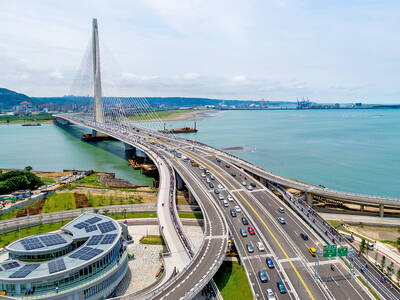
The Ministry of Transportation and Communications yesterday inaugurated the Danjiang Bridge across the Tamsui River in New Taipei City, saying that the structure would be an architectural icon and traffic artery for Taiwan. Feted as a major engineering achievement, the Danjiang Bridge is 920m long, 211m tall at the top of its pylon, and is the longest single-pylon asymmetric cable-stayed bridge in the world, the government’s Web site for the structure said. It was designed by late Iraqi-British architect Zaha Hadid. The structure, with a maximum deck of 70m, accommodates road and light rail traffic, and affords a 200m navigation channel for boats,
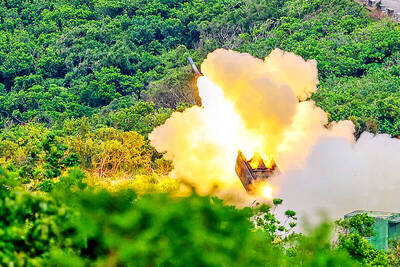
PRECISION STRIKES: The most significant reason to deploy HIMARS to outlying islands is to establish a ‘dead zone’ that the PLA would not dare enter, a source said A High Mobility Artillery Rocket System (HIMARS) would be deployed to Penghu County and Dongyin Island (東引) in Lienchiang County (Matsu) to force the Chinese military to retreat at least 100km from the coastline, a military source said yesterday. Taiwan has been procuring HIMARS and Army Tactical Missile Systems (ATACMS) from the US in batches. Once all batches have been delivered, Taiwan would possess 111 HIMARS units and 504 ATACMS, which have a range of 300km. Considering that “offense is the best defense,” the military plans to forward-deploy the systems to outlying islands such as Penghu and Dongyin so that

‘CLEAR MESSAGE’: The bill would set up an interagency ‘tiger team’ to review sanctions tools and other economic options to help deter any Chinese aggression toward Taiwan US Representative Young Kim has introduced a bill to deter Chinese aggression against Taiwan, calling for an interagency “tiger team” to preplan coordinated sanctions and economic measures in response to possible Chinese military or political action against Taiwan. “[Chinese President] Xi Jinping [習近平] has directed the People’s Liberation Army to be ready to invade Taiwan by 2027. China has a plan. America should have one too,” Kim said in a news release on Thursday last week. She introduced the “Deter PRC [People’s Republic of China] aggression against Taiwan act” to “ensure the US has a coordinated sanctions strategy ready should

Taiwan Semiconductor Manufacturing Co (TSMC, 台積電), the world’s largest foundry service provider, yesterday said that global semiconductor revenue is projected to hit US$1.5 trillion in 2030, after the figure exceeds US$1 trillion this year, as artificial intelligence (AI) demand boosts consumption of token and compute power. “We are still at the beginning of the AI revolution, but we already see a significant impact across the whole semiconductor ecosystem,” TSMC deputy cochief operating officer Kevin Zhang (張曉強) said at the company’s annual technology symposium in Hsinchu City. “It is fair to say that in the past decade, smartphones and other mobile devices were


 RSS
RSS