

A 150kg pig who resides at the intersection of Yanping N Road and Minzu W Road has become part of the community in Datong District, Taipei City.
The pig, named Happy, lives alone in an unused concrete house. Happy is well liked by the local community and fed by stallholders at the local market. In fine weather Happy finds shade near buildings and often goes on strolls as far as Taipei Bridge. No matter where she goes, Happy always manages to find her way home.
Many mistake Happy for a wild pig and the Guoshun Borough (國順) chief has in the past made calls for help to police, the Department of Environmental Protection and the Council of Agriculture. However, as the matter remained unresolved for more than two years, local residents have grown accustomed to coexisting with the porker.

PHOTO: CHIEN JUNG-FONG, TAIPEI TIMES
Happy’s owner, Hu Wan-chi (胡萬吉), said he purchased Happy from a pet shop on Heping W Road three years ago for NT$4,500. The owner had told him that Happy, who weighed 30kg at the time, was a miniature pig that would not grow longer than 100cm. However, a year later, Happy had become so large that she could no longer climb the stairs to Hu’s fifth floor apartment.
Hu remembers Happy’s earlier days with fondness. Back then, Happy would follow Hu around. In hot weather, Hu bathed Happy often and Happy was obedient and clean.
The small concrete building where Happy resides is an empty ice storage area from the time when Hu was an ice vendor. After Happy became too big, Hu was unable to keep her at home and yet loath to send her to a slaughterhouse.
Unable to find a new owner for Happy, Hu made the empty ice storage Happy’s new home.
Luckily, Happy is well liked and often fed by locals who give her milk and leftovers, Hu said.
Once a young woman even hired workmen to mend Happy’s house, he said.
Hu is reserved about the fact that he has no choice but to allow Happy to live on the street. He also refused to be photographed with the pig. He says that he has not given Happy a bath in the last two years and that Happy has become so overweight that she can barely open his eyes.
However, when Hu walks past, Happy always greets him joyfully, he said.

The Philippine Coast Guard yesterday said it has deployed its largest vessel and an aircraft to challenge a Chinese research ship operating off northern Batanes near Taiwan, adding that a Chinese coast guard vessel had also moved in. The Philippine operation “disrupted the vessel’s unauthorized marine scientific research and compelled it to leave its loitering position,” said Jay Tarriela, Philippine Coast Guard spokesperson on South China Sea issues. The Philippine Coast Guard said the BRP Teresa Magbanua and an aircraft were deployed to counter the Chinese vessel, which it said had remained about 37 nautical miles northwest of Itbayat Island since Monday. The
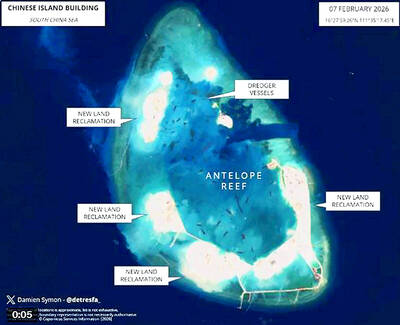
RUNWAY: Analysts said the first aircraft landing is expected by the middle of next year, while Chinese state media said it would serve civilian needs Chinese construction of a runway on Antelope Reef (Lingyang Reef, 羚羊礁) in the Paracel Islands (Xisha Islands, 西沙群島), is well under way with analysts estimating it could be completed by the middle of next year, strengthening Beijing’s military control over the disputed South China Sea. Satellite images reviewed by Reuters show grading work, piles of gravel and concrete, and compaction cranes in operation to build a full-scale runway that military attaches and security analysts say could be one of China’s most important offshore bases in the region. The images, taken on Friday last week by commercial satellite imagery provider Vantor, also show

SHIFTING COOPERATION: With the new arrangement, US representatives would be able to participate directly in defense discussions, including weapons procurement Taiwan-US military cooperation is deepening, with the Pentagon expected to station personnel at the Ministry of National Defense (MND), sources said. The NT$470 million (US$14.77 million) joint program is scheduled to run from this year through 2028, under which the Pentagon would dispatch representatives from the Office of the Under Secretary of Defense for Policy and the Institute for Defense Analyses, a senior military official said on condition of anonymity, adding that one representative from each organization would be stationed at the ministry’s headquarters. The Office of the Under Secretary of Defense for Policy is one of the US’ bodies responsible for

The Presidential Office today condemned China's transnational repression after an alleged Chinese foreign agent was arrested in California yesterday on suspicion of surveilling President William Lai's (賴清德) son, Lai Ting-yu (賴廷與), the FBI said. The 34-year-old woman, named Wanying Heather Zhang (張婉瑩), was arrested on suspicion of acting as an unregistered foreign agent, US news agency CBS reported. She was apprehended at Los Angeles International Airport yesterday attempting to fly to Shanghai, it said. This represents a “typical case” of China’s transnational repression, Presidential Office spokeswoman Karen Kuo (郭雅慧) said today. "Our country expresses the strongest condemnation of such barbaric conduct that


 RSS
RSS