


Myanmar's junta yesterday warned of legal action against people who hoard or trade aid supplies meant for the survivors of a cyclone that may have killed up to 128,000 people, the first indirect acknowledgment of problems with relief operations.
Reports have emerged that foreign aid was being sold openly in markets and that the military was pilfering and diverting aid for its own use. New York-based Human Rights Watch said on Wednesday the military had seized high-energy biscuits that came from abroad and distributed low-quality, locally produced biscuits to survivors.
State radio obliquely denied the military was misappropriating aid.
“The government has systematically accepted donations and has distributed the relief goods immediately and directly to the victims,” it said. “Effective legal action will be taken against those who hoard, sell or buy, use or misuse the international or local donations or relief goods or cash to the cyclone victims.”
The government says 38,491 people have died and 27,838 are missing in the cyclone which hit on May 2 and May 3. But the International Federation of Red Cross and Red Crescent Societies estimated the death toll was between 68,833 and 127,990. The UN has said more than 100,000 may have died.
The UN and the Red Cross say 1.6 million to 2.5 million people are in urgent need of food, water and shelter. Only 270,000 have been reached so far by aid groups.
Tonnes of foreign aid — including water, blankets, mosquito nets, tarpaulins, medicines and tents — have been sent to Myanmar, but delivery has been slowed by bottlenecks, poor infrastructure and bureaucratic tangles.
The junta insists on taking control of the distribution, saying it can handle the disaster on its own — a stance that appears to stem not from its abilities but its deep suspicion of most foreigners, who have frequently criticized its human rights abuses.
It has allowed the UN and some other agencies to hand out the aid directly but barred the few foreign staff allowed into Myanmar from leaving Yangon, the country’s main city.
In a clear sign that politics is playing a role, the junta granted approval to 160 relief workers from India, China, Bangladesh and Thailand, which have rarely criticized Myanmar’s democracy record.
Monks in the disaster zone said yesterday that the junta has moved tens of thousands of homeless cyclone survivors into government-run shelters, pushing them out of monasteries and schools.
They said that people in the hardest-hit parts of the Irrawaddy Delta were relocated by boats and trucks to camps, where it was unclear if they had enough food and water after the storm that left 66,000 dead or missing.
Around the main city of Yangon, people seeking shelter at Buddhist monasteries said they had been ordered to leave but given no other accommodation.
Last October, security forces fired on and beat the protesters, leaving at least 31 dead and prompting most of Yangon’s monks to flee the country’s main city.
Many monasteries in Yangon have since been empty, but in the wake of Cyclone Nargis, monks have taken the lead in providing shelter for people left homeless by the storm.
About 80,000 people had sought sanctuary in schools and temples in the Irrawaddy Delta town of Labutta, they said.
Now, only about 20,000 remain in their care at 50 monasteries in Labutta, after the military moved them to camps set up in the towns of Myaungmya and Pathein, which escaped the storm with little damage, the monks said.
“People were moved in boats and trucks to nearby towns,” one of them told reporters in the main city of Yangon, where monks have come to seek donations for the disaster relief effort.
The UN estimates that 550,000 people are now living in temporary settlements, where accounts from evacuees say there is not enough food, water or shelter for everyone.
Also See: Convenient Chinese, disposable Burmese
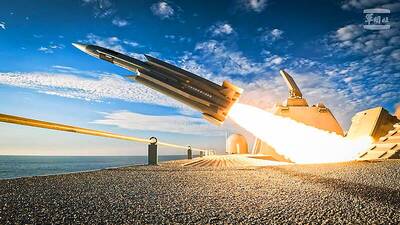
DETERRENCE: With 1,000 indigenous Hsiung Feng II and III missiles and 400 Harpoon missiles, the nation would boast the highest anti-ship missile density in the world With Taiwan wrapping up mass production of Hsiung Feng II and III missiles by December and an influx of Harpoon missiles from the US, Taiwan would have the highest density of anti-ship missiles in the world, a source said yesterday. Taiwan is to wrap up mass production of the indigenous anti-ship missiles by the end of year, as the Chungshan Institute of Science and Technology has been meeting production targets ahead of schedule, a defense official with knowledge of the matter said. Combined with the 400 Harpoon anti-ship missiles Taiwan expects to receive from the US by 2028, the nation would have

North Korea yesterday fired about 10 ballistic missiles to the sea toward Japan, the South Korean Joint Chiefs of Staff (JCS) said, days after Pyongyang warned of “terrible consequences” over ongoing South Korea-US military drills. Pyongyang recently dashed hopes of a diplomatic thaw with Seoul, Washington’s security ally, describing its latest peace efforts as a “clumsy, deceptive farce.” Seoul’s military detected “around 10 ballistic missiles launched from the Sunan area in North Korea toward the East Sea [Sea of Japan] at around 1:20pm,” JCS said in a statement, referring to South Korea’s name for the body of water. The missiles

‘UNWAVERING FRIENDSHIP’: A representative of a Japanese group that co-organized a memorial, said he hopes Japanese never forget Taiwan’s kindness President William Lai (賴清德) yesterday marked the 15th anniversary of the Tohoku earthquake and tsunami, urging continued cooperation between Taiwan and Japan on disaster prevention and humanitarian assistance. Lai wrote on social media that Taiwan and Japan have always helped each other in the aftermath of major disasters. The magnitude 9 earthquake struck northeastern Japan on March 11, 2011, triggering a massive tsunami that claimed more than 19,000 lives, according to data from Japanese authorities. Following the disaster, Taiwan donated more than US$240 million in aid, making it one of the largest contributors of financial assistance to Japan. In addition to cash donations and
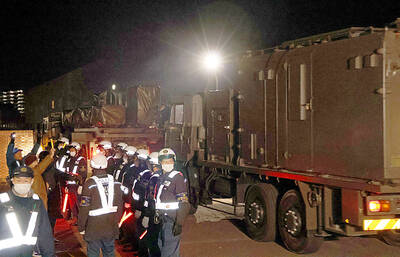
CLOSER TO CHINA: The upgraded Type-12 missile has a range of about 1,000km, compared with the original model’s range of 200km, and can reach mainland China Japan is preparing to deploy its first batch of domestically developed long-range missiles, with their launchers arriving at an army camp yesterday, as the country accelerates its offensive capability in response to rising challenges in the region. The upgraded Type-12 land-to-ship missiles are to be deployed at Camp Kengun in Japan’s southwestern prefecture of Kumamoto by the end of this month, completing the process of deployment, Japanese Chief Cabinet Secretary Minoru Kihara said without giving details. Army vehicles carrying the launchers and other equipment arrived past midnight in a highly secretive mission criticized by residents. Dozens of people stood outside of the


 RSS
RSS