


The three high-ranking officials at the center of the Papua New Guinea diplomatic fund scandal resigned yesterday after prosecutors raided their homes and offices in the search for clues to what happened to the missing US$30 million.
Premier Chang Chun-hsiung (張俊雄) approved the resignations of Vice Premier Chiou I-jen (邱義仁) and Minister of Foreign Affairs James Huang (黃志芳) at 2pm, Executive Yuan Spokesman Shieh Jhy-wey (謝志偉) said. Deputy Minister of National Defense Ko Cheng-heng (柯承亨) announced his resignation at 3:30pm.
Huang apologized to the nation for the blunder but maintained his innocence as he announced his resignation.
“I had planned to step down immediately after the scandal broke, but I felt obligated to assist the prosecutors in the probe. Last night, I decided it was the right time to step down after I turned over all the evidence to the authorities,” Huang said.
He said that throughout his political career his main goal had been to safeguard Taiwan’s national interests and dignity.
Huang’s resignation came as a surprise because up until Monday he had insisted “he could not step down because he had important matters to take care of.”
Since the scandal broke last Thursday, Huang had said that he had stopped the fraud from moving forward because he had refused to sign a communique and that he played no part in helping the missing broker.
He said he believed the judicial system would clear his name and those of his colleagues in the Ministry of Foreign Affairs (MOFA) who have been named as possible players in the scandal.
Huang is the third foreign minister to step down during the Democratic Progressive Party (DPP) administration. The others resigned after Taipei lost diplomatic allies to China.
The 50-year-old Huang was the youngest person in Taiwan’s history to serve as foreign minister. During his term, Taiwan lost allies Costa Rica and Malawi to Beijing, but gained the recognition of St. Lucia.
Deputy Minister of Foreign Affairs Yang Tzu-pao (楊子葆) will serve as the acting minister until May 19, the day before the new government takes office.
Chiou, meanwhile, told reporters at the Government Information Office (GIO) that he had resigned “to facilitate the judicial investigation in the hope that it can clear up the matter as soon as possible and prove my innocence.”
Chiou had previously refused to step down, saying that it would be hypocritical because the Cabinet is set to resign next Wednesday. His about-face came after he was listed as a witness on Monday.
“As a political appointee, it’s inappropriate for me to stay in my job when listed as a defendant and not a witness, even though it is still meaningless to resign when there are only 10 more days [left under the DPP administration],” he said.
The diplomatic scandal snowballed when sources revealed on Monday that Chiou and Huang were among a group of seven individuals who may have received kickbacks ranging from between US$400,000 to US$2 million from the funds earmarked for establishing relations with Papua New Guinea in 2006.
“I have confidence that I am innocent because I didn’t receive a cent. I will fully cooperate with the investigation,” Chiou said.
He reiterated that he would shoulder full responsibility for the matter, politically and judicially, because he had “introduced Ching to Huang and I didn’t check Ching’s security background beforehand.”
But Chiou said he couldn’t afford to take “executive responsibility.”
“I do not know all the details of how Huang handled the matter. For example, I had no idea why the foreign ministry didn’t have one of its officials join the joint account owned by Ching and Wu. That was a decision made solely by the ministry,” Chiou said.
Prosecutors raided the residences and offices of Huang, Chiou and Ko early yesterday morning, seizing a number of documents. Prosecutor Huang Mo-hsin (黃謀信) led seven prosecutors and more than 20 assistants in the searches.
James Huang’s office at the foreign ministry and his home were searched, as were Ko’s office at the Ministry of National Defense, his official residence and home, and Chiou’s office at the Executive Yuan along with his official residence and home in Sijhih, Taipei County.
The premier announced the raids later in the day.
“The Cabinet has been very cooperative during the investigation and will not cover up any irregularities or wrongdoing,” he said.
Shieh said prosecutors did not take anything away with them after finishing a one-hour search of Chiou’s computer, office and documents.
Prosecutors said that they didn’t find evidence of irregularities in connection with the case, Deputy Cabinet Secretary General Chen Mei-ling (陳美伶) said.
At the press conference held to announce his resignation in the afternoon, Chiou denied a report in yesterday’s Chinese-language United Evening News which said that prosecutors had found “crucial evidence” of his “deep involvement” in the case at his residence.
The paper said prosecutors thought that Chiou was in the loop regarding the process of negotiation with Papua New Guinea via a cellphone SIM card they found in his study. Chiou regularly reported the process of negotiation to someone by sending text messages and there was other evidence showing that Chiou arranged meetings with Ching, Wu and Papuan officials, the paper said.
“The report was absolutely not true, as I don’t know how to use text messaging,” Chiou said.
He had said previously that he was not aware of details of the negotiation.
Meanwhile, foreign ministry spokeswoman Phoebe Yeh (葉非比) said five investigators arrived at James Huang’s residence in Taipei around 7am and did not take any documents with them after the search.
She said Huang had not answered the door for half an hour after the investigator arrived because the family thought the female investigator was a journalist.
Yeh also confirmed that investigators came to the ministry to search Huang’s office and took “a small stack” of documents. She did not elaborate on the nature of the documents.
Prosecutors arrived at the Ministry of National Defense with a warrant to search Ko’s office at 9am. Minister of National Defense Michael Tsai (蔡明憲) cooperated with prosecutors but said he believed in Ko’s innocence.
In related news, Criminal Investigation Bureau Deputy Commissioner Kao Cheng-sheng (高政昇) confirmed yesterday that Ching Chi-ju (金紀玖), one of the brokers believed to have been involved in the deal, was in the US.
Kao said Ching entered the US on May 2. He said police want to stop Ching from fleeing to another country and hoped to bring him for questioning. Ching has been placed on the International Criminal Police Organization’s (Interpol) “Red Notice” at the government’s request, he said.
A Red Notice is a notice to police agencies worldwide that a person is wanted, and requests Interpol members to help locate wanted individuals for arrest and extradition.
The Taipei District Court held a hearing yesterday evening to decide whether or not to detain Wu Shih-tsai (吳思材), another key player in the scandal.
Prosecutors made a request to the Taipei District Court on April 25 to detain Wu after interviewing him, but the court turned down the request, citing insufficient evidence. The Taipei District Prosecutors’ Office immediately appealed to the Taiwan High Court, requesting it return the case to the Taipei District Court for reconsideration.
The Taiwan High Court ruled yesterday that the district court must reconsider the case.
The DPP legislative caucus yesterday urged the public to help law enforcement officers locate and arrest Ching.
“It is about the national interest and concerns everybody,” DPP whip William Lai (賴清德) told a press conference at the caucus office yesterday morning.
While KMT Legislator Chiu Yi (邱毅) said that Ching was a friend of a friend and that he would meet Ching sometime next week, possibly in Shanghai, Lai said that Chiu is supposed to help the government since he is a lawmaker.
“It is not time for [Chiu] to play hero,” Lai said. “Our priority is to find [Ching] and get the stolen money back.”
DPP whip Ker Chien-ming (柯建銘) said that the scandal had seriously harmed the DPP and the damage would not be repaired easily. He said he believed that President Chen Shui-bian (陳水扁) was not directly involved.
The two brokers, Ching and Wu, were two notorious liars and thieves and two of his friends have also had money stolen by the pair, he said.
“Honestly, I have no idea how officials could pay the money without double checking,” Ker said.
Meanwhile, the legislature’s Procedure Committee agreed to include a proposal from the KMT caucus to require Premier Chang and other Cabinet officials to report to the legislature on how the Cabinet intends to deal with the scandal. The proposal was placed on the agenda for Friday’s plenary session.
KMT caucus acting secretary-general Hsieh Kuo-liang (謝國樑) said Chang should explain the matter to the legislature on behalf of Chiou.
“This is the only way the Democratic Progressive Party government can apologize to the public in its remaining days in office,” he said.
ADDITIONAL REPORTING BY FLORA WANG

‘NO SECURITY RISK’: The Railway Bureau reassured the public that the technicians’ activities were limited to technical guidance and did not involve sensitive systems The Railway Bureau yesterday said it had invited eight Chinese technicians to assist with an airport MRT construction project. The bureau issued the confirmation after an Internet user said Chinese nationals had entered the construction zone of Taiwan Taoyuan International Airport’s Terminal 3 project. They asked why “individuals from an enemy state” were allowed access to such a major national infrastructure project, which raised serious concerns over Taiwan’s industrial safety, sensitive systems and information security. The bureau’s Northern Region Engineering Branch Office said subcontractor Taiwan Handle Industrial Co (台灣手把工業) of the Taoyuan airport MRT’s “Contract No. CU05 Project A14 Station Civil, MEP &

The National Chungshan Institute of Science and Technology yesterday showcased its locally developed variants of the Vision 60 robotic patrol dog, which it plans to deploy on the nation’s outlying territories in the South China Sea. The variants were produced under the Joint Lab project — created by the institute and domestic companies — and assembled with domestically produced motors, lenses and artificial intelligence (AI) systems alongside licensed tech from the US, Missile and Rocket Systems Research Division deputy director Jen Kuo-kang (任國光) told the media event at a military base in Taipei’s Dazhi (大直) area. Taiwan has built up its strengths

NOT IMMEDIATE: Taiwan has a chance to appeal the proposed 10 percent tariff before it starts, while other countries face a 12.5 percent tariff from the trade office Taiwan is among 60 economies determined by the US to have failed to impose or enforce a ban on the importation of goods produced with forced labor, according to a notice released on Tuesday by the Office of the US Trade Representative (USTR), which proposed imposing an additional 10 percent or more tariff on them. The USTR in a statement said that following an investigation, it had determined under Section 301 of the Trade Act of 1974 that the failure of the 60 economies to impose and effectively enforce a prohibition on the importation of goods produced with forced labor is
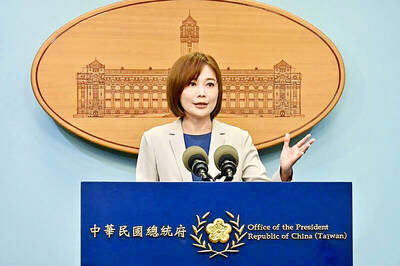
TIT-FOR-TAT: The US allegedly revoked the visa of a Chinese national working at Xinhua News Agency in the US in response to Beijing’s expulsion of Vivian Wang The Presidential Office yesterday condemned China for expelling a New York Times correspondent from Beijing following the newspaper’s interview with President William Lai (賴清德), saying the move highlighted Beijing’s suppression of press freedom and its threat to international news media. Taiwan has noted a series of recent incidents in which Beijing used similar tactics to “threaten and pressure international media outlets and journalists,” Presidential Office spokeswoman Karen Kuo (郭雅慧) said in a statement. “This concerns not only press freedom and freedom of expression, but also the safety of journalists, and Taiwan and relevant partners are paying close attention to the situation,” she


 RSS
RSS