


Protesters waved Chinese flags and shouted slogans outside Carrefour stores in Beijing and other cities yesterday, venting anger over the disruption of the Olympic torch relay. No violence was reported and police dispersed the gatherings.
The French retailer has borne much of the nationalistic backlash after a pro-Tibet protester in Paris tried to grab the Olympic torch from a Chinese athlete in a wheelchair. Chinese Web sites have accused Carrefour of supporting the exiled Tibetan leader the Dalai Lama, but the company denied that.
In Beijing, a handful of protesters at a Carrefour in the Haidian university district were outnumbered by dozens of police who guarded the store, which was packed with shoppers. Police detained seven men and two women. One of the men carried a sign saying “Protest Carrefour, Protest CNN” as about 200 spectators cheered. US-based CNN has been a focus of complaints that foreign news coverage of China’s crackdown on Tibet is biased.
“We want to let all foreigners know that China is very angry today. We have to let Chinese people in China know that we are united,” a protester said as he was led to a police van.
Protesters also carried banners and chanted slogans at Carrefour stores in Changsha in central China, Fuzhou in the southeast, Chongqing in the southwest and Shenyang in the northeast, the government’s Xinhua news agency reported. It said hundreds of people demonstrated in Changsha and 400 were on hand in Fuzhou, but it gave no other details.
The protests occurred despite Beijing’s efforts to discourage them and to calm anti-French sentiment.
Calls for boycotts of foreign companies have been deleted from Web sites.
A top figure in the ruling Communist Party, Jia Qinglin (賈慶林), on Wednesday called for Chinese to channel their “patriotic passion” into holding a successful Beijing Olympics in August.
Carrefour outlets in a dozen cities were the target of earlier protests, with scuffles erupting between Chinese and foreigners.
Paris-based Carrefour is China’s biggest retailer, with 112 outlets in areas throughout the country.
Phone calls to Carrefour officials yesterday were not answered.
At a Carrefour on Beijing’s east side yesterday, there was no sign of protests and the store was packed with shoppers.
One woman said she came to see whether there would be protests and stayed to shop.
“I heard about it, but didn’t think it would happen,” said the woman, who would give only her surname, Liu. “And since I was here, I figured I would pick up some things.”
Meanwhile, US actress and activist Mia Farrow yesterday touched down in Hong Kong, promising not to disturb the Olympic torch relay as she campaigns over Darfur and China’s links to the Sudan government.
Amid fears over freedom of speech ahead of today’s leg of the relay — which has been dogged by protests on its worldwide journey — Farrow said she had been questioned briefly by officials on her arrival.
“They were very polite and very nice,” she told reporters at Hong Kong airport. “They wanted some assurance that we are not here to disrupt the torch relay, which of course we are not.”
Today’s relay is expected to offer a last chance for pro-Tibet protesters and critics of China’s rights record to target the torch before it passes from the relatively open former British colony to the more restrictive mainland.
Farrow has been pushing China to help stop violence in Sudan’s conflict-riven Darfur region, and is expected to deliver an address in Hong Kong today entitled “Darfur and the Olympics.”
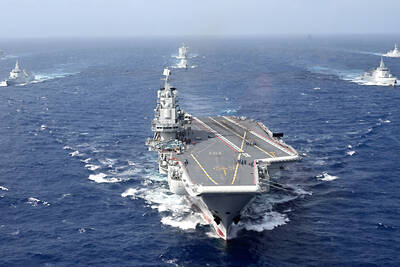
PROVOCATIVE: Chinese Deputy Ambassador to the UN Sun Lei accused Japan of sending military vessels to deliberately provoke tensions in the Taiwan Strait China denounced remarks by Japan and the EU about the South China Sea at a UN Security Council meeting on Monday, and accused Tokyo of provocative behavior in the Taiwan Strait and planning military expansion. Ayano Kunimitsu, a Japanese vice foreign minister, told the Council meeting on maritime security that Tokyo was seriously concerned about the situation in the East China and South China seas, and reiterated Japan’s opposition to any attempt to change the “status quo” by force, and obstruction of freedom of navigation and overflight. Stavros Lambrinidis, head of the EU delegation to the UN, also highlighted South China Sea
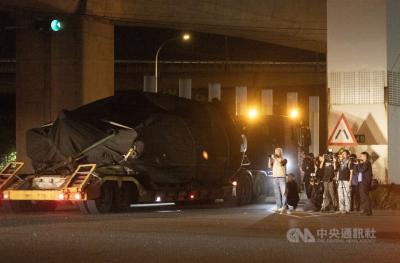
The final batch of 28 M1A2T Abrams tanks purchased from the US arrived at Taipei Port last night and were transported to the Armor Training Command in Hsinchu County’s Hukou Township (湖口), completing the military’s multi-year procurement of 108 of the tanks. Starting at 12:10am today, reporters observed more than a dozen civilian flatbed trailers departing from Taipei Port, each carrying an M1A2T tank covered with black waterproof tarps. Escorted by military vehicles, the convoy traveled via the West Coast Expressway to the Armor Training Command, with police implementing traffic control. The army operates about 1,000 tanks, including CM-11 Brave Tiger
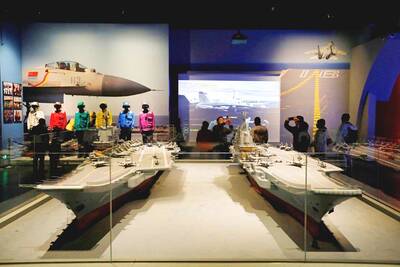
China on Wednesday teased in a video an aircraft carrier that could be its fourth, and the first using nuclear power, while making an allusion to Taiwan and vowing to further build up its islands, as it looks to boost maritime power, secure resources and bolster territorial claims. The video, issued on the eve of the 77th founding anniversary of the Chinese People’s Liberation Army Navy, featured fictional officers with names that are homophones of three commissioned aircraft carriers, the Liaoning (遼寧), Shandong (山東) and Fujian (福建). Titled Into the Deep, it showed a 19-year-old named “Hejian” (何劍) joining the group, sparking
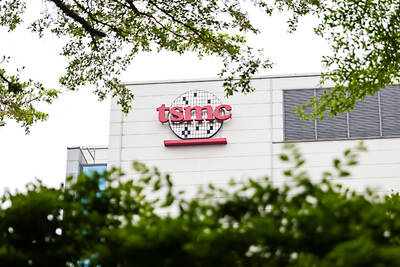
Taiwan Semiconductor Manufacturing Co (TSMC, 台積電), the world’s largest contract chipmaker, said it expects its 2-nanometer (2nm) chip capacity to grow at a compound annual rate of 70 percent from this year to 2028. The projection comes as five fabs begin volume production of 2-nanometer chips this year — two in Hsinchu and three in Kaohsiung — TSMC senior vice president and deputy cochief operating officer Cliff Hou (侯永清) said at the company’s annual technology symposium in Silicon Valley, California, last week. Output in the first year of 2-nanometer production, which began in the fourth quarter of last year, is expected to


 RSS
RSS