


The Bush administration is proposing a sweeping overhaul of the way the government regulates the nation's financial services industry from banks and securities firms to mortgage brokers and insurance companies.
The plan would give major new powers to the Federal Reserve, a 22-page executive summary obtained by The Associated Press showed.
The Fed would be given broad authority to oversee financial market stability, including powers to examine the books of any institution deemed to represent a potential threat to the proper functioning of the overall financial system.
The proposal, which will be outlined tomorrow in a speech by US Treasury Secretary Henry Paulson, is certain to set off heated debate within different sectors of the financial services industry and in Congress, where some Democrats are likely to complain that the proposal does not go far enough to crack down on abuses.
The recommendations are the product of a yearlong review that was begun in an effort to modernize the government's regulatory structure so that the country's financial services industries could better compete in a fast-changing global economy.
The plan also seeks to address problems that have been brought to light in recent months since a severe credit crisis began roiling financial markets last August.
That crisis has already claimed as its biggest victim Bear Stearns, the nation's fifth-largest investment bank, which came to the brink of collapse before its purchase by JP Morgan Chase & Co.
"I am not suggesting that more regulation is the answer, or even that more effective regulation can prevent the periods of financial market stress that seem to occur every five to 10 years," Paulson will say in his remarks.
But the plan does seek to address problems highlighted by the current crisis, in which the Fed in an unprecedented move has begun making direct loans to securities firms in an effort to shore up a system badly shaken sour mortgage loans.
The proposal would allow the Fed, in its new role as "market stability regulator," to dispatch examiners to check the books of all segments of the financial services industry.
The administration proposal would also consolidate bank regulation by shutting down the Office of Thrift Supervision and transferring its functions to the Office of the Comptroller of the Currency, which regulates nationally chartered banks.
The role that Federal Reserve Chairman Ben Bernanke and his colleagues have been playing to shore up the financial system would be formalized by giving Fed officials greater power to detect where threats might be lurking.
Senator Charles Schumer, a New York Democrat, said he believed Paulson's plan offered some valid suggestions.
"In broad outlines, we agree with large parts of Secretary Paulson's plan," Schumer, chairman of the Joint Economic Committee, said in a statement.
"He is on the money when he calls for a more unified regulatory structure," he said.
Under Paulson's approach, the long-term goal would be to designate the Fed as market stability regulator and to have a financial regulator that would focus on financial institutions that operate with government guarantees.

‘NO SECURITY RISK’: The Railway Bureau reassured the public that the technicians’ activities were limited to technical guidance and did not involve sensitive systems The Railway Bureau yesterday said it had invited eight Chinese technicians to assist with an airport MRT construction project. The bureau issued the confirmation after an Internet user said Chinese nationals had entered the construction zone of Taiwan Taoyuan International Airport’s Terminal 3 project. They asked why “individuals from an enemy state” were allowed access to such a major national infrastructure project, which raised serious concerns over Taiwan’s industrial safety, sensitive systems and information security. The bureau’s Northern Region Engineering Branch Office said subcontractor Taiwan Handle Industrial Co (台灣手把工業) of the Taoyuan airport MRT’s “Contract No. CU05 Project A14 Station Civil, MEP &

The National Chungshan Institute of Science and Technology yesterday showcased its locally developed variants of the Vision 60 robotic patrol dog, which it plans to deploy on the nation’s outlying territories in the South China Sea. The variants were produced under the Joint Lab project — created by the institute and domestic companies — and assembled with domestically produced motors, lenses and artificial intelligence (AI) systems alongside licensed tech from the US, Missile and Rocket Systems Research Division deputy director Jen Kuo-kang (任國光) told the media event at a military base in Taipei’s Dazhi (大直) area. Taiwan has built up its strengths

NOT IMMEDIATE: Taiwan has a chance to appeal the proposed 10 percent tariff before it starts, while other countries face a 12.5 percent tariff from the trade office Taiwan is among 60 economies determined by the US to have failed to impose or enforce a ban on the importation of goods produced with forced labor, according to a notice released on Tuesday by the Office of the US Trade Representative (USTR), which proposed imposing an additional 10 percent or more tariff on them. The USTR in a statement said that following an investigation, it had determined under Section 301 of the Trade Act of 1974 that the failure of the 60 economies to impose and effectively enforce a prohibition on the importation of goods produced with forced labor is
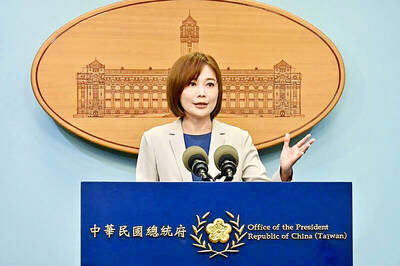
TIT-FOR-TAT: The US allegedly revoked the visa of a Chinese national working at Xinhua News Agency in the US in response to Beijing’s expulsion of Vivian Wang The Presidential Office yesterday condemned China for expelling a New York Times correspondent from Beijing following the newspaper’s interview with President William Lai (賴清德), saying the move highlighted Beijing’s suppression of press freedom and its threat to international news media. Taiwan has noted a series of recent incidents in which Beijing used similar tactics to “threaten and pressure international media outlets and journalists,” Presidential Office spokeswoman Karen Kuo (郭雅慧) said in a statement. “This concerns not only press freedom and freedom of expression, but also the safety of journalists, and Taiwan and relevant partners are paying close attention to the situation,” she


 RSS
RSS