


A powerful coalition of US industries has urged the US government to keep Taiwan on a watch list of countries with serious intellectual property violations, apparently dashing Taipei's hopes that its progress against piracy would earn it better treatment by US trade officials.
The International Intellectual Property Alliance (IPAA), a grouping of 11 major trade associations representing movies, music, software and other copyright material, made its recommendations to the US Trade Representative's office on Monday in an annual report that plays a major role in determining the office's decisions on global rankings that it makes each spring.
The IPAA said Taiwan's piracy ranking should not be eased under the US' "Special 301" law until it passes new legislation, carries out more effective enforcement measures and curbs illegal photocopying on university campuses.
The industry report estimated that copyright piracy in Taiwan cost US industries US$328 million in revenues last year. While this is substantially lower than the annual figures for the early 2000s and the 1990s, it represents a continuation of a virtually horizontal trend line in recent years. Comparisons with 2006 are difficult, however, since some 2006 figures are not available in the IPAA report.
The biggest loss claimed by the IPAA last year was US$202 million in entertainment software, followed by US$104 million in business software.
While Taiwan has taken a wide variety of measures to crack down on piracy of all kinds in recent years, the alliance said the situation is still bad.
Taiwan has been on the Special 301 watch list and more serious Priority Watch List since 2001 and had similar rankings in the 1990s.
The country's continued appearance on the lists, which include nearly 30 other countries, has been a major irritant in bilateral trade relations and has impeded greater progress under the Trade and Investment Framework Agreement between Washington and Taipei, which seeks to negotiate settlements to trade frictions.
As in recent years, the alliance this year zeroed in on Internet piracy as the most critical area for attention by Taiwanese authorities.
"Internet piracy continues as one of Taiwan's most critical piracy problems," the IPAA's nine-page report section on Taiwan said. "While the authorities have made significant efforts to run raids and bring criminal actions against such piracy, including the use of the new, and long-awaited P2P law passed in June 2007, enforcement should be further strengthened."
The P2P, or "peer-to-peer," law aimed to clamp down on illegal file sharing among individuals using the Internet.
"Taiwan should be commended for passing strong legislation to deal with growing P2P piracy," the alliance said.
But it called for new laws to impose liability on Internet service providers (ISPs) who do not clamp down on piracy conducted using their networks."An ISP liability bill that would clarify and extend liability to ISPs for infringements in certain cases, create safe harbors from liability upon expeditious takedown of infringing sites and set out an expeditious notice and takedown mechanism, should be passed this spring," the report said.
The alliance also urged the Ministry of Education once again to clamp down on piracy over the government-owned TANet. Last spring, the IPAA said, the ministry drew up an action plan to deal with the use of TANet for illegal P2P file sharing.
"This plan has yet to be effectively implemented and a government rights holder special task force created under the plan has not met since last August and must meet on a more frequent basis," the IPAA said.
"This implementation must include clear guidance to universities to block access to students engaged in significant illegal file sharing, to inform rights holders of its actions and to cooperate with enforcement authorities," it said.
The IPAA praised Taiwan for its efforts to clamp down on more traditional forms of piracy of physical products.
"Taiwan is to be commended for reducing industrial [factory] OD [optical disc] piracy and retail OD [original design] piracy to very low levels, and for continued reductions in end user piracy of business software," the report said.
However, the report also said that OS piracy had shifted from factory production to illegal "burning" of copyrighted material onto discs.
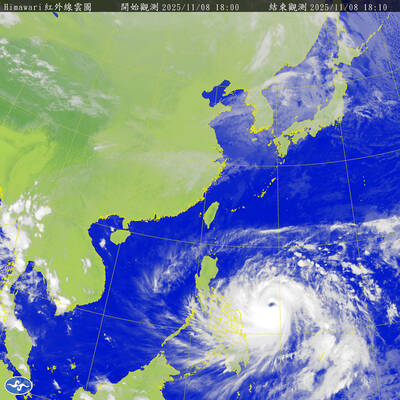
The Central Weather Administration (CWA) yesterday said it expected to issue a sea warning for Typhoon Fung-Wong tomorrow, which it said would possibly make landfall near central Taiwan. As of 2am yesterday, Fung-Wong was about 1,760km southeast of Oluanpi (鵝鑾鼻), Taiwan’s southernmost point, moving west-northwest at 26kph. It is forecast to reach Luzon in the northern Philippines by tomorrow, the CWA said. After entering the South China Sea, Typhoon Fung-Wong is likely to turn northward toward Taiwan, CWA forecaster Chang Chun-yao (張峻堯) said, adding that it would likely make landfall near central Taiwan. The CWA expects to issue a land
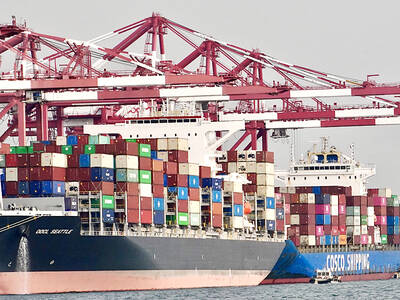
Taiwan’s exports soared to an all-time high of US$61.8 billion last month, surging 49.7 percent from a year earlier, as the global frenzy for artificial intelligence (AI) applications and new consumer electronics powered shipments of high-tech goods, the Ministry of Finance said yesterday. It was the first time exports had exceeded the US$60 billion mark, fueled by the global boom in AI development that has significantly boosted Taiwanese companies across the international supply chain, Department of Statistics Director-General Beatrice Tsai (蔡美娜) told a media briefing. “There is a consensus among major AI players that the upcycle is still in its early stage,”
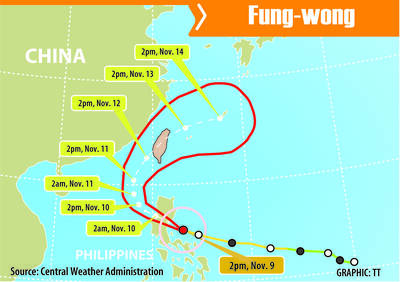
The Central Weather Administration (CWA) yesterday said it is expected to issue a sea warning for Typhoon Fung-wong this afternoon and a land warning tomorrow. As of 1pm, the storm was about 1,070km southeast of Oluanpi (鵝鑾鼻), Taiwan’s southernmost point, and was moving west-northwest at 28 to 32kph, according to CWA data. The storm had a radius of 250km, with maximum sustained winds of 173kph and gusts reaching 209kph, the CWA added. The storm is forecast to pass near Luzon in the Philippines before entering the South China Sea and potentially turning northward toward Taiwan, the CWA said. CWA forecaster Chang Chun-yao (張峻堯) said

PREPARATION: Ferry lines and flights were canceled ahead of only the second storm to hit the nation in November, while many areas canceled classes and work Authorities yesterday evacuated more than 3,000 people ahead of approaching Tropical Storm Fung-wong, which is expected to make landfall between Kaohsiung and Pingtung County this evening. Fung-wong was yesterday morning downgraded from a typhoon to a tropical storm as it approached the nation’s southwest coast, the Central Weather Administration (CWA) said, as it issued a land alert for the storm. The alert applies to residents in Tainan, Kaohsiung, Pingtung and Taitung counties, and the Hengchun Peninsula (恆春). As of press time last night, Taichung, Tainan, Kaohsiung, and Yilan, Miaoli, Changhua, Yunlin, Pingtung and Penghu counties, as well as Chiayi city and county had


 RSS
RSS