


Following protests from Aboriginal groups, Chinese Nationalist Party (KMT) presidential candidate Ma Ying-jeou (馬英九) yesterday afternoon apologized for recent remarks he had made about Aborigines.
He said that he had not meant to humiliate indigenous people.
At issue was remarks Ma made at a campaign event on Dec. 8 in Sindian City (
The Amis community in Sindian is facing relocation by the Taipei County Government since their houses are built on a flood plain.
"No one should live where there is a danger of flooding. If you continue to live there, you will have problems," Ma told Saoma.
However, what Ma said next has drawn outraged reactions from Aboriginal communities.
"When you come into our city, you become one of us ... I [will] see you as a human being, as a citizen. I will educate you well, and give you opportunities," Ma said. "Aborigines should adjust their mentality -- if you come into the city, you have to play by our rules."
Ma said yesterday he had meant to say that the general public should take care of indigenous people and not discriminate against them if they move to the city.
When first approached by reporters for comment earlier in the day, Ma said he was "willing to apologize if my remarks made some people uncomfortable."
The absence of an apology enraged Council of Indigenous Peoples Minister Icyang Parod, who held a press conference yesterday morning at which he condemned Ma for his comments and urged him to apologize.
"We Aborigines of all 13 tribes find Ma's statement unacceptable," Icyang said.
"Ma not only refused to admit his mistake, but said people have `taken his words out of context.' Today, he said he would be willing to apologize if some people felt uncomfortable about his words," Icyang said. "We are here to condemn Ma's ignorance of Aboriginal peoples and his arrogant and prejudiced statement."
"We'd also like to tell him that [his remarks] did not just make some people feel `uncomfortable,' but also angered all 480,000 Aborigines in the country," he said.
Icyang also protested against a comment Ma had made on several occasions to the effect that "Aborigines are not genetically disadvantaged, they just don't have opportunities."
The statement was printed on Ma's campaign flyers describing his stance on Aboriginal issues, and Ma also used it during his Dec. 8 visit to Sindian.
"By saying so, Ma keeps telling people that there is a genetic difference between Aborigines and non-Aborigines. This only shows he is a racist at heart," Icyang said. "He should apologize to Aborigines, as well as to Taiwanese society."
Members of several Aboriginal rights groups also staged a demonstration outside of Ma's campaign headquarters yesterday morning.
"Ma should withdraw from the presidential election. We don't need a president like this," Taiwan Aboriginal Society secretary-general Isak Afo told the crowd.
A minor physical clash broke out when demonstrators presented their protest letter to staff members at Ma's campaign headquarters.
Demonstrators were angered when staffers handed out flyers about Ma's campaign statement on Aboriginal policies.
Staffers allegedly also shoved some of the protesters.
Angered campaign staff then yelled at Democratic Progressive Party Legislator Chen Ying (
The two sides were quickly separated by police.
ADDITIONAL REPORTING BY MO YAN-CHIH
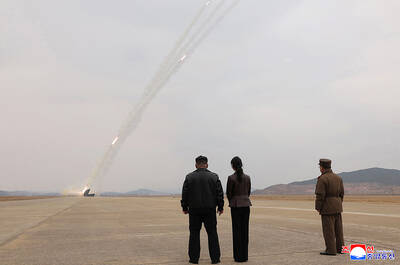
North Korea tested nuclear-capable rocket launchers, state media reported yesterday, a day after Seoul detected the launch of about 10 ballistic missiles. The test comes after South Korean and US forces launched their springtime military drills, due to run until Thursday. North Korean leader Kim Jong-un on Saturday oversaw the testing of the multiple rocket launcher system (MRLS), the Korean Central News Agency (KCNA) said. The test involved 12 600mm-caliber ultra-precision multiple rocket launchers and two artillery companies, it said. Kim said the drill gave Pyongyang’s enemies, within the 420km striking range, a sense of “uneasiness” and “a deep understanding

North Korea yesterday fired about 10 ballistic missiles to the sea toward Japan, the South Korean Joint Chiefs of Staff (JCS) said, days after Pyongyang warned of “terrible consequences” over ongoing South Korea-US military drills. Pyongyang recently dashed hopes of a diplomatic thaw with Seoul, Washington’s security ally, describing its latest peace efforts as a “clumsy, deceptive farce.” Seoul’s military detected “around 10 ballistic missiles launched from the Sunan area in North Korea toward the East Sea [Sea of Japan] at around 1:20pm,” JCS said in a statement, referring to South Korea’s name for the body of water. The missiles

RECOGNITION: Former Fijian prime minister Mahendra Chaudhry said that Taiwan’s New Southbound Policy serves as a stabilizing force in the Indo-Pacific region Taiwan can lead the unification of the Chinese people, Nobel Peace Prize laureate and former Polish president Lech Walesa said in Taipei yesterday, adding that as the world order is changing, peaceful discussion would find good solutions, and that the use of force and coercion would always fail. Walesa made the remarks during his keynote address at a luncheon of the Yushan Forum in Taipei, titled “Indo-Pacific Partnership Prospects: Taiwan’s Values, Technology and Resilience,” organized by the Taiwan-Asia Exchange Foundation with the Ministry of Foreign Affairs. Walesa said that he had been at the forefront of a big peaceful revolution and “if

‘UNWAVERING FRIENDSHIP’: A representative of a Japanese group that co-organized a memorial, said he hopes Japanese never forget Taiwan’s kindness President William Lai (賴清德) yesterday marked the 15th anniversary of the Tohoku earthquake and tsunami, urging continued cooperation between Taiwan and Japan on disaster prevention and humanitarian assistance. Lai wrote on social media that Taiwan and Japan have always helped each other in the aftermath of major disasters. The magnitude 9 earthquake struck northeastern Japan on March 11, 2011, triggering a massive tsunami that claimed more than 19,000 lives, according to data from Japanese authorities. Following the disaster, Taiwan donated more than US$240 million in aid, making it one of the largest contributors of financial assistance to Japan. In addition to cash donations and


 RSS
RSS