

The Cabinet yesterday said it would proceed with the one-step voting system for the legislative elections and two referendums on Jan. 12 and did not rule out replacing defiant local election personnel.
Cabinet Spokesman Shieh Jhy-wey (
He ruled out deploying the military, however.

PHOTO: CHIEN JUNG-FONG, TAIPEI TIMES
"There are many ways to achieve this goal. Relieving election personnel of their posts is one of them," he said. "Taking over election affairs is another. We are in the process of preparing for replacements and replacement personnel are ready [if needed]."
The decision of the Central Election Commission (CEC) to use the one-step voting system was clear, Shieh said.
"We are calling on local governments run by the pan-blue camp to refrain from challenging the law," he said. "We will not allow `one country, two systems' to prevail."
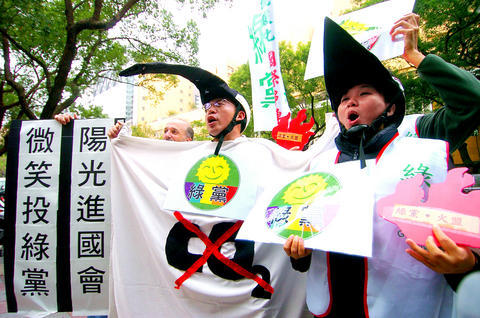
PHOTO: WANG MIN-WEI, TAIPEI TIMES
The CEC adopted the one-step voting system, but the Chinese Nationalist Party (KMT) prefers a two-step voting system in which voters would receive legislative ballots and cast them first before receiving the referendum ballots.
There are tough and soft measures to deal with the problem, Shieh said. The former include legal repercussions, while the latter could involve communicating with local election commissions on the matter.
Shieh emphasized, however, that there would be no room for compromise.
He denied that executive officials would "intimidate" local election personnel, but they would come to understand the consequences of defying the law and the best way of protecting themselves.
The government was confident that law-abiding voters would be well-protected, he said.
If any disturbances did occur, Shieh said, the KMT should be held fully responsible.
Shieh said that Vice Premier Chiou I-jen (
THE TAIPEI WAY
Elsewhere yesterday, Taipei Mayor Hau Lung-bin (
Yeh Chin-yuan (
"According to regulations on local election commissions, the commissioners are guaranteed a three-year term. Although the commissioners were named by the Executive Yuan, it has no right to displace them," Yeh said yesterday at Taipei City Hall.
Yeh said the post of election commissioner is often filled by the deputy mayor rather than the mayor to prevent electoral procedures from being influenced by politics, and that no laws or regulations grant the Executive Yuan the right to remove commissioners.
The CEC has said it will only print out the illustration of the one-step voting procedure for the election, but Samuel Wu (
The KMT caucus also slammed the CEC yesterday, raising fears of electoral fraud if the CEC officially announces the results of next month's legislative elections one week after the poll.
KMT caucus whip Kuo Su-chun (
"[CEC Secretary-General] Teng Tien-yu (
"If the CEC really enjoys the authority to decide who wins the elections one week after the elections, why would we still need to hold elections? The CEC could just designate [the legislators] they prefer," she said.
DPP Secretary-General Cho Jung-tai (
Finalizing election results within seven days of the election has always been mandated by the Election and Recall Law of Civil Servants (
At CEC headquarters, representatives from smaller political parties yesterday used the drawing of the order for parties listed on the legislator-at-large ticket to complain that the commission had treated them unfairly.
Legislator-at-large candidates from the New Party -- including current KMT Legislator Joanna Lei (雷倩), who changed parties after failing to secure KMT support for this poll -- the Home Party, the Taiwan Farmers Party, the Taiwan Solidarity Union (TSU), the Third Society Party and the Hakka Party said that the current version of a CEC poster explaining the new "single district, two vote" system only listed the DPP, the KMT, the People First Party, the TSU and the Non-Partisan Solidarity Union (NPSU).
Teng promised to print a new poster with the names and numbers of every party on the ballot.
In the new system, only one lawmaker will be elected from geographical districts.
But voters will cast a second ballot for a political party. The parties will then have extra legislators elected based on the proportion of the vote received.
In yesterday's draw, the Civil Party was listed first on the ballot, the Alliance for a New Constitution was second, the TSU third, the Third Society Party fourth, the DPP fifth, the New Party sixth, Green Party Taiwan seventh, the Taiwan Farmers Party eighth, the NPSU ninth, the KMT 10th, the Home Party 11th and the Hakka Party 12th.
Elsewhere, former DPP chairman Lin I-hsiung (林義雄) yesterday urged the public to vote in favor of the two referendums that seek UN membership for Taiwan during the presidential election in March.
Although local parties have different proposals, Taiwanese must tell the world that they are unanimous in wanting to join the UN, Lin said.
Lin said he was baffled by opposition to the UN referendum in Washington and Beijing.
The process would only help Beijing better understand the demands of Taiwanese people, he said.
Additional reporting by Mo Yan-chih and Flora Wang
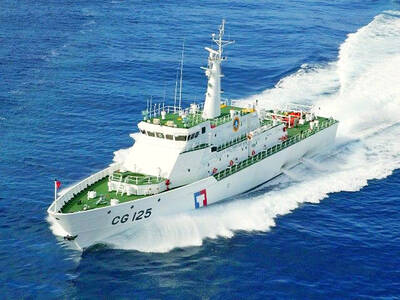
GEOPOLITICAL SIGNIFICANCE: The CGA’s nonmilitary role makes it a tool to avert diplomatic issues, an official said, while confirming the donation of a ship to Manila Coast Guard Administration (CGA) ships are scheduled to sail to the Philippines bearing the words “Taiwan Coast Guard” in a high-profile visit in October next year, the first such visit by a Taiwanese maritime law enforcement vessel to the Southeast Asian nation, the agency said yesterday. The CGA also confirmed that it had donated one of its decommissioned patrol vessels to the Philippines in a rare transfer of a retired ship to a nondiplomatic ally. The Republic of China (ROC) Navy last made such a visit in 1974, shortly before the Philippines switched diplomatic recognition to the People’s Republic of China in

‘GLOBAL WARNING’: The infiltration is not just a local problem, as Beijing has been deploying the same tactics worldwide against Western democracies, a report said Between 50,000 and 100,000 Chinese spies are operating in Taiwan, far more than the National Security Bureau’s previous estimate of 5,000, German journalist and author Jurgen Kremb said on Monday. Kremb presented his research, titled “The War of Spies: How China’s Intelligence Services Are Infiltrating Taiwan — and What Europe Must Learn from It,” at a joint event held by the Taiwan offices of the Friedrich Naumann Foundation and the European Values Center for Security Policy. The report was published in June in the Ministry of Justice Investigation Bureau’s Prospect & Exploration Monthly (展望與探索月刊). By spies, he said he was referring to informants,
CALL FOR CHANGE: They urged the UN to facilitate Taiwan’s involvement in the body, recognize its peace efforts and to work with members in preventing military conflict Representatives to the UN from five of Taiwan’s diplomatic allies sent a joint letter to UN Secretary-General Antonio Guterres on Friday, calling for the country’s inclusion in the body. Allies in the letter sent ahead of the 81st session of the UN General Assembly General Debate made three demands in support of Taiwan: inclusion, recognition and camaraderie. They implored the UN to seek an appropriate way to facilitate Taiwan’s meaningful involvement in the world governing body, saying that UN Resolution 2758, which accepted the People’s Republic of China (PRC) as a member of the UN, does not exclude Taiwan. Beijing claims that the
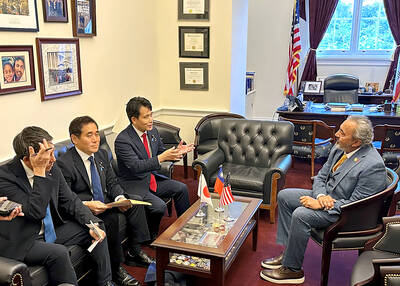
WASHINGTON MEETING: Japan’s Hirofumi Takinami said participants rejected the idea that the US should limit its defensive perimeter to the Second Island Chain US and Japanese lawmakers agree that the US must defend the First Island Chain, including Taiwan, and should not fall back to the Second Island Chain, while “a Taiwan contingency is a Japan contingency and therefore a US-Japan alliance contingency,” media reported after a meeting between officials of the two nations in Washington on Tuesday. A delegation of Japanese lawmakers from the Liberal Democratic Party met with US Senator Thom Tillis, co-chair of the Senate Taiwan Caucus, and US Representative Ami Bera, co-chair of the US Congressional Taiwan caucus, to discuss issues concerning East Asia and the Taiwan Strait. The Japanese and


 RSS
RSS