


American Institute in Taiwan (AIT) Chairman Raymond Burghardt said yesterday that the US would take the pledge President Chen Shui-bian (
"I was reassured by President Chen's remarks, in which he stressed that he would not go back on his commitments to the `four noes,' that the referendum does not represent a step toward de jure independence, and that if it passes, it won't have significance beyond the words of the referendum itself. I think those are all important reassurances," Burghardt said.
The AIT chief -- who had a two-hour meeting with Chen on Monday -- made the remarks yesterday at a press conference that wrapped up a four-day trip in Taipei.
He said his visit was to "emphasize the US view concerning the stability of the Taiwan Strait," referring to "tensions" across the Strait raised by the government-backed referendum on a UN bid under the name "Taiwan."
Despite intensive communications, there has been no closing of the divide between Taiwan and the US on the issue.
The Democratic Progressive Party (DPP)-proposed referendum is scheduled to be held alongside the March 22 presidential election and a KMT-sponsored referendum on returning to the UN as "Republic of China" and using whatever name was appropriate to join other international bodies.
The government has attempted to define the DPP-sponsored referendum as a way for voters to make their voice heard and to decouple it from independence and a change in the cross-strait "status quo."
The US remains concerned over the consequences for cross-strait stability of that referendum if it passes.
Burghardt applauded Chen's "reassurances" yesterday, but said "there is a lot of time between now and May and between the day after May for people to make expensive and elaborate statements on what the [DPP's] referendum means."
"People have to be very careful about statements and reactions [in relation to] the [DPP's] UN referendum, not only before, during the election, but also after the election," he said.
Burghardt said there is no question that cross-strait tensions have been raised not only because of the DPP-sponsored referendum itself but also by comments made by political figures.
While the US told Chen that what he has said and done concerning that referendum could "harm the new president's ability to get off on the right foot," it had "relayed the same message to Beijing," Burghardt said. "We said to Beijing, `Wait. There is going to be a new president [in Taiwan]. Don't overreact. Don't do stupid things' ... It's important to keep tensions under control."
Burghardt also met DPP presidential candidate Frank Hsieh (謝長廷) and his Chinese Nationalist Party (KMT) rival Ma Ying-jeou (馬英九) during his trip.
He refused to say how the two candidates had responded to the US' concerns, but said that "the period right after the election would be a period in which prudent statements and actions would be particularly important."
His remarks confirmed comments by local analysts that the goal of his visit was to communicate with Hsieh and Ma about the manner in which they would handle the result of the DPP's UN referendum and its impact on cross-strait relations.
In answer to a question about whether the US was also worried about the situation between March 22 and May 20 when Chen leaves office, Burghardt said: "You are right. We have to keep listening, and we have to keep vigilant on this issue."
"President Chen's reassurances are more important ... because it goes to the heart of this question. The pledge is quite significant, in terms of statements or actions the president might make between March 22 and May 20," he said.
Asked how valuable Chen's reassurance about the "four noes" was, Burghardt said: "Diplomats always try to find something positive."
He dismissed remarks by Chen that the US would realize that its "one China" policy was wrong if the DPP-sponsored referendum were passed, saying: "Obviously it is not going to happen."
He said the US was not going to change its Taiwan policy of three decades and seven US administrations, which is based on the three communiques and the Taiwan Relations Act.
Approached by reporters later for a comment, Minister of Foreign Affairs James Huang (
The Presidential Office said Burghardt's comments yesterday were aimed at telling China to restrain itself and thwarting Taiwan's referendum seeking UN membership.
Presidential Office Spokesman David Lee (
An official at the Presidential Office, who spoke on condition of anonymity, said that Burdhardt's remarks yesterday were a message to Beijing that China must exercise self-restraint because the US government would take care of the matter.
The US was also hoping to make its disapproval clear to Taiwanese voters and media in the hopes that the referendum would receive a lower approval rate, the official said.
Chen has made it clear that the purpose of the DPP's UN referendum was to consolidate unity and consensus, not to change the "status quo" or to change the country's name, the official said.
In related news, Ma confirmed he had met Burghardt yesterday.
Approached by reporters while campaigning in Taoyuan, Ma said Burghardt had expressed his concerns about the government-backed referendum.
"He was very worried that this issue could have a negative impact on cross-strait relations and US-Taiwan relations," Ma said.
He said Burghardt was also concerned that the Central Election Commission's decision to adopt a one-step voting process would lead to passage of the referendum.
Ma said he told Burghardt that the KMT's attitude on the issue was "consistent" and that "the KMT was a peacemaker, not a troublemaker."
He said he also told Burghardt that the KMT would not unilaterally change the cross-strait "status quo."
"I told him clearly that I will not negotiate the issue of unification with China during my presidential term if elected, nor would I endorse Taiwan's independence," Ma said, adding that he had told the envoy "we will not resolve cross-strait issues through non-peaceful means."
Meanwhile in the legislature, KMT Legislator Joanna Lei (雷倩) said that Burghardt's visit and US Deputy Assistant Secretary of State for East Asian and Pacific Affairs Thomas Christensen's comments against the DPP-proposed referendum represented Washington's "most formal and serious concerns" about the UN plebiscite.
"I want to remind [the government] again that the real meaning of `status quo' does not refer to the maintenance of a party's regime, but to the 60 years of peace across the Taiwan Strait despite the so-called `hostility' of the two sides toward one other," she said.
While the DPP's UN referendum did not seem "dangerous," it could endanger Taiwan's stability and regional peace "to some extent, under the manipulation of the DPP," she said.
"Therefore, Burghardt's warning should be considered a warning to all Taiwanese people instead of to Chen Shui-bian alone," Lei said.
She also said Chen might not have really been truthful when he told Burghardt on Monday that he would keep his promises to the US.

‘NO SECURITY RISK’: The Railway Bureau reassured the public that the technicians’ activities were limited to technical guidance and did not involve sensitive systems The Railway Bureau yesterday said it had invited eight Chinese technicians to assist with an airport MRT construction project. The bureau issued the confirmation after an Internet user said Chinese nationals had entered the construction zone of Taiwan Taoyuan International Airport’s Terminal 3 project. They asked why “individuals from an enemy state” were allowed access to such a major national infrastructure project, which raised serious concerns over Taiwan’s industrial safety, sensitive systems and information security. The bureau’s Northern Region Engineering Branch Office said subcontractor Taiwan Handle Industrial Co (台灣手把工業) of the Taoyuan airport MRT’s “Contract No. CU05 Project A14 Station Civil, MEP &

A US uncrewed surface vessel (USV) encountered multiple Chinese warships during an autonomous transit of the Taiwan Strait, US defense company Seasats said in a statement on Wednesday. Seasats announced that a Lightfish USV had completed the first autonomous transit of the Taiwan Strait. Over five days, the USV traversed the entire length of the Strait while constantly monitoring surface vessel traffic, the company said. The Lightfish encountered multiple Chinese warships, one of which was a Chinese People’s Liberation Army Navy (PLAN) Type 056 corvette, it said. The Chinese vessels were operating “well within Taiwan’s exclusive economic zone without transmitting their identity via the

Taiwan is still in the process of assessing the possibility of recruiting workers from Eswatini, the Ministry of Foreign Affairs said yesterday, adding that its goal is to help Eswatini upgrade its vocational training centers. If there are plans to recruit workers from Eswatini, safeguarding national security, protecting public health and ensuring the employment rights of Taiwanese would be prerequisites, Department of West Asian and African Affairs Director-General Yen Chia-liang (顏嘉良) told a news conference. Key considerations would also include filling labor shortages in specific industries, and fostering bilateral professional and technical exchanges, he said. Yen was asked about the progress of labor
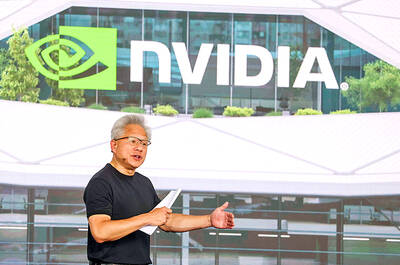
‘BOOMING’: ’ The number of partners we have here is incredible. You can see from their stock prices. They’re doing so well, they’re so happy,’ Jensen Huang said Nvidia Corp’s spending in Taiwan has ballooned to about US$150 billion a year, 10 times the US$10 billion to US$15 billion the company spent five years ago, Nvidia chief executive officer Jensen Huang (黃仁勳) said yesterday, suggesting Taiwan’s strategic importance in the global artificial intelligence (AI) supply chain. “Taiwan is the epicenter of the AI revolution. This is where the chips come, packaging comes. This is where the systems are made. This is where AI supercomputers were created,” Huang said at a meeting for the company’s employees in Beitou-Shilin Technology Park (北投士林科技園區) in Taipei, the planned site of Nvidia’s Taipei headquarters. “Taiwan


 RSS
RSS