


The new inscription on the National Taiwan Democracy Hall's main arch made its debut last night when the final bolt was hammered in at 6:03pm to install the Chinese characters ZIYOU GUANGCHANG (
The Ministry of Education said that installation of the inscription on both sides of the arch, as well as the new name plaque on the main hall, was to be completed before midnight yesterday.
Supporters celebrated with champagne and a lion's dance, while protesters heckled when work on the front side of the arch was finished.
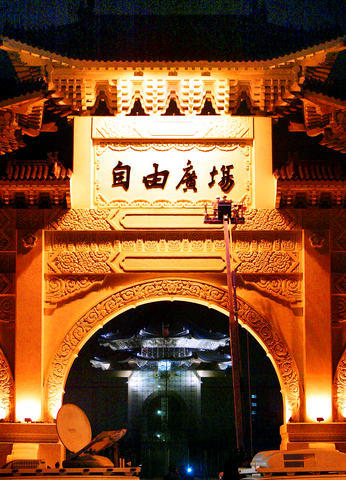
PHOTO: CNA
RESTRAINING ORDER
The ministry said earlier that the new name plaque would not be installed until 10am today as it had to suspend work on the project for 24 hours on Friday when the Taipei City Government's Department of Labor issued a restraining order to halt work on the project, citing safety risks.
The ministry's secretary-general, Chuang Kuo-rong (莊國榮), blamed Taipei Mayor Hau Lung-bin (郝龍斌) for the delay, calling him the instigator of the "blue terror" with his "incessant and illegal interference" in the project.
"It is puzzling why Hau is so obsessed and infatuated with a past dictatorship," Chuang said.
However, work on the project resumed yesterday.
When asked if the ministry plans to pay the NT$1 million (US$31,000) fine that the city's Department of Cultural Affairs imposed on Friday for tampering with the plaque and the inscription without the city's approval, Chuang said the ministry was "not afraid of the city" because it was a "law-abiding" party, while Hau had been a "habitual law breaker."
REOPENING
The plaza, formerly known as the Chiang Kai-shek Memorial Hall, is expected to be reopened to the public at 10am tomorrow after the new marble name tablet is safely installed, Chuang said.
The square has been completely sealed off with a barricade of barbed wires since Thursday to accommodate the construction work.
While the Democratic Progressive Party and its supporters lauded the change as a milestone in the country's democratic development and a symbolic finale to an authoritarian era, the opposition Chinese Nationalist Party (KMT) lambasted the government for ushering in a new "authoritarian regime" that has sacrificed a historic site for political gain.
The debate over the name change of the hall has been a marathon tug-o-war between the city government and the central government since May, when President Chen Shui-bian (
The conflict heightened when the central and the city governments both claimed jurisdiction over the memorial hall. The city government has said it will not stop pursuing legal action against the ministry until it has been brought to justice for vandalizing a historic site.
The name change and the removal of the inscription have been marred by intermittent altercations since construction began three days ago. The most severe clash occurred on Thursday when a pickup truck driver mowed down a group of reporters, leaving ETTV cameraman Wang Jui-chang (王瑞璋) with critical injuries, including multiple lacerations, rib fractures and severe internal hemorrhaging.
The National Taiwan University Hospital said yesterday that Wang would undergo surgery on Monday to repair his shattered rib cage in a bid to stop the bleeding. A Central News Agency report said that Wang was out of critical condition and was able to swallow liquids.
KMT presidential candidate Ma Ying-jeou (馬英九) yesterday condemned the central government for causing ethnic strife by removing the plaque without seeking a public consensus.
"The government's decision does not promote freedom and democracy. It's also not legal," he said.
Ma lashed out at the government for damaging a historic site and ignoring the law by tearing down the original plaque without obtaining the city's approval.
"There is room for discussions in terms of whether or not the plaque should be removed. The government failed to seek a consensus before making the move, and it's a new autarchy," he said.
At a separate setting yesterday, former president Lee Teng-hui (
Lee said everyone should take an optimistic view on the issue of national identity instead of quarrelling over the matter.
The memorial hall controversy was the result of politicians manipulating ethnic issues, he said.
Additional reporting by Mo Yan-chih and Shih Hsiu-chuan

A signaling system malfunction disrupted high-speed rail (HSR) services beginning at 8am today, with trains temporarily reduced to three northbound and three southbound trains per hour as authorities conduct inspections. The malfunction occurred on a section of track in Miaoli County during pre-operation checks early this morning, forcing northbound and southbound trains to use a single track, the HSR operator said. The regular schedule has been replaced with three hourly trains offering only nonreserved seating in each direction, stopping at every station, it said, adding that business class cars would still have reserved seating. Departures from terminal stations are scheduled at the top

DRONE CENTRAL: Taiwan aims to become Asia’s democratic hub for drones, with most exports focused on high-quality military-grade models, an official said Taiwan’s drone industry is expected to expand significantly by 2030, producing 100,000 units per month and exporting half of them, the Ministry of Economic Affairs said yesterday. Current drone production capacity is about 15,000 units per month, but the industry can quickly scale up as demand increases, Industrial Development Administration Director-General Chiou Chyou-huey (邱求慧) told a news conference in Taipei. Taiwan’s drone output grew 2.5-fold last year to NT$12.9 billion (US$408.3 million) under a government program to develop the uncrewed vehicle sector, he said. The Executive Yuan in October last year approved plans to invest NT$44.2 billion into domestic production of uncrewed aerial

VERBOSE VESSELS: A CGA cutter and a China Coast Guard exchanged verbal barbs for more than a day in Taiwanese-controlled waters before the Chinese vessel left The Taiwanese and Chinese coast guards had a standoff near the strategically located Pratas Islands (Dongsha Islands, 東沙群島) in the north of the South China Sea, the Coast Guard Administration (CGA) said yesterday. The two sides engaged in intense radio exchanges over sovereignty claims during the 33-hour standoff. China Coast Guard vessel 3501 eventually left the restricted waters, 26.6 nautical miles (49.2km) west of the Pratas Islands, at 5pm yesterday, the CGA said. Lying approximately between southern Taiwan and Hong Kong, the Taiwan-controlled Pratas are seen by some security experts as vulnerable to Chinese attack due to their distance — more than
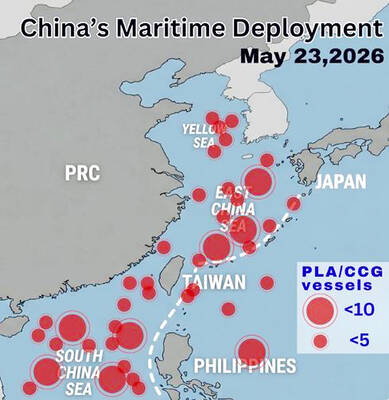
WARNING: China should stop engaging in actions that undermine regional peace and stability, as it would only build resentment among people across the Strait, the CGA said China has deployed more than 100 navy, coast guard and other vessels in waters from the Yellow Sea to the South China Sea and the western Pacific since US President Donald Trump and Chinese President Xi Jinping (習近平) met in Beijing, National Security Council Secretary-General Joseph Wu (吳釗燮) said yesterday. “In this part of the world, #China is the one & only PROBLEM wrecking the #StatusQuo & threatening regional peace & stability,” Wu wrote on X. In a separate post, he said Beijing was coercing Taiwan’s maritime domain, calling it illegal and provocative, after the Coast Guard Administration (CGA) expelled a


 RSS
RSS