


China is too cautious about the lust in Ang Lee's (
The case highlights public dissent about China's censorship system, which doesn't classify films by age-appropriateness. All movies that clear censors are open to everyone.
Dong Yanbin (
The graduate law student at the China University of Political Science and Law is also suing the movie theater where he saw the film, alleging that it denied him his right to information and wants 500 yuan (US$67) for mental anguish and apologies from the theater and SARFT, the Beijing Times said.
"The publicly released version of Lust, Caution is structurally flawed. It fails to portray the psychology of the female lead," Dong was quoted as saying.
Asked about the newspaper report, a man who answered the phone at the publicity office of Beijing's Xicheng courthouse said Dong had filed such a lawsuit but that the court hasn't decided whether to accept the case.
"He has filed the lawsuit, but the court had not created a case yet," the man said, declining to give his name. He said he didn't know the details of the case.
Dong couldn't immediately be reached for comment. Calls to the graduate student office at his university, to a SARFT spokesman and the movie theater, UME Huaxing International Cineplex, went unanswered.
Lust, Caution is about the sexually charged relationship between an undercover student activist and the Japanese-allied intelligence chief in World War II Shanghai. Its explicit nature -- featuring abusive sex and a variety of lovemaking positions -- have earned it adult-only ratings in the US and Asia.
Although the censored version was shown in China, local audiences appeared to be aware of the cuts from media reports.
Despite the cuts, Lust, Caution has quickly become a big hit in China, earning more than 90 million yuan (US$12 million) since opening two weeks ago and generating a huge number of Internet commentaries.
Lee, however, hasn't made a big fuss about the cuts in China.
"It doesn't affect the story or character development because they only involve a few minutes ... The movie will feel much less intense. That's all," he told reporters while promoting the film in Hong Kong recently.

‘NO SECURITY RISK’: The Railway Bureau reassured the public that the technicians’ activities were limited to technical guidance and did not involve sensitive systems The Railway Bureau yesterday said it had invited eight Chinese technicians to assist with an airport MRT construction project. The bureau issued the confirmation after an Internet user said Chinese nationals had entered the construction zone of Taiwan Taoyuan International Airport’s Terminal 3 project. They asked why “individuals from an enemy state” were allowed access to such a major national infrastructure project, which raised serious concerns over Taiwan’s industrial safety, sensitive systems and information security. The bureau’s Northern Region Engineering Branch Office said subcontractor Taiwan Handle Industrial Co (台灣手把工業) of the Taoyuan airport MRT’s “Contract No. CU05 Project A14 Station Civil, MEP &

A US uncrewed surface vessel (USV) encountered multiple Chinese warships during an autonomous transit of the Taiwan Strait, US defense company Seasats said in a statement on Wednesday. Seasats announced that a Lightfish USV had completed the first autonomous transit of the Taiwan Strait. Over five days, the USV traversed the entire length of the Strait while constantly monitoring surface vessel traffic, the company said. The Lightfish encountered multiple Chinese warships, one of which was a Chinese People’s Liberation Army Navy (PLAN) Type 056 corvette, it said. The Chinese vessels were operating “well within Taiwan’s exclusive economic zone without transmitting their identity via the
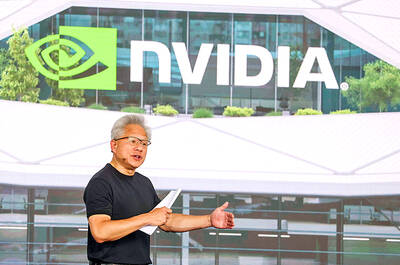
‘BOOMING’: ’ The number of partners we have here is incredible. You can see from their stock prices. They’re doing so well, they’re so happy,’ Jensen Huang said Nvidia Corp’s spending in Taiwan has ballooned to about US$150 billion a year, 10 times the US$10 billion to US$15 billion the company spent five years ago, Nvidia chief executive officer Jensen Huang (黃仁勳) said yesterday, suggesting Taiwan’s strategic importance in the global artificial intelligence (AI) supply chain. “Taiwan is the epicenter of the AI revolution. This is where the chips come, packaging comes. This is where the systems are made. This is where AI supercomputers were created,” Huang said at a meeting for the company’s employees in Beitou-Shilin Technology Park (北投士林科技園區) in Taipei, the planned site of Nvidia’s Taipei headquarters. “Taiwan
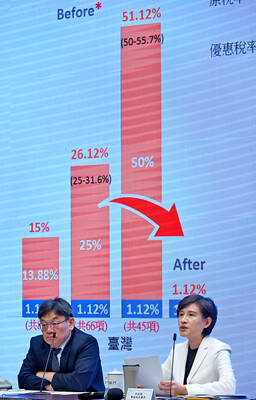
GREATER REACH? Auto parts and wood products would face tariffs of up to 15%, matching those targeting the EU, Japan and South Korea, Vice Premier said The US has announced that preferential tariff treatment for Taiwan’s non-semiconductor Section 232 goods would take effect retroactively from May 1, the Executive Yuan said yesterday. The US government yesterday posted a notice on the Federal Register’s public inspection Web site previewing tariff concessions for Taiwan under a memorandum of understanding (MOU) on Taiwan-US investment after two months of negotiations. The MOU signed on Jan. 15 stipulated three major preferential tariff arrangements: a 15 percent “reciprocal” tariff rate for Taiwan without stacking most-favored nation (MFN) rates; preferential Section 232 treatment for semiconductors and related products; and preferential Section 232 treatment for non-semiconductor


 RSS
RSS