


President Chen Shui-bian (
"It is very clear now that if we were to sign such a peace treaty under the framework of the `one China' principle, then I think this would mean, for the 23 million people of Taiwan, a treaty of surrender," Chen said in a 90-minute interview at the Presidential Office.
The interview was published on Thursday.
On Monday, Hu suggested during his speech at the opening of the Chinese Communist Party Congress in Beijing that China and Taiwan conclude a peace agreement ending the formal state of hostility that has endured since Chiang Kai-shek's (蔣介石) Nationalists lost China's civil war in 1949 and retreated to Taiwan.
But the offer carried a longstanding Chinese condition rejected by most Taiwanese politicians: that negotiations can proceed only under the principle that there is one China, with Taiwan and China representing indivisible components of a single nation ruled from Beijing.
That condition makes it unlikely that Hu's somewhat vague proposal, which included eventual unification of Taiwan with China, could serve as a basis for negotiations.
"Taiwan is an independent, sovereign country; Taiwan is not part of China, nor is Taiwan a local government of the People's Republic of China," Chen said during the interview, reiterating a formulation that he has been using lately to the irritation of Beijing officials.
In an interview last month, Wu Jianmin (
"People don't like tension, and he likes tension, and whenever he can he does what he can to increase tensions," he said.
It was Chen who chose to schedule an interview during the Communist Party Congress in Beijing, a politically sensitive time when the Chinese government tries to avoid domestic and international disputes.
Chen made clear on Thursday that he has an equal dislike of Hu.
"Hu is a formidable rival, sharp yet merciless," Chen said. "He is like a smiling tiger, hiding a dagger in a smile, with honey in his mouth but a sword at his stomach."
Chinese Nationalist Party (KMT) presidential candidate Ma Ying-jeou (
In a phone interview later on Thursday he said, "In general, it is in conformity with our party's platform."
Ma, said his party maintained its position that there is "one China," but that Taiwan and China have different interpretations of what this means.
He also said talks with China should be about a peace pact, not Taiwan's future, which should be decided only by the Taiwanese.
"The mainland side should remove the almost 1,000 missiles targeted against Taiwan, and they should do it before we start negotiations," he said.
Ma's Democratic Progressive Party counterpart Frank Hsieh (謝長廷) has not granted interviews to the foreign news media during his campaign.
Hsieh said to local reporters on Tuesday that he could accept a peace agreement with China provided that the people of Taiwan held the initiative in making decisions and provided that any agreement gave Taiwan a "dignified relationship" with China.
"He doesn't want to burn any bridges to future possibilities of dialogue," said Hsiao Bi-khim (
Chen's continuing criticism of Beijing has made Hsieh appear more moderate. That has prompted questions of whether Chen and Hsieh, who have worked together for two decades, are secretly coordinating a policy of seeming to take divergent policies toward China to ensure Hsieh's election.
"None of us opposes the idea of signing a peace treaty, but everybody has different preconditions and different conditions of accepting this proposal," Chen said. "Hu has his version and Ma has his conditions, Hsieh has his conditions and I have my own insistence."
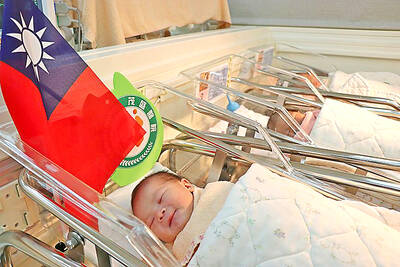
AGING: As of last month, people aged 65 or older accounted for 20.06 percent of the total population and the number of couples who got married fell by 18,685 from 2024 Taiwan has surpassed South Korea as the country least willing to have children, with an annual crude birthrate of 4.62 per 1,000 people, Ministry of the Interior data showed yesterday. The nation was previously ranked the second-lowest country in terms of total fertility rate, or the average number of children a woman has in her lifetime. However, South Korea’s fertility rate began to recover from 2023, with total fertility rate rising from 0.72 and estimated to reach 0.82 to 0.85 by last year, and the crude birthrate projected at 6.7 per 1,000 people. Japan’s crude birthrate was projected to fall below six,
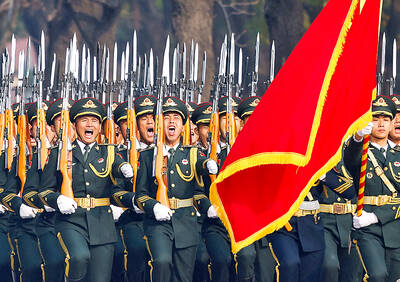
Conflict with Taiwan could leave China with “massive economic disruption, catastrophic military losses, significant social unrest, and devastating sanctions,” a US think tank said in a report released on Monday. The German Marshall Fund released a report titled If China Attacks Taiwan: The Consequences for China of “Minor Conflict” and “Major War” Scenarios. The report details the “massive” economic, military, social and international costs to China in the event of a minor conflict or major war with Taiwan, estimating that the Chinese People’s Liberation Army (PLA) could sustain losses of more than half of its active-duty ground forces, including 100,000 troops. Understanding Chinese
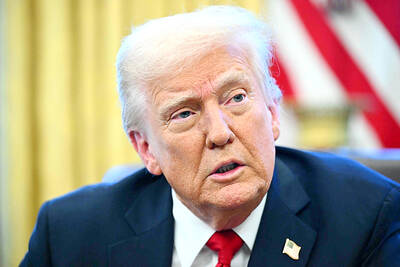
US President Donald Trump in an interview with the New York Times published on Thursday said that “it’s up to” Chinese President Xi Jinping (習近平) what China does on Taiwan, but that he would be “very unhappy” with a change in the “status quo.” “He [Xi] considers it to be a part of China, and that’s up to him what he’s going to be doing, but I’ve expressed to him that I would be very unhappy if he did that, and I don’t think he’ll do that. I hope he doesn’t do that,” Trump said. Trump made the comments in the context
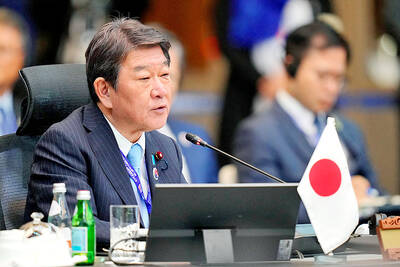
SELF-DEFENSE: Tokyo has accelerated its spending goal and its defense minister said the nation needs to discuss whether it should develop nuclear-powered submarines China is ramping up objections to what it sees as Japan’s desire to acquire nuclear weapons, despite Tokyo’s longstanding renunciation of such arms, deepening another fissure in the two neighbors’ increasingly tense ties. In what appears to be a concerted effort, China’s foreign and defense ministries issued statements on Thursday condemning alleged remilitarism efforts by Tokyo. The remarks came as two of the country’s top think tanks jointly issued a 29-page report framing actions by “right-wing forces” in Japan as posing a “serious threat” to world peace. While that report did not define “right-wing forces,” the Chinese Ministry of Foreign Affairs was


 RSS
RSS