


Chinese President Hu Jintao (胡錦濤) yesterday called for a peace agreement with Taiwan, but insisted that independence would never be tolerated.
"We would like to make a solemn appeal," Hu said at the opening of the Chinese Communist Party's five-yearly Congress.
"On the basis of the one-China principle, let us discuss a formal end to the state of hostility between the two sides, reach a peace agreement, construct a framework for peaceful development of cross-strait relations and thus usher in a new phase of peaceful development," he said.
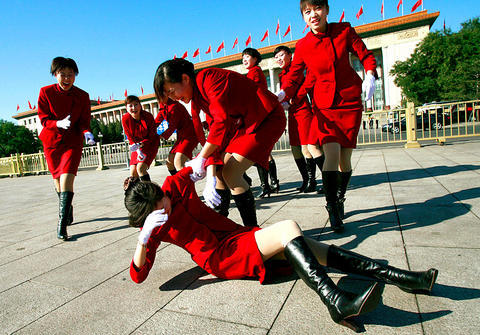
PHOTO: AFP
His speech did not carry direct references to using force in bringing about Taiwan's unification with China, as China has done in the past. Hu did warn that Taiwan's "independence forces" were seriously jeopardizing cross-strait relations, in an apparent reference to President Chen Shui-bian's (
"China's sovereignty and territorial integrity brook no division, and any matter in this regard must be decided by the entire Chinese people, including our Taiwan compatriots," he said. "China will never allow anyone to separate Taiwan from the motherland in any name or by any means."
Hu's latest remarks should not be interpreted as a major shift in China's policy, said Kou Chien-wen (
"This is not the first time Hu has called for a cross-strait peace mechanism and like before he has based it on the acceptance of the `one China' principle," Kou said. "But Taiwan's ruling party has refused to accept the `one China' policy and insists that there are two countries involved, China and Taiwan."
"Hu did not repeat the war-like rhetoric, but his mention of the `one China' principle shows that he is not renouncing the use of force," Kou said.
During his speech, Hu also appeared to reach out to those in Taiwan who oppose Chen, promising policies beneficial to Taiwan and which would protect the huge investments in China by Taiwanese enterprises.
He also called for a resumption of direct trade, travel and mail links between the two sides.
Also see stories:
Hu promises `cautious' reform
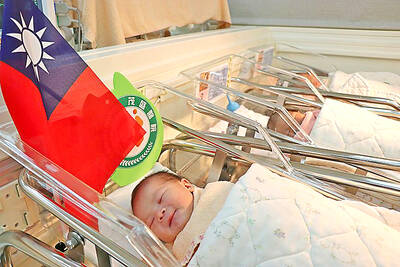
AGING: As of last month, people aged 65 or older accounted for 20.06 percent of the total population and the number of couples who got married fell by 18,685 from 2024 Taiwan has surpassed South Korea as the country least willing to have children, with an annual crude birthrate of 4.62 per 1,000 people, Ministry of the Interior data showed yesterday. The nation was previously ranked the second-lowest country in terms of total fertility rate, or the average number of children a woman has in her lifetime. However, South Korea’s fertility rate began to recover from 2023, with total fertility rate rising from 0.72 and estimated to reach 0.82 to 0.85 by last year, and the crude birthrate projected at 6.7 per 1,000 people. Japan’s crude birthrate was projected to fall below six,
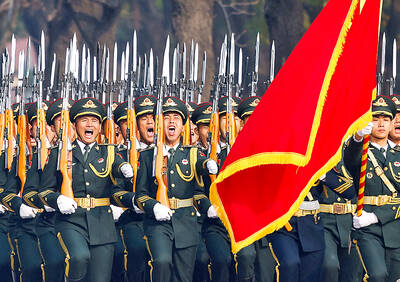
Conflict with Taiwan could leave China with “massive economic disruption, catastrophic military losses, significant social unrest, and devastating sanctions,” a US think tank said in a report released on Monday. The German Marshall Fund released a report titled If China Attacks Taiwan: The Consequences for China of “Minor Conflict” and “Major War” Scenarios. The report details the “massive” economic, military, social and international costs to China in the event of a minor conflict or major war with Taiwan, estimating that the Chinese People’s Liberation Army (PLA) could sustain losses of more than half of its active-duty ground forces, including 100,000 troops. Understanding Chinese
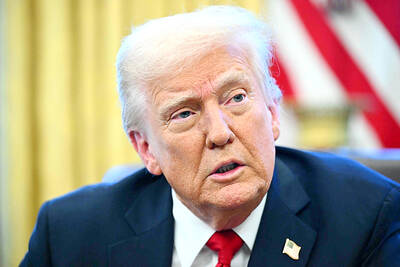
US President Donald Trump in an interview with the New York Times published on Thursday said that “it’s up to” Chinese President Xi Jinping (習近平) what China does on Taiwan, but that he would be “very unhappy” with a change in the “status quo.” “He [Xi] considers it to be a part of China, and that’s up to him what he’s going to be doing, but I’ve expressed to him that I would be very unhappy if he did that, and I don’t think he’ll do that. I hope he doesn’t do that,” Trump said. Trump made the comments in the context
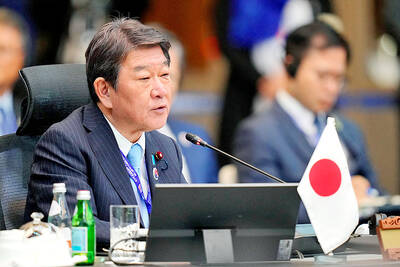
SELF-DEFENSE: Tokyo has accelerated its spending goal and its defense minister said the nation needs to discuss whether it should develop nuclear-powered submarines China is ramping up objections to what it sees as Japan’s desire to acquire nuclear weapons, despite Tokyo’s longstanding renunciation of such arms, deepening another fissure in the two neighbors’ increasingly tense ties. In what appears to be a concerted effort, China’s foreign and defense ministries issued statements on Thursday condemning alleged remilitarism efforts by Tokyo. The remarks came as two of the country’s top think tanks jointly issued a 29-page report framing actions by “right-wing forces” in Japan as posing a “serious threat” to world peace. While that report did not define “right-wing forces,” the Chinese Ministry of Foreign Affairs was


 RSS
RSS