


China has blacklisted more than 400 exporters for violating trade rules following a series of food, drug and other health scares across the world, the Commerce Ministry said yesterday.
The list included two pet food manufacturers that had exported to the US. Washington stepped up inspections of imports from China after a chemical additive in pet food caused the death of some pets there earlier this year.
Since then, poisonous ingredients have been found in Chinese exports of toys, toothpaste and fish, while the deaths of patients in Panama were blamed on improperly labeled Chinese chemicals that were mixed into cough syrup.
In the latest scare, US toy maker Mattel said on Wednesday that it was recalling 1.5 million Chinese-made toys worldwide because their paint may contain too much lead.
Chinese Vice Commerce Minister Gao Hucheng (高虎城) stressed the government line that Chinese products were overwhelmingly safe and of high quality, and called on foreign media not to hype the problems of a small minority of goods or companies.
But on the ministry Web site, he said 429 Chinese firms on the blacklist had been punished for violating export regulations. The Web site did not elaborate.
"China will strengthen international cooperation on the safety of products," Gao was quoted as saying.
A delegation of US officials in Beijing hammered out "basic frameworks" for two agreements seeking to reassure US consumers that Chinese-made goods met safety standards, Secretary of Health and Human Services Mike Leavitt said on Friday.
China, where the former drug and food safety watchdog chief was executed last month for corruption, has also canceled the licenses of six medicine manufacturers.
The China Daily said 270 "on-the-spot drug test" vans would soon hit the roads of rural China to weed out counterfeit drugs.
In related news, Beijing has banned all Indonesian seafood imports after checks turned up toxins, dangerous chemicals and pathogens, the government said.
Martani Huseini, a senior official at Indonesia's Department of Maritime Affairs and Fisheries, said the move appeared to be in reaction to an import ban last month on certain Chinese products. Indonesia said it had found that some Chinese cosmetics contained mercury.
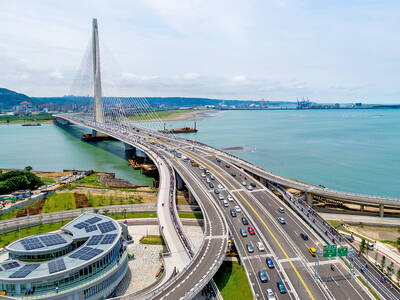
The Ministry of Transportation and Communications yesterday inaugurated the Danjiang Bridge across the Tamsui River in New Taipei City, saying that the structure would be an architectural icon and traffic artery for Taiwan. Feted as a major engineering achievement, the Danjiang Bridge is 920m long, 211m tall at the top of its pylon, and is the longest single-pylon asymmetric cable-stayed bridge in the world, the government’s Web site for the structure said. It was designed by late Iraqi-British architect Zaha Hadid. The structure, with a maximum deck of 70m, accommodates road and light rail traffic, and affords a 200m navigation channel for boats,
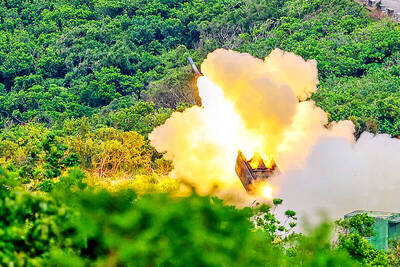
PRECISION STRIKES: The most significant reason to deploy HIMARS to outlying islands is to establish a ‘dead zone’ that the PLA would not dare enter, a source said A High Mobility Artillery Rocket System (HIMARS) would be deployed to Penghu County and Dongyin Island (東引) in Lienchiang County (Matsu) to force the Chinese military to retreat at least 100km from the coastline, a military source said yesterday. Taiwan has been procuring HIMARS and Army Tactical Missile Systems (ATACMS) from the US in batches. Once all batches have been delivered, Taiwan would possess 111 HIMARS units and 504 ATACMS, which have a range of 300km. Considering that “offense is the best defense,” the military plans to forward-deploy the systems to outlying islands such as Penghu and Dongyin so that
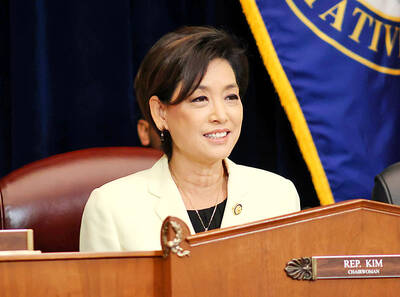
‘CLEAR MESSAGE’: The bill would set up an interagency ‘tiger team’ to review sanctions tools and other economic options to help deter any Chinese aggression toward Taiwan US Representative Young Kim has introduced a bill to deter Chinese aggression against Taiwan, calling for an interagency “tiger team” to preplan coordinated sanctions and economic measures in response to possible Chinese military or political action against Taiwan. “[Chinese President] Xi Jinping [習近平] has directed the People’s Liberation Army to be ready to invade Taiwan by 2027. China has a plan. America should have one too,” Kim said in a news release on Thursday last week. She introduced the “Deter PRC [People’s Republic of China] aggression against Taiwan act” to “ensure the US has a coordinated sanctions strategy ready should
Taiwan Semiconductor Manufacturing Co (TSMC, 台積電), the world’s largest foundry service provider, yesterday said that global semiconductor revenue is projected to hit US$1.5 trillion in 2030, after the figure exceeds US$1 trillion this year, as artificial intelligence (AI) demand boosts consumption of token and compute power. “We are still at the beginning of the AI revolution, but we already see a significant impact across the whole semiconductor ecosystem,” TSMC deputy cochief operating officer Kevin Zhang (張曉強) said at the company’s annual technology symposium in Hsinchu City. “It is fair to say that in the past decade, smartphones and other mobile devices were


 RSS
RSS