


President Chen Shui-bian (陳水扁) yesterday vowed to persist with Taiwan's UN bid and said he would not stop until the nation becomes a full member.
The president made the remarks following the return of his letter to the Chinese ambassador to the UN.
Chen sent UN Secretary-General Ban Ki-moon a letter last Friday and sent another to Beijing's UN representative, Wang Guangya (
The letters were sent following Chen's first letter to Ban on July 18 requesting UN membership under the name "Taiwan," a departure from previous applications that had used the name "Republic of China" (ROC).
The UN Office of Legal Affairs rejected the letter on July 23, citing UN Resolution 2758.
Wang, who handed over the rotating chairmanship of the Security Council to the Democratic Republic of the Congo on Tuesday, told UN correspondents on Wednesday that he returned Chen's letter the same day that he received it.
Chen, in the latest issue of his weekly e-newsletter, said that more than 77 percent of the public supported the bid to join the UN, without citing a source for the figure.
"We can accomplish this mission impossible if we solidify a public consensus," he said. "We want to let the world hear the voice of the Taiwanese people."
Chen said that Taiwan had been excluded from the international community for far too long and China had repeatedly rejected the nation's sovereignty and suppressed its influence.
This year, the government adopted a new strategy by applying under the name "Taiwan" to emphasize the nation's sovereignty and democracy, he said.
"Taiwan, which is a liberal democracy, should not be isolated from world," he said.
"We will keep trying until the international community and the United Nations acknowledge our democratic development and accept Taiwan as a full member," he said.
Saying that it is important that the Taiwanese decide their own future, Chen said in Pingtung County yesterday that a planned referendum on whether to join the UN under the name "Taiwan" must be held.
Vice President Annette Lu (呂秀蓮) said separately yesterday the government must listen to the public and help them realize their dream of joining the UN.
"We cannot give up just because somebody is against it," she said.
Cho Jung-tai (卓榮泰), acting Presidential Office secretary-general, added that the administration realized the difficulty of the undertaking, but he urged the public and all political parties to support the campaign.
Taiwan must take this matter seriously for the world to take it seriously, he said.
Lin Yung-lo (
no change
In New York, a UN official said on Wednesday that the UN's position on Taiwan's participation in the world body had not changed despite Taiwan's request for the world body to reconsider its membership application.
Marie Okabe, deputy spokeswoman for the secretary-general, made the remarks during a daily press briefing. When asked about the letters sent by Chen, she said she could not confirm at this point whether the UN had responded officially to the latest move by Taiwan.
Okabe noted that the previous application was returned in keeping with UN Resolution 2758, which she said is the basis of the UN's "one China" policy.
She was referring to the resolution adopted by the General Assembly in 1971 recognizing the People's Republic of China as "the only legitimate representatives of China to the United Nations."
Responding to a question on the issue by a Central News Agency reporter last week, Ban said that UN membership is only granted to sovereign countries and that the position of the UN is that "Taiwan is part of China."
separatist
Meanwhile, China's state controlled Xinhua news agency quoted Wang as calling Taiwan's latest move "a very serious separatist act seeking independence for Taiwan."
Expressing firm opposition to the move, Wang stressed that there is only one China in the world and that Taiwan is an inseparable part of China, according to Xinhua.
The Chinese Nationalist Party (KMT) yesterday also lashed out at Chen for humiliating the nation by sending the letter to Wang.
`arrogant'
"Chen and his government have failed to learn their lesson from their failures in foreign affairs over the past seven years," Chang Jung-kung (張榮恭), deputy director of the KMT's policy committee, said in a statement.
"The move is arrogant, and it's like pushing Taiwanese people in front of a car," Chang said.
Chen's letter to Ban prompted the UN secretary-general to say that Taiwan was part of the People's Republic of China.
"The government sending a letter now would only further damage Taiwan's position in the international community and hurt the feelings of the Taiwanese public," he said.
Additional reporting by Mo Yan-chih and Jewel Huang
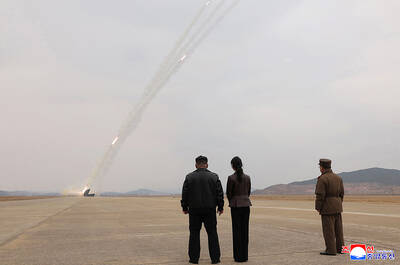
North Korea tested nuclear-capable rocket launchers, state media reported yesterday, a day after Seoul detected the launch of about 10 ballistic missiles. The test comes after South Korean and US forces launched their springtime military drills, due to run until Thursday. North Korean leader Kim Jong-un on Saturday oversaw the testing of the multiple rocket launcher system (MRLS), the Korean Central News Agency (KCNA) said. The test involved 12 600mm-caliber ultra-precision multiple rocket launchers and two artillery companies, it said. Kim said the drill gave Pyongyang’s enemies, within the 420km striking range, a sense of “uneasiness” and “a deep understanding

North Korea yesterday fired about 10 ballistic missiles to the sea toward Japan, the South Korean Joint Chiefs of Staff (JCS) said, days after Pyongyang warned of “terrible consequences” over ongoing South Korea-US military drills. Pyongyang recently dashed hopes of a diplomatic thaw with Seoul, Washington’s security ally, describing its latest peace efforts as a “clumsy, deceptive farce.” Seoul’s military detected “around 10 ballistic missiles launched from the Sunan area in North Korea toward the East Sea [Sea of Japan] at around 1:20pm,” JCS said in a statement, referring to South Korea’s name for the body of water. The missiles
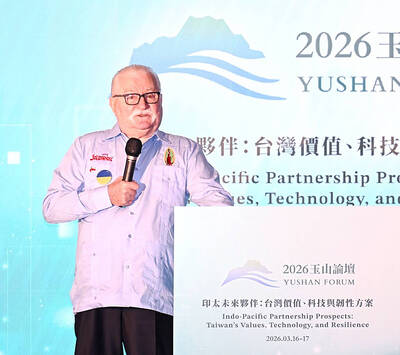
RECOGNITION: Former Fijian prime minister Mahendra Chaudhry said that Taiwan’s New Southbound Policy serves as a stabilizing force in the Indo-Pacific region Taiwan can lead the unification of the Chinese people, Nobel Peace Prize laureate and former Polish president Lech Walesa said in Taipei yesterday, adding that as the world order is changing, peaceful discussion would find good solutions, and that the use of force and coercion would always fail. Walesa made the remarks during his keynote address at a luncheon of the Yushan Forum in Taipei, titled “Indo-Pacific Partnership Prospects: Taiwan’s Values, Technology and Resilience,” organized by the Taiwan-Asia Exchange Foundation with the Ministry of Foreign Affairs. Walesa said that he had been at the forefront of a big peaceful revolution and “if

‘UNWAVERING FRIENDSHIP’: A representative of a Japanese group that co-organized a memorial, said he hopes Japanese never forget Taiwan’s kindness President William Lai (賴清德) yesterday marked the 15th anniversary of the Tohoku earthquake and tsunami, urging continued cooperation between Taiwan and Japan on disaster prevention and humanitarian assistance. Lai wrote on social media that Taiwan and Japan have always helped each other in the aftermath of major disasters. The magnitude 9 earthquake struck northeastern Japan on March 11, 2011, triggering a massive tsunami that claimed more than 19,000 lives, according to data from Japanese authorities. Following the disaster, Taiwan donated more than US$240 million in aid, making it one of the largest contributors of financial assistance to Japan. In addition to cash donations and


 RSS
RSS