


Swiss authorities on Wednesday returned US$34 million in frozen bank deposits to Taiwan that were believed to be kickbacks connected to the purchase of six Lafayette-class frigates from France in 1991, Swiss officials said.
Officials at the Swiss Department of Justice said the funds belonged to two different account holders but declined to identify them, saying only that one of them was a Taiwanese official.
The officials said that according to Switzerland's Federal Act on International Mutual Assistance in Criminal Matters, frozen capital assets can be released to foreign governments if they are related to criminal activities.
The funds were handed over to Taiwanese officials on the condition that legal proceedings against the two people concerned would comply with human rights principles, they said.
The sum is part of a total of US$520 million that Taiwan has sought to recover from a number of frozen Swiss bank accounts belonging to several Taiwanese involved in the scandal, including fugitive arms dealer Andrew Wang (
Proceedings for the retrieval of the remaining funds are ongoing, the officials said.
Kickbacks
Wang was a Taiwanese agent for French arms supplier Thompson-CSF. He fled the country following the death of Navy Captain Yin Ching-feng (尹清楓) under suspicious circumstances in late 1993. It is believed that Yin was poised to blow the whistle on colleagues who had received kickbacks from the Lafayette deal.
Wang has been wanted by Taiwanese prosecutors on a murder charge since September 2000.
Concluding a second-phase investigation into the arms procurement scandal in September last year, a special judicial panel in Taiwan indicted Wang and his wife, Yeh Hsiu-chen (葉秀貞), as well as their four children and the Kuo brothers on charges of collecting kickbacks from the Lafayette deal.
According to the indictment, the Wangs opened more than 60 bank accounts in Europe and Asia to launder US$520 million in illicit gains from the deal.
Taiwan began to seek assistance from the Swiss government in 2001 to retrieve funds frozen in several Swiss banks.
Through a judicial aid agreement with Switzerland, Taiwanese prosecutors acquired a collection of bank files from a Swiss federal judge in November 2005. After nearly 10 months of examination of the files, Taiwan petitioned in September last year for the return of US$520 million from a total of US$730 million frozen in the Swiss banks.
Additional reporting by AP
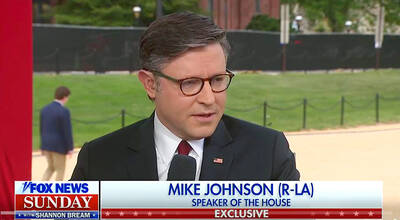
RESOLUTE BACKING: Two Republican senators are planning to introduce legislation that would impose immediate sanctions on China if it attempts to invade Taiwan US House of Representatives Speaker Mike Johnson on Sunday reaffirmed US congressional support for Taiwan, saying the US and “all freedom-loving people” have a stake in preventing China from seizing Taiwan by force. Johnson made the remarks in an interview with Fox News Sunday on US President Donald Trump’s summit with Chinese President Xi Jinping (習近平) last week. In an interview that aired on Friday on Fox News, just as Trump wrapped up a high-stakes visit to China, he said he has yet to green-light a new US$14 billion arms package to Taiwan and that it “depends on China.” “It’s a very good
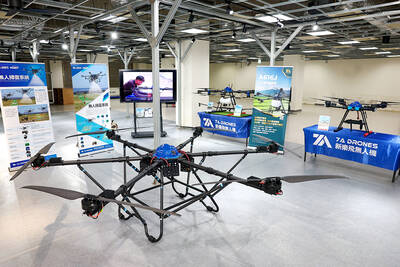
DRONE CENTRAL: Taiwan aims to become Asia’s democratic hub for drones, with most exports focused on high-quality military-grade models, an official said Taiwan’s drone industry is expected to expand significantly by 2030, producing 100,000 units per month and exporting half of them, the Ministry of Economic Affairs said yesterday. Current drone production capacity is about 15,000 units per month, but the industry can quickly scale up as demand increases, Industrial Development Administration Director-General Chiou Chyou-huey (邱求慧) told a news conference in Taipei. Taiwan’s drone output grew 2.5-fold last year to NT$12.9 billion (US$408.3 million) under a government program to develop the uncrewed vehicle sector, he said. The Executive Yuan in October last year approved plans to invest NT$44.2 billion into domestic production of uncrewed aerial
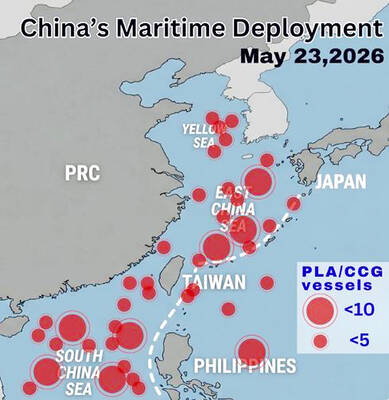
WARNING: China should stop engaging in actions that undermine regional peace and stability, as it would only build resentment among people across the Strait, the CGA said China has deployed more than 100 navy, coast guard and other vessels in waters from the Yellow Sea to the South China Sea and the western Pacific since US President Donald Trump and Chinese President Xi Jinping (習近平) met in Beijing, National Security Council Secretary-General Joseph Wu (吳釗燮) said yesterday. “In this part of the world, #China is the one & only PROBLEM wrecking the #StatusQuo & threatening regional peace & stability,” Wu wrote on X. In a separate post, he said Beijing was coercing Taiwan’s maritime domain, calling it illegal and provocative, after the Coast Guard Administration (CGA) expelled a
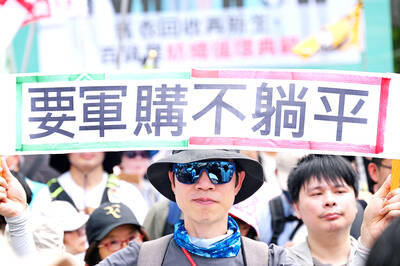
More than 8,000 people took part in a rally in Taipei yesterday to express support for more defense spending, after the opposition slashed the Cabinet’s proposed NT$1.25 trillion (US$39.6 billion) special defense budget and capped it at NT$780 billion. The demonstrators urged the Cabinet to propose another bill. Taiwan Economic Democracy Union convener Lai Chung-chiang (賴中強) said the main problem of the passed budget plan is the removal of funding for critical items, not just that the total amount is smaller. Critical budget items included purchasing or developing uncrewed vehicles, Strong Bow (強弓) missile systems, additional ammunition, artificial intelligence-powered combat systems and Taiwan-US


 RSS
RSS