


A program by the Government Information Office (GIO) to provide scholarships for foreign reporters working for international news outlets to learn Mandarin in Taiwan drew a mixed reaction from academics and lawmakers yesterday.
"The program has nothing to do with currying favor with international reporters [as local media alleged]. It is aimed at facilitating cultural exchanges," said Government Information Office Deputy Minister William Yih (易榮宗) at a press conference, in response to a report by the Chinese-language Apple Daily yesterday, which asked if the program was appropriate.
Under the program which starts in September, foreign students studying journalism at certain colleges and foreign reporters working for international news outlets, regardless of whether or not they are based in Taiwan, will be eligible for the scholarship, Yih said.
According to application regulations, the scholarship grants a monthly stipend of NT$25,000 (US$754) and successful applicants will be able to apply for four terms with each term lasting three months.
According to Yih, seven reporters from the US, Britain, Germany, Japan, Thailand and Turkey had applied for the scholarship this year.
"Four of them are now covering stories in Taiwan, and three would take leave from their jobs and come to Taiwan to study Chinese," he said.
Yih said that the program is part of a Ministry of Education (MOE) project to promote learning Mandarin in Taiwan.
"The program will let the world know that Taiwan is a good place to learn Chinese and enhance international reporters' understanding of Taiwan," he said.
Commenting on the program, Chinese Nationalist Party (KMT) Legislator Diane Lee (李慶安) said it was "improper" for a government to financially support reporters.
"No matter the reason, the acceptance of financial sponsorship from governments violates news ethics. I doubt respectable international media professionals will take what is on offer," she said.
Democratic Progressive Party Legislator Hsiao Bi-khim (
For one thing, given that more and more international reporters covering Asian news choose to live in Tokyo, Beijing or Hong Kong rather than Taipei, the program might lure them to Taiwan, cultivate their feelings toward the country, and increase their familiarity with it, Hsiao said.
"For another, as many international reporters stationed in Taiwan are working as freelancers with irregular payment rather than as regular employees of mainstream media companies, granting them the scholarship is no bad thing," she said.
An associate professor in the department of mass communications at Chinese Culture University, Weber Lai (賴祥蔚), said such a program should be undertaken by private institutions and not by the GIO.
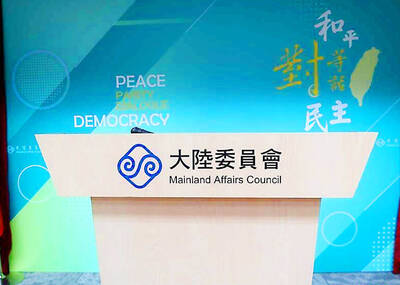
NO RECIPROCITY: Taipei has called for cross-strait group travel to resume fully, but Beijing is only allowing people from its Fujian Province to travel to Matsu, the MAC said The Mainland Affairs Council (MAC) yesterday criticized an announcement by the Chinese Ministry of Culture and Tourism that it would lift a travel ban to Taiwan only for residents of China’s Fujian Province, saying that the policy does not meet the principles of reciprocity and openness. Chinese Deputy Minister of Culture and Tourism Rao Quan (饒權) yesterday morning told a delegation of Chinese Nationalist Party (KMT) lawmakers in a meeting in Beijing that the ministry would first allow Fujian residents to visit Lienchiang County (Matsu), adding that they would be able to travel to Taiwan proper directly once express ferry

STUMPED: KMT and TPP lawmakers approved a resolution to suspend the rate hike, which the government said was unavoidable in view of rising global energy costs The Ministry of Economic Affairs yesterday said it has a mandate to raise electricity prices as planned after the legislature passed a non-binding resolution along partisan lines to freeze rates. Chinese Nationalist Party (KMT) lawmakers proposed the resolution to suspend the price hike, which passed by a 59-50 vote. The Taiwan People’s Party (TPP) voted with the KMT. Legislative Speaker Han Kuo-yu (韓國瑜) of the KMT said the resolution is a mandate for the “immediate suspension of electricity price hikes” and for the Executive Yuan to review its energy policy and propose supplementary measures. A government-organized electricity price evaluation board in March
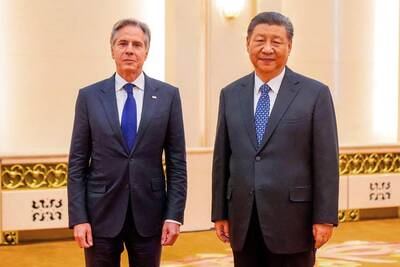
MANAGING DIFFERENCES: In a meeting days after the US president signed a massive foreign aid bill, Antony Blinken raised concerns with the Chinese president about Taiwan US Secretary of State Antony Blinken yesterday met with Chinese President Xi Jinping (習近平) and senior Chinese officials, stressing the importance of “responsibly managing” the differences between the US and China as the two sides butt heads over a number of contentious bilateral, regional and global issues, including Taiwan and the South China Sea. Talks between the two sides have increased over the past few months, even as differences have grown. Blinken said he raised concerns with Xi about Taiwan and the South China Sea, along with China’s support for Russia and its invasion of Ukraine, as well as other issues

FAST RELEASE: The council lauded the developer for completing model testing in only four days and releasing a commercial version for use by academia and industry The National Science and Technology Council (NSTC) yesterday released the latest artificial intelligence (AI) language model in traditional Chinese embedded with Taiwanese cultural values. The council launched the Trustworthy AI Dialogue Engine (TAIDE) program in April last year to develop and train traditional Chinese-language models based on LLaMA, the open-source AI language model released by Meta. The program aims to tackle the information bias that is often present in international large-scale language models and take Taiwanese culture and values into consideration, it said. Llama 3-TAIDE-LX-8B-Chat-Alpha1, released yesterday, is the latest large language model in traditional Chinese. It was trained based on Meta’s Llama-3-8B


 RSS
RSS