


Lebanese troops pounded Islamist militiamen in a Palestinian refugee camp yesterday, the second day of the bloodiest internal fighting since the civil war that has now killed 55 people and raised deep concerns about Lebanon's fragile security.
Nine Palestinian civilians were killed in the shelling of the Nahr al-Bared camp in northern Lebanon, where soldiers battled militants from the shadowy Fatah al-Islam group, a camp medic said.
Plumes of thick black smoke rose from the camp, which has been turned into a war zone by ferocious gunbattles yesterday between soldiers and Fatah al-Islam, a group accused of links to al-Qaeda and Syrian intelligence services.
Lebanese leaders vowed they would take "all necessary measures" to restore order after the fighting that left 46 people dead on Sunday alone, while the international community appealed for an end to the violence.
As warships patrolled nearby coastal waters, troops were locked in heavy exchanges of artillery and machinegun fire with militants in Nahr al-Bared, where buildings have been burnt or destroyed.
Officials are fearful for the plight of refugees.
"We are deeply concerned about the developing humanitarian crisis, particularly the danger to civilian lives," UN Palestinian refugee agency director Richard Cook said.
Doctors have describing seeing bodies strewn on the streets of the Nahr al-Bared, which like all other refugee camps in Lebanon remain outside the control of the government and in the hands of Palestinian factions.
"The electricity has been cut, there's not much water and the camp's bakeries are shut," said Hajj Rifaat, an official from the mainstream group Fatah, which denies any links with Fatah al-Islam.
Also see story:
Bomb plot suspect killed in Lebanon

‘NO SECURITY RISK’: The Railway Bureau reassured the public that the technicians’ activities were limited to technical guidance and did not involve sensitive systems The Railway Bureau yesterday said it had invited eight Chinese technicians to assist with an airport MRT construction project. The bureau issued the confirmation after an Internet user said Chinese nationals had entered the construction zone of Taiwan Taoyuan International Airport’s Terminal 3 project. They asked why “individuals from an enemy state” were allowed access to such a major national infrastructure project, which raised serious concerns over Taiwan’s industrial safety, sensitive systems and information security. The bureau’s Northern Region Engineering Branch Office said subcontractor Taiwan Handle Industrial Co (台灣手把工業) of the Taoyuan airport MRT’s “Contract No. CU05 Project A14 Station Civil, MEP &

A US uncrewed surface vessel (USV) encountered multiple Chinese warships during an autonomous transit of the Taiwan Strait, US defense company Seasats said in a statement on Wednesday. Seasats announced that a Lightfish USV had completed the first autonomous transit of the Taiwan Strait. Over five days, the USV traversed the entire length of the Strait while constantly monitoring surface vessel traffic, the company said. The Lightfish encountered multiple Chinese warships, one of which was a Chinese People’s Liberation Army Navy (PLAN) Type 056 corvette, it said. The Chinese vessels were operating “well within Taiwan’s exclusive economic zone without transmitting their identity via the
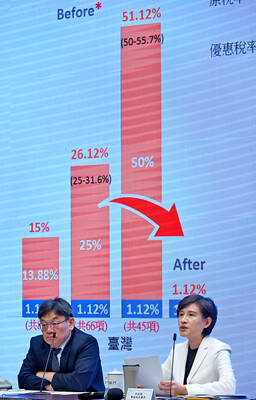
GREATER REACH? Auto parts and wood products would face tariffs of up to 15%, matching those targeting the EU, Japan and South Korea, Vice Premier said The US has announced that preferential tariff treatment for Taiwan’s non-semiconductor Section 232 goods would take effect retroactively from May 1, the Executive Yuan said yesterday. The US government yesterday posted a notice on the Federal Register’s public inspection Web site previewing tariff concessions for Taiwan under a memorandum of understanding (MOU) on Taiwan-US investment after two months of negotiations. The MOU signed on Jan. 15 stipulated three major preferential tariff arrangements: a 15 percent “reciprocal” tariff rate for Taiwan without stacking most-favored nation (MFN) rates; preferential Section 232 treatment for semiconductors and related products; and preferential Section 232 treatment for non-semiconductor

The National Chungshan Institute of Science and Technology yesterday showcased its locally developed variants of the Vision 60 robotic patrol dog, which it plans to deploy on the nation’s outlying territories in the South China Sea. The variants were produced under the Joint Lab project — created by the institute and domestic companies — and assembled with domestically produced motors, lenses and artificial intelligence (AI) systems alongside licensed tech from the US, Missile and Rocket Systems Research Division deputy director Jen Kuo-kang (任國光) told the media event at a military base in Taipei’s Dazhi (大直) area. Taiwan has built up its strengths


 RSS
RSS