


Chinese police have detained an environmental activist who was once praised for his efforts to save the country's third-largest freshwater lake, his wife said yesterday, in the latest government crackdown on dissent.
Wu Lihong was detained on April 13 by police in Yixing, in the eastern province of Jiangsu, accused of extortion and blackmail, Xu Jiehua said.
Wu, 39, a salesman-turned-activist, had reported worsening pollution at the Tai Lake from chemical factories to local environmental departments and the media.
His efforts upset local authorities who benefited from the high profits and taxes paid by the offending factories, Xu said.
"He has been accused of blackmail," Xu said. "More than 10 plainclothes police officers broke through our door at night and took him away. This is the 10th day he remains in police custody."
"Not until one the next morning did these people tell me that they were police and told me that my husband had been detained," she said. "The accusations are totally groundless. All my husband did was try to save the environment and make more people aware of the situation at the lake."
Tai Lake, with an area of 2,420km2 and a coastline of 400km, straddles the border of Jiangsu and Zhejiang provinces and is home to more than 60 kinds of fish and other aquatic life.
In 2005, Wu was a candidate in a national campaign to name 10 people who "moved China" in their services to society.
Local police were not immediately available for comment.
Detention and harassment of activists is not uncommon in China.
Last year, a court in Zhejiang sentenced an environmental activist to a year and a half in prison for "illegally obtaining state secrets."
Gao Yaojie (高耀潔), a 79-year-old AIDS activist, accused the local government in Henan Province yesterday of putting her under secret surveillance after she returned from the US where she received a human rights award.
"I would rather die so I can save the government the money they are spending on spying on me," Gao said.
Confirmation or comment from the local government was not immediately available.
Gao received the Vital Voices Global Women's Leadership Award for Human Rights in March for helping bring to light official complicity in the spread of AIDS in Henan where thousands of poor farmers were infected in blood-selling schemes in the 1990s.

South Korea has adjusted its electronic arrival card system to no longer list Taiwan as a part of China, a move that the Ministry of Foreign Affairs said would help facilitate exchanges between the two sides. South Korea previously listed “Taiwan” as “Taiwan (China)” in the drop-down menus of its online arrival card system, where people had to fill out where they came from and their next destination. The ministry had requested South Korea make a revision and said it would change South Korea’s name on Taiwan’s online immigration system from “Republic of Korea” to “Korea (South),” should the issue not be

Tainan, Taipei and New Taipei City recorded the highest fines nationwide for illegal accommodations in the first quarter of this year, with fines issued in the three cities each exceeding NT$7 million (US$220,639), Tourism Administration data showed. Among them, Taipei had the highest number of illegal short-term rental units, with 410. There were 3,280 legally registered hotels nationwide in the first quarter, down by 14 properties, or 0.43 percent, from a year earlier, likely indicating operators exiting the market, the agency said. However, the number of unregistered properties rose to 1,174, including 314 illegal hotels and 860 illegal short-term rental
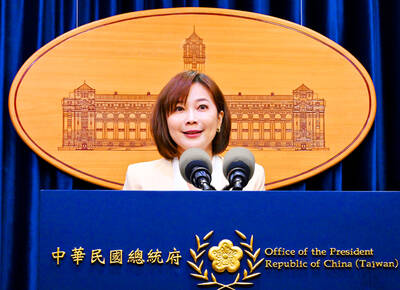
ECONOMIC COERCION: Such actions are often inconsistently applied, sometimes resumed, and sometimes just halted, the Presidential Office spokeswoman said The government backs healthy and orderly cross-strait exchanges, but such arrangements should not be made with political conditions attached and never be used as leverage for political maneuvering or partisan agendas, Presidential Office spokeswoman Karen Kuo (郭雅慧) said yesterday. Kuo made the remarks after China earlier in the day announced 10 new “incentive measures” for Taiwan, following a landmark meeting between Chinese President Xi Jinping (習近平) and Chinese Nationalist Party (KMT) Chairwoman Cheng Li-wun (鄭麗文) in Beijing on Friday. The measures, unveiled by China’s Xinhua news agency, include plans to resume individual travel by residents of Shanghai and China’s Fujian

Chinese President Xi Jinping (習近平) and Chinese Nationalist Party (KMT) Chairwoman Cheng Li-wun (鄭麗文) met in Beijing yesterday, where they vowed to bring people on both sides of the Taiwan Strait closer to facilitate the “great rejuvenation of the Chinese nation.” The meeting was held in the East Hall of the Great Hall of the People, a venue typically reserved for meetings between Xi and foreign heads of state. In public remarks prior to a closed-door meeting, Xi, in his role as head of the Chinese Communist Party (CCP), said that Taiwan is historically part of China, and remains an “inalienable” and


 RSS
RSS