


Asia's richest woman left her wealth to her fortune-teller in her last known will, which is all but certain to spark a huge legal battle with relatives, Hong Kong media reported yesterday.
Nina Wang (龔如心), who died aged 69 earlier this month and had no children, left a legacy estimated to be worth at least US$4.2 billion after transforming her company Chinachem into a real estate empire.
A day after her lavish funeral on Wednesday, two wills she allegedly wrote in 2002 and last year were published separately in Next Magazine and its sister Apple Daily publication. The 2002 document said Wang's fortune would go to her charitable trust. But the later version named her personal fortune-teller, Chan Chun-chuen (
Citing unnamed sources close to the family, Apple Daily said Wang's family and senior aides were unfamiliar with Chan and were set to take the issue to court.
The sources said the family held "important evidence" that could discredit Wang's second will and were confident of winning any case.
Neither her lawyer nor her personal assistant could be reached for comment.
If true, last year's document would have been penned two years after Wang was diagnosed with cancer and after she won an eight-year court battle against her father-in-law for control of her late husband Teddy Wang's (王德輝) estate.
Meanwhile, Next Magazine published a two-page will provided by a friend of Wang and supposedly written in Chinese in 2002.
It named no beneficiary but indicated that her assets would go to a charity trust she set up with Teddy Wang before he disappeared.
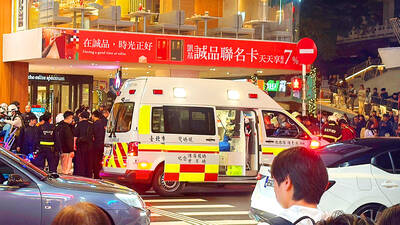
TRAGEDY STRIKES TAIPEI: The suspect died after falling off a building after he threw smoke grenades into Taipei Main Station and went on a killing spree in Zhongshan A 27-year-old suspect allegedly threw smoke grenades in Taipei Main Station and then proceeded to Zhongshan MRT Station in a random killing spree that resulted in the death of the suspect and two other civilians, and seven injured, including one in critical condition, as of press time last night. The suspect, identified as a man surnamed Chang Wen (張文), allegedly began the attack at Taipei Main Station, the Taipei Fire Department said, adding that it received a report at 5:24pm that smoke grenades had been thrown in the station. One man in his 50s was rushed to hospital after a cardiac arrest

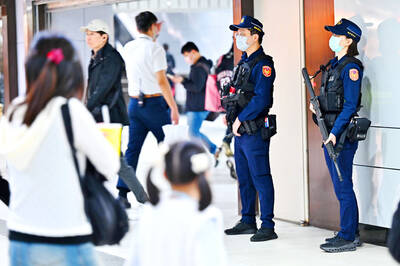
SAFETY FIRST: Double the number of police were deployed at the Taipei Marathon, while other cities released plans to bolster public event safety Authorities across Taiwan have stepped up security measures ahead of Christmas and New Year events, following a knife and smoke bomb attack in Taipei on Friday that left four people dead and 11 injured. In a bid to prevent potential copycat incidents, police deployments have been expanded for large gatherings, transport hubs, and other crowded public spaces, according to official statements from police and city authorities. Taipei Mayor Chiang Wan-an (蔣萬安) said the city has “comprehensively raised security readiness” in crowded areas, increased police deployments with armed officers, and intensified patrols during weekends and nighttime hours. For large-scale events, security checkpoints and explosives
PUBLIC SAFETY: The premier said that security would be tightened in transport hubs, while President Lai commended the public for their bravery The government is to deploy more police, including rapid response units, in crowded public areas to ensure a swift response to any threats, President William Lai (賴清德) said yesterday after a knife attack killed three people and injured 11 in Taipei the previous day. Lai made the remarks following a briefing by the National Police Agency on the progress of the investigation, saying that the attack underscored the importance of cooperation in public security between the central and local governments. The attack unfolded in the early evening on Friday around Taipei Main Station’s M7 exit and later near the Taipei MRT’s Zhongshan
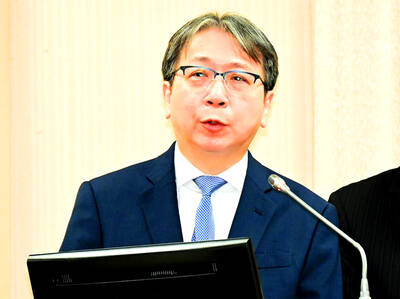
ON ALERT: Taiwan’s partners would issue warnings if China attempted to use Interpol to target Taiwanese, and the global body has mechanisms to prevent it, an official said China has stationed two to four people specializing in Taiwan affairs at its embassies in several democratic countries to monitor and harass Taiwanese, actions that the host nations would not tolerate, National Security Bureau (NSB) Director-General Tsai Ming-yen (蔡明彥) said yesterday. Tsai made the comments at a meeting of the legislature’s Foreign Affairs and National Defense Committee, which asked him and Minister of National Defense Wellington Koo (顧立雄) to report on potential conflicts in the Taiwan Strait and military preparedness. Democratic Progressive Party (DPP) Legislator Michelle Lin (林楚茵) expressed concern that Beijing has posted personnel from China’s Taiwan Affairs Office to its


 RSS
RSS