


A US federal court on Monday sentenced former State Department official Donald Keyser to a prison term of 12 months and one day, plus two years of subsequent supervised release, in a case that stemmed from Keyser's illicit relationship with a Taiwanese intelligence officer, Isabelle Cheng Nien-tsu (程念慈), when she was posted to Washington earlier this decade.
The sentence, which many people who attended the hearing described as lenient, also includes a US$25,000 fine and would give Keyser some flexibility in where he would serve the prison term.
It was not immediately clear whether Keyser's lawyers planned an appeal.
Keyser, 63, was not immediately taken into custody, as the judge, T.S. Ellis III, of the Federal District Court of the Eastern District of Virginia, in the Washington suburbs, allowed Keyser to surrender voluntarily.
The case, which at one time seemed poised to strain the convoluted way in which the US and Taiwan do business in Washington, devolved into a matter of fairly narrow technical and bureaucratic issues, plus a saga of an affair between a middle-aged senior US official and a younger Taiwanese intelligence officer.
Keyser pleaded guilty in December 2005 to three charges that carried maximum prison terms of 13 years. A plea agreement between the prosecutor and Keyser's lawyers had initially called for a minimum term of 18 to 24 months in prison.
The charges were that Keyser lied to customs officials and State Department investigators about a secret trip to Taiwan he took with Cheng in 2003, that he lied about having an affair with Cheng which may have exposed him to blackmail by Taiwanese authorities, and that he stored more than 3,000 official documents in his home -- including many secret and classified documents -- in violation of government rules.
Prosecuting attorney David Laufman was critical of Taiwan during the case and during Monday's hearing at one point called the Chen administration a "hostile government," which raised eyebrows among attendees, many of whom were friends of Taiwan.
However, Ellis repeatedly interrupted Laufman's efforts to interject US-Taiwan relations into the arguments. He said that the US government, through the FBI, had tried to establish an espionage charge in the Keyser-Cheng relationship, but had failed to do so. At one point, Ellis reminded Laufman that the case "was not about spying."
The case began when Keyser met Cheng socially in 2002 and began a two-year relationship. The following year, Keyser made an unauthorized trip to Taiwan to meet the 35-year-old Cheng. Keyser, who is married, hid a customs declaration he signed on his return to the US and failed to mention the trip in an internal State Department questionnaire. He also failed to tell his wife about the trip.
Later, in an annual review of his top secret clearance, Keyser also hid his relationship when questioned about any foreign entanglements that could subject him to blackmail or exploitation. That was the basis of the second charge.
A FBI raid on his house uncovered thousands of sensitive and classified official documents, the basis of the third charge against him.
In an impassioned plea to the judge for leniency, Keyser expressed regret for "unforgivable carelessness" and "a significant lapse of judgment."
"I can't imagine what I was thinking," he said about becoming involved with Cheng -- whom he called "that young woman" -- and concealing the relationship.
However, he said: "I was not at any time an agent of Taiwan."
He added that his meetings with Cheng and her boss at the Taipei Economic and Cultural Representative Office (TECRO) in Washington -- the National Security Bureau's (NSB's) top agent in TECRO, [Huang Kuang-hsun (黃光勳)] -- were in furtherance of US policy on Taiwan.
"Neither Cheng nor Huang ever sought or received from me any unauthorized information," Keyser said.
Many US officials meet NSB officials in Washington on a regular basis, a normal and useful activity for US policy toward Taiwan, he said.
In sentencing Keyser, Ellis said he took into account more than 50 letters supporting Keyser and attesting to his character.
These came from various sources, including former senior ambassadors, generals, admirals, intelligence officials and active State Department officials.
An aide to US Secretary of State Condoleezza Rice was in the courthouse, but told the Taipei Times that Rice was not one of the letter writers.
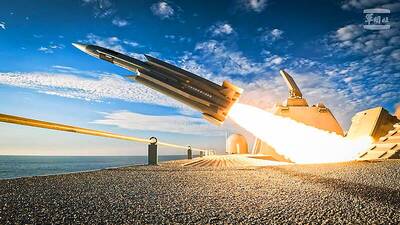
DETERRENCE: With 1,000 indigenous Hsiung Feng II and III missiles and 400 Harpoon missiles, the nation would boast the highest anti-ship missile density in the world With Taiwan wrapping up mass production of Hsiung Feng II and III missiles by December and an influx of Harpoon missiles from the US, Taiwan would have the highest density of anti-ship missiles in the world, a source said yesterday. Taiwan is to wrap up mass production of the indigenous anti-ship missiles by the end of year, as the Chungshan Institute of Science and Technology has been meeting production targets ahead of schedule, a defense official with knowledge of the matter said. Combined with the 400 Harpoon anti-ship missiles Taiwan expects to receive from the US by 2028, the nation would have

POSSIBILITIES EMERGE: With Taiwan’s victory and Japan’s narrow win over Australia, Taiwan now have a chance to advance if South Korea also beat the Aussies Taiwan has high hopes that the national baseball team would advance to the World Baseball Classic (WBC) quarter-finals after clinching a crucial 5-4 victory over South Korea in a nail-biting extra-inning game at the Tokyo Dome yesterday. Boosted by three home runs — two solo shots by Yu Chang (張育成) and Cheng Tsung-che (鄭宗哲) and a two-run homer by Stuart Fairchild — the triumph gave Taiwan a much-needed second victory in the five-team Pool C, where only the top two finishers would advance to the knockout stage in Miami, Florida. Entering extra innings with the game tied at four apiece, Taiwan scored
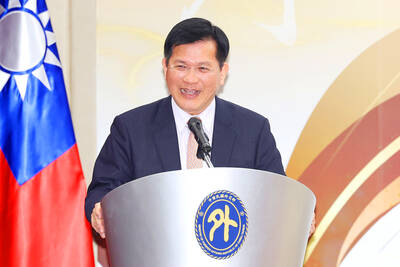
MISSION OF PEACE: The foreign minister urged Beijing to respect Taiwan’s existence as an independent nation, and work together to ensure peace and stability in the region Minister of Foreign Affairs Lin Chia-lung (林佳龍) yesterday rejected Chinese Minister of Foreign Affairs Wang Yi’s (王毅) comments about Taiwan, criticizing China as a “troublemaker” in the international community and a disruptor of cross-strait peace. Speaking at a news conference on the sidelines of the Chinese National People’s Congress, Wang said that Taiwan has always been a territory of China and that it would be impossible for it to become its own country. The “return” of Taiwan to China was the natural outcome of the Chinese people’s resistance against Japan in World War II, and that any pursuit of independence was “doomed

‘UNWAVERING FRIENDSHIP’: A representative of a Japanese group that co-organized a memorial, said he hopes Japanese never forget Taiwan’s kindness President William Lai (賴清德) yesterday marked the 15th anniversary of the Tohoku earthquake and tsunami, urging continued cooperation between Taiwan and Japan on disaster prevention and humanitarian assistance. Lai wrote on social media that Taiwan and Japan have always helped each other in the aftermath of major disasters. The magnitude 9 earthquake struck northeastern Japan on March 11, 2011, triggering a massive tsunami that claimed more than 19,000 lives, according to data from Japanese authorities. Following the disaster, Taiwan donated more than US$240 million in aid, making it one of the largest contributors of financial assistance to Japan. In addition to cash donations and


 RSS
RSS