


Chunghwa Telecom Co, the nation's biggest phone company, said yesterday that it had restored voice services to the US, Canada and China by rerouting connections after earthquakes on Tuesday damaged two undersea cables.
Voice services to Hong Kong and Singapore were expected to be partially restored soon as the company completes agreements on rerouting the connections, Chunghwa vice president Leng Tai-feng (冷台芬) said by telephone last night.
Chunghwa Telecom said it activated its backup system and was relying on two remaining undersea cables. But it would take at least two to three weeks to restore the damaged cables and restore normal data services, the company said.
Links to the US, Japan, China and Southeast Asia were damaged by the quakes on Tuesday night, and millions of Internet and telephone connections across Asia were severely disrupted or slowed yesterday. Banks and businesses across the region also reported problems with communications.
HSBC customers, for instance, were unable to access online banking services in Taiwan, Hong Kong and China, said Vinh Tran, a company spokeswoman in Hong Kong.
Securities traders in Hong Kong and Singapore were unable to obtain prices and complete orders after networks linking financial companies were disrupted.
Dealers said, however, that because it is around Christmas, the impact would be less serious.
Chunghwa Telecom estimates that about 30 percent of its users of overseas data transmission have been affected, with those in Southeast Asia suffering most.
Chunghwa earlier yesterday said that telephone calls to the US were down to 40 percent of normal capacity, while calls to China were down to 10 percent and 11 percent for Japan.
It promised to compensate clients by charging lower fees. It also said it had sought help from other undersea cable suppliers and telecom operators to improve its services.
"Data is more difficult to restore because it is high speed," Leng said.
Primary cables were being repaired by another company, she added.
Taiwan's undersea communications cable system consists of seven lines extending from the northern and southern points of the island. The quake damaged the two southern lines.
Chunghwa said the damaged portions of the cables would be pulled to the surface and repaired aboard a ship.
Damaged cables include the APCN2 cable and Sea-Me-We3 cables, Leng said. Eight STM-1 cables from Okinawa and 4 STM-1 cables from Shanghai are acting as backup, Chunghwa said. The company may also use the ST-1 satellite in the meantime.
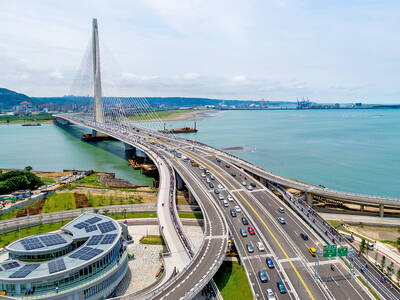
The Ministry of Transportation and Communications yesterday inaugurated the Danjiang Bridge across the Tamsui River in New Taipei City, saying that the structure would be an architectural icon and traffic artery for Taiwan. Feted as a major engineering achievement, the Danjiang Bridge is 920m long, 211m tall at the top of its pylon, and is the longest single-pylon asymmetric cable-stayed bridge in the world, the government’s Web site for the structure said. It was designed by late Iraqi-British architect Zaha Hadid. The structure, with a maximum deck of 70m, accommodates road and light rail traffic, and affords a 200m navigation channel for boats,
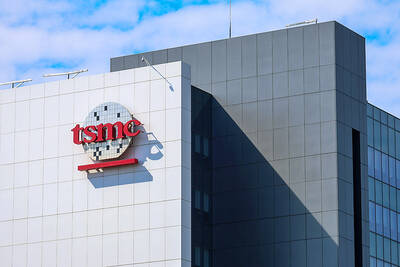
Taiwan Semiconductor Manufacturing Co (TSMC, 台積電), the world’s largest foundry service provider, yesterday said that global semiconductor revenue is projected to hit US$1.5 trillion in 2030, after the figure exceeds US$1 trillion this year, as artificial intelligence (AI) demand boosts consumption of token and compute power. “We are still at the beginning of the AI revolution, but we already see a significant impact across the whole semiconductor ecosystem,” TSMC deputy cochief operating officer Kevin Zhang (張曉強) said at the company’s annual technology symposium in Hsinchu City. “It is fair to say that in the past decade, smartphones and other mobile devices were
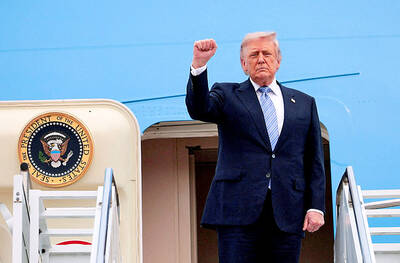
US-CHINA SUMMIT: MOFA welcomed US reassurance of no change in its Taiwan policy; Trump said he did not comment when Xi talked of opposing independence US President Donald Trump yesterday said he has not made a decision on whether to move forward with a major arms package for Taiwan after hearing concerns about it from Chinese President Xi Jinping (習近平). Trump’s comments on Taiwan came as he flew back to Washington after wrapping up critical talks in which both leaders said important progress was made in stabilizing US-China relations even as deep differences persist between the world’s two biggest powers on Iran and Taiwan. “I will make a determination,” Trump said, adding: “I’ll be making decisions. But, you know, I think the last thing we need right
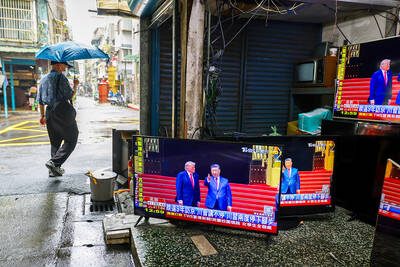
TAIWAN ISSUE: US treasury secretary Scott Bessent said on the first day of meetings that ‘it wouldn’t be a US-China summit without the Taiwan issue coming up’ There were no surprises on the first day of the summit between US President Donald Trump and Chinese President Xi Jinping (習近平), the Mainland Affairs Council (MAC) said yesterday, as the government reiterated that cross-strait stability is crucial to the Asia-Pacific region, as well as the world. As the two presidents met for a highly anticipated summit yesterday, Chinese state media reported that Xi warned Trump that missteps regarding Taiwan could push their two countries into “conflict.” Trump arrived in China with accolades for his host, calling Xi a “great leader” and “friend,” and extending an invitation to visit the White House


 RSS
RSS