


The local benchmark index capped 10 consecutive days of gains by hitting a six-year high yesterday, spurred by the Carlyle Group's bid for Advanced Semiconductor Engineering (ASE), the world's largest chip-testing and packaging company.
The TAIEX rose 70.79 points, or 0.95 percent, to 7,498.15 on turnover of NT$127.17 billion (US$3.89 billion), marking its highest close since Sept. 6, 2000.
Foreign investors bought a net NT$16.02 billion of shares yesterday, boosting net purchases to NT$88.57 billion since the beginning of this month.
"International acquisition activities are an inevitable trend," Ann Chang (
Taiwanese stocks that boast healthy fundamentals are relatively cheaper than those in neighboring markets like Hong Kong, making them attractive to foreign investors and private equity funds like the Carlyle Group, Chang said.
The market watcher expects the injection of overseas funds to continue for the foreseeable future, spurring the local equity market, which has lagged behind other Asian markets.
Shares of ASE rose by the 7 percent daily limit to close at NT$37.95, bringing it closer to Carlyle's offer of NT$39 per share.
Encouraging
"[Investors] have been encouraged by the Carlyle bid. It is not a surprise at all. [ASE's] share price is expected to increase [again] on Tuesday [today]," said Fuh-Hwa Securities Investment and Trust analyst Bentham Hung.
Over the weekend, ASE said it had received an indication of interest from a consortium of investors led by Carlyle of the US on a potential offer to acquire all outstanding ASE shares.
At NT$39 per share, the deal values ASE at US$5.46 billion.
ASE chairman and chief executive officer Jason Chang (張虔生) agreed, subject to certain conditions, to commit his 18.4 percent ASE stake to the deal, the company said.
"The Carlyle bid for ASE is likely to trigger a series of takeovers by foreign investors in Taiwan's high-tech sector, using the island as a springboard into the huge mainland [China] market," an analyst with a regional brokerage said.
If the Carlyle bid succeeds, regulations dictate that ASE will be delisted from the local stock market.
Financial Supervisory Commission (FSC) spokeswoman Susan Chang (張秀蓮) said the commission would monitor the "unusual case," as ASE announced the share sale before applying to the commission.
Chang said there was also some concern that a series of foreign takeovers of local listed companies could see the stock market stripped of its top companies.
Citing institutional investor research, local media reported yesterday that 30 local companies, including the world's second-largest contract chip maker, United Microelectronics Corp, along with Acer Inc and Chunghwa Picture Tubes, had been targeted by suitors.
Maintaining an edge
Eager to maintain its edge over rivals in an industry led by Amkor Technology Inc, ASE was expected to use the foreign takeover -- if it went through -- to bypass the government's restrictions on investments in China, dealers said.
Under the nation's current policy on China-bound investments, local companies are only allowed to invest up to 40 percent of their net worth on the mainland.
Critics have called for a relaxation of this regulation which ties the hands of local businesses, while their rivals from around the world face no such restrictions.
"Above all, ASE has come up with a solution for many other Taiwanese companies that have also been weighed down by the government's restrictions against their expanding further in China," said an analyst with a leading foreign securities house who asked not to be named.
Analysts said the government's tight grip on China-bound investments by local companies had a profound impact on the local stock market even before the Carlyle-ASE case surfaced.
This has led local companies to seek overseas listings, with Hong Kong the preferred choice, in order to enjoy much higher valuations than is possible at home, as well as to get around the restrictions on China-bound investments, they said.
Uni-President Enterprises Corp, the flagship of the nation's largest food and beverage conglomerate, has said it plans to list a wholly owned China-based unit in Asia, with Hong Kong seen as one of the possible locations for the listing.
"No final decision has been made on the timing and stock exchange for the planned listing," company spokeswoman Selina Wu (
Meanwhile, the nation's financial stocks also soared for the fifth day yesterday, led by small-cap, independent banks on speculations for their possible acquisition by interested international private equity funds.
The financial sub-index rose 0.34 percent yesterday, with EnTie Bank (
The two banking stocks gained after being listed by analysts among 30 most likely acquisition targets.
EnTie said in a filing to the Taiwan Stock Exchange yesterday that it is open to a partnership with foreign investors.
"A number of foreign investors have called on us before, but no deals have taken place thus far," EnTie vice president Rich Lee (
EnTie would prefer an approach from a foreign bank, rather than a buyout fund, as such a partnership could help to sharpen its management know-how and international presence, Lee said.
Meanwhile, the Carlyle Group is reportedly also interested in acquiring Chinese Bank after taking control of its affiliate, Eastern Multimedia Co (
However, the financial regulator is likely to take an increasingly guarded approach to approaches from international buyout funds.
The FSC held an informal meeting on the issue yesterday, but has not yet reached any conclusions, Susan Chang said.
The financial watchdog would closely review the suitability of buyout funds becoming major shareholder of local financial institutions, she said.
Takeovers of non-financial companies by private equity funds are subject to the approval of the Ministry of Economic Affairs' Investment Commission, she added.
In regulatory terms, it is almost impossible to block bids from buyout funds. Any new defensive measures would require inter-departmental consensus within the Cabinet, Susan Chang said.
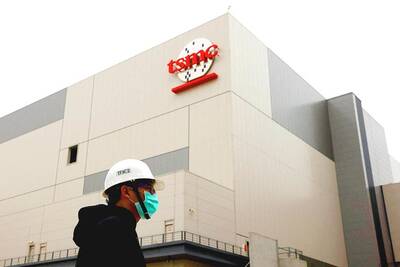
Taiwan Semiconductor Manufacturing Co (TSMC, 台積電) on Wednesday said that a new chip manufacturing technology called “A16” is to enter production in the second half of 2026, setting up a showdown with longtime rival Intel over who can make the fastest chips. TSMC, the world’s biggest contract manufacturer of advanced computing chips and a key supplier to Nvidia and Apple, announced the news at a conference in Santa Clara, California, where TSMC executives said that makers of artificial intelligence (AI) chips will likely be the first adopters of the technology rather than a smartphone maker. Analysts said that the technologies announced on
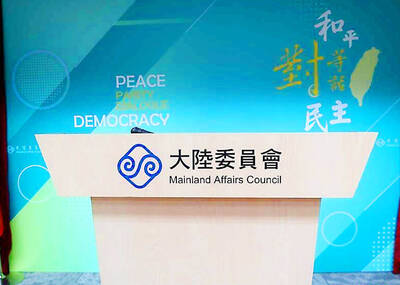
NO RECIPROCITY: Taipei has called for cross-strait group travel to resume fully, but Beijing is only allowing people from its Fujian Province to travel to Matsu, the MAC said The Mainland Affairs Council (MAC) yesterday criticized an announcement by the Chinese Ministry of Culture and Tourism that it would lift a travel ban to Taiwan only for residents of China’s Fujian Province, saying that the policy does not meet the principles of reciprocity and openness. Chinese Deputy Minister of Culture and Tourism Rao Quan (饒權) yesterday morning told a delegation of Chinese Nationalist Party (KMT) lawmakers in a meeting in Beijing that the ministry would first allow Fujian residents to visit Lienchiang County (Matsu), adding that they would be able to travel to Taiwan proper directly once express ferry

CALL FOR DIALOGUE: The president-elect urged Beijing to engage with Taiwan’s ‘democratically elected and legitimate government’ to promote peace President-elect William Lai (賴清德) yesterday named the new heads of security and cross-strait affairs to take office after his inauguration on May 20, including National Security Council (NSC) Secretary-General Wellington Koo (顧立雄) to be the new defense minister and former Taichung mayor Lin Chia-lung (林佳龍) as minister of foreign affairs. While Koo is to head the Ministry of National Defense and presidential aide Lin is to take over as minister of foreign affairs, Tsai Ming-yen (蔡明彥) would be retained as the nation’s intelligence chief, continuing to serve as director-general of the National Security Bureau, Lai told a news conference in Taipei. Koo,
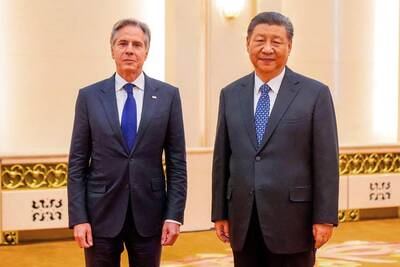
MANAGING DIFFERENCES: In a meeting days after the US president signed a massive foreign aid bill, Antony Blinken raised concerns with the Chinese president about Taiwan US Secretary of State Antony Blinken yesterday met with Chinese President Xi Jinping (習近平) and senior Chinese officials, stressing the importance of “responsibly managing” the differences between the US and China as the two sides butt heads over a number of contentious bilateral, regional and global issues, including Taiwan and the South China Sea. Talks between the two sides have increased over the past few months, even as differences have grown. Blinken said he raised concerns with Xi about Taiwan and the South China Sea, along with China’s support for Russia and its invasion of Ukraine, as well as other issues


 RSS
RSS