


Taipei Mayor Ma Ying-jeou (馬英九) confirmed he was questioned by prosecutors again yesterday morning about the details of all donations he claimed to have made to public welfare groups with money from his mayoral special allowance fund.
It was the second time Ma has been questioned by prosecutors. Taipei prosecutors questioned him on Tuesday for more than four hours over his handling of his special allowance fund.
Returning to his office at around 12:30pm, Ma said the session had provided him with a good opportunity to clarify the facts.
"Everything is fine," Ma told reporters gathered in front of his office.
While declining to comment on the details of his conversation with the prosecutors, Ma insisted that he had explained the matter in detail, and believed that the prosecutors would make their judgment in accordance with the law.
"The prosecutors wanted to know the details of my donations. I respect the prosecutors and believe that they will handle the case impartially," he said while attending a municipal event at Chiang Cheng Municipal Junior High School.
Ma has previously said that he had donated more than NT$69 million (US$2.09 million) to public welfare groups over the past eight years, including two foundations established with NT$47 million left over from mayoral election subsidies and more than NT$16 million from his personal account that was given to more than 11 groups.
Last Friday Ma said that he had donated NT$6 million earlier that day and would contribute another NT$5.5 million from the special mayoral fund this week.
Those two donations, he said, in addition to the NT$5 million he donated over the past year, would equal the NT$16 million of his monthly mayoral allowance that required no independent accounting oversight.
On Saturday, however, the Taipei City Government said that the money came not from Ma's special allowance fund, but from his personal bank account. The mayor had decided to donate an amount equal in proportion to highlight the flaws in the special fund system, the city government said.
Facing continuous requests for him to publicize his donation records, Ma reiterated yesterday that he would make the records public "at the proper time," but declined to give an exact date.
Ma also confirmed that his wife, Chou Mei-ching (周美青), was questioned last week, but denied she was questioned again yesterday.
Ma was questioned by Prosecutor Hou Kuan-jen (侯寬仁) from the Taiwan High Court Prosecutors' Office's Black Gold Investigation Center.
Taiwan High Court Prosecutors' Office Spokesman Chang Wen-cheng (
"Prosecutors needed to see him [Ma] again to clarify their questions over documents that the defendant provided during the last session," Chang said.
"Prosecutors never summon anyone randomly. Our sessions are all scheduled. We would not summon anyone without good reason," he added.
Additional reporting by Jimmy ChuaNg

PROVOCATIVE: Chinese Deputy Ambassador to the UN Sun Lei accused Japan of sending military vessels to deliberately provoke tensions in the Taiwan Strait China denounced remarks by Japan and the EU about the South China Sea at a UN Security Council meeting on Monday, and accused Tokyo of provocative behavior in the Taiwan Strait and planning military expansion. Ayano Kunimitsu, a Japanese vice foreign minister, told the Council meeting on maritime security that Tokyo was seriously concerned about the situation in the East China and South China seas, and reiterated Japan’s opposition to any attempt to change the “status quo” by force, and obstruction of freedom of navigation and overflight. Stavros Lambrinidis, head of the EU delegation to the UN, also highlighted South China Sea
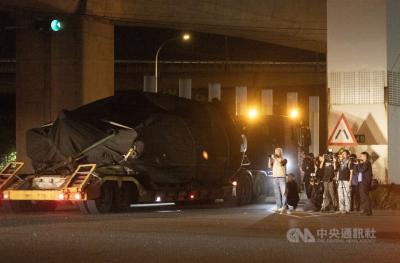
The final batch of 28 M1A2T Abrams tanks purchased from the US arrived at Taipei Port last night and were transported to the Armor Training Command in Hsinchu County’s Hukou Township (湖口), completing the military’s multi-year procurement of 108 of the tanks. Starting at 12:10am today, reporters observed more than a dozen civilian flatbed trailers departing from Taipei Port, each carrying an M1A2T tank covered with black waterproof tarps. Escorted by military vehicles, the convoy traveled via the West Coast Expressway to the Armor Training Command, with police implementing traffic control. The army operates about 1,000 tanks, including CM-11 Brave Tiger

Taiwan Semiconductor Manufacturing Co (TSMC, 台積電), the world’s largest contract chipmaker, said it expects its 2-nanometer (2nm) chip capacity to grow at a compound annual rate of 70 percent from this year to 2028. The projection comes as five fabs begin volume production of 2-nanometer chips this year — two in Hsinchu and three in Kaohsiung — TSMC senior vice president and deputy cochief operating officer Cliff Hou (侯永清) said at the company’s annual technology symposium in Silicon Valley, California, last week. Output in the first year of 2-nanometer production, which began in the fourth quarter of last year, is expected to
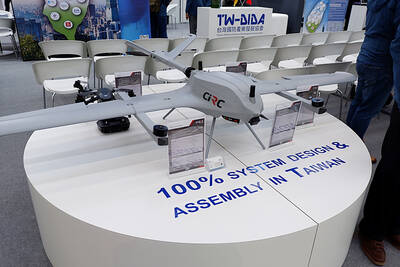
Taiwan’s drone exports surged past US$100 million in the first quarter, exceeding last year’s full-year total, with the Czech Republic emerging as the largest buyer, the Ministry of Economic Affairs said. Exports of complete drones reached US$115.85 million in the period, about 1.2 times the total recorded for all of last year, the ministry said in a report. Exports to the Czech Republic accounted for about US$100 million, far outpacing other markets. Poland, last year’s top destination, recorded about US$11.75 million in the first quarter. Taiwan’s drone exports have expanded rapidly in the past few years, with last year’s total


 RSS
RSS