


Pan-green lawmakers yesterday may have reacted with shock to the indictment of first lady Wu Shu-jen (吳淑珍), but their pan-blue counterparts were gleeful, vowing to launch a third recall motion against President Chen Shui-bian (陳水扁), should he refuse to step down.
The pan-blues also demanded Premier Su Tseng-chang (
"It's a day of infamy for the Republic of China ... We feel great sorrow and indignation," People First Party (PFP) Legislator Liu Wen-hsiung (
If Chen persisted in staying in his post, the ruling and opposition parties would be deadlocked from this point forward and could never reconcile, Liu said.
"If Chen has a sense of shame he should resign immediately," Chinese Nationalist Party (KMT) Legislator Hung Hsiu-chu (
After learning that Wu had been indicted, the Taiwan Solidarity Union (TSU) called a press conference, with chairman Shu Chin-chiang (蘇進強) saying that his party would throw its weight behind a third recall motion.
"The president should know that now it's time for him to leave office," Shu said.
TSU Legislator Lo Chih-ming (
A recall or an impeachment motion requires the backing of two-thirds of all sitting legislators to pass. As only 220 seats are currently filled in the 225-seat Legislative Yuan, that means 147 legislators would have to back a recall or impeachment for it to pass.
If all 90 KMT lawmakers, 22 PFP lawmakers and 12 TSU lawmakers voted in favor of a recall or impeachment, they would still need 23 votes.
The Non-Partisan Solidarity Union's eight lawmakers generally vote with the pan-blue parties. Among the three independent lawmakers, Li Ao (李敖) often vote with the pan-blue parties. The other two are former DPP members,they generally vote with the DPP.
Therefore, a minimum of 12 of the 85 Democratic Progressive Party (DPP) legislators would also have to back a recall or impeachment motion in order for it to pass.
Passage of an impeachment motion then requires approval from the Council of Grand Justices to dismiss the president, while passage of a recall motion would initiate a public referendum on whether Chen should step down.
The public referendum requires a simple majority of all voters who cast ballots to approve the dismissal of the president.
KMT response
After an impromptu Central Standing Committee meeting to discuss the issue last night, Chinese Nationalist Party (KMT) Chairman Ma Ying-jeou (
Ma added that the party had not ruled out impeaching the president.
In a separate press conference yesterday, Ma called on the DPP, as the ruling party, to take the initiative and to demand that the president offer his resignation.
"The ruling party should put its house in order and show some self-reflection. The DPP should not miss the historic timing. It should bravely take responsibility and urge the president to step down," he added.
Declining to say what the KMT would do next, Ma said that it was the president and the DPP's time to act.
PFP Chairman James Soong (
Soong echoed Ma in urging the DPP to take the initiative and propose a recall motion against Chen.
"The DPP should apologize to the people with morality and courage, and demand that A-bian step down. It should also respond to public opinion by initiating a recall motion against Chen," Soong said during a press conference in the Legislative Yuan.
Soong also suggested that the ruling and opposition parties should hold a summit to seek a solution to the "current constitutional crisis." He also said that although the Constitution requires the vice president to succeed an ousted president, [vice president Annette] Lu [(
Soong said the PFP would first negotiate with the KMT, and would propose a recall motion against Chen if he refused to step down, with the possibility of also trying to impeach him.
Premier Su Tseng-chang (
KMT Legislator Huang Teh-fu (
"An indictment is not a decision that a suspect is guilty. Whether or not the president should resign is a problem we should talk about after judges reach their final verdict, not now," Su said.
Pan-blue lawmakers said the comment was "unacceptable."
"When [the first lady] Wu Shu-jen (
On the legislative floor, Su was faced with previous comments he made that "the president should resign if any of his family members or himself has been involved in any corruption-related scandal."
PFP Legislator Lu Hsueh-chang (
Su's comment had been made in response to KMT Legislator Pan Wei-kang (
Pan also asked Su "Do you agree whether Chen should resign if he or Wu are involved in the `state affairs fund' scandal?"
Su replied "That's right."
Yesterday, Su tried to downplay the comments.
"I can only say that my remarks were seriously twisted," he said.
The premier confirmed that he had met with President Chen Shui-bian (
KMT rally
The party is due to hold a large-scale rally this afternoon in Kaohsiung to urge Chen to step down followed by another tomorrow in Taipei.
Meanwhile, the campaign aimed at ousting Chen yesterday joined the opposition camp in condemning the president, urging Chen to step down immediately.
Returning to its protest site in front of the Taipei Railway Station at 7pm to celebrate the result of the investigation with protesters, campaign leader Shih Ming-teh (
"This is our history ... We want A-bian to step down immediately," Shih said yesterday.
Shih later led the protesters on a "walk" from the station to Ketagalan Boulevard.

National Taiwan University (NTU) yesterday said it disqualified a person from an entrance examination for using AI smart glasses to cheat, along with two others for making untruthful statements in their curriculum vitae. The three applicants were given null scores, Taiwan’s highest-ranked university said, calling on prospective students to be honest in the admissions process. NTU registrar Lee Hung-sen (李宏森) said that the cheating applicant wore a hat and thick-rimmed glasses to the second written exam for medical school, claiming that they felt cold. Suspicions were aroused when the applicant stared oddly at the test for long stretches while steadily bringing the paper
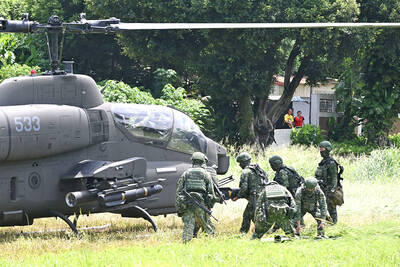
MILITARY ISSUES: A partisan divide between the Cabinet and the legislature ‘raised questions about Taiwan’s ability to adequately fund its defense,’ the report said Taiwan’s defense budget, military personnel numbers and resilience are challenges to its ability to meet national defense goals, the US Naval Institute said in a report published on Tuesday. In response to the perception of a growing military threat posed by China, Taiwan has embarked on an effort to enhance the capabilities needed to deter an attempt by Beijing to annex the nation by force, the institute said in the US Congressional Research Service report, titled Taiwan: Defense and Military Issues, which was filed on Thursday last week. Taiwan’s defense budget increased by about 7.5 percent from 2024 to last year, it

66 FIGHTER JETS: The aircraft is likely undergoing preparations for its transfer to Taiwan — a significant step forward in the nation’s modernization program, a lawmaker said The first of Taiwan’s order of F-16V Block 70 aircraft has been sighted in Texas ahead of delivery, Democratic Progressive Party (DPP) Legislator Wang Ting-yu (王定宇) said. Taiwan’s first F-16V Block 70 two-seat aircraft, tail number 6831, was seen flying from Lockheed Martin’s production facility in Greenville, South Carolina, to Naval Air Station Joint Reserve Base Fort Worth in Texas, Wang wrote on Facebook yesterday. The plane is likely undergoing preparations for its transfer to Taiwan, marking a significant step forward in the Republic of China Air Force’s modernization program, Wang said, citing military analysts. The F-16V Block 70 is a new-build version
NOT JUST NUMBERS: What matters to intelligence work is crucial, reliable information, so even a few credible leads can be highly valuable to national security, a legislator said The National Security Bureau (NSB) yesterday said it has finished the establishment of an information-reporting channel for Chinese nationals, the aim of which is to broaden intelligence gathering on China’s political, military, economic and social developments. Chinese nationals can submit information on the Web page, https://report.nsb.gov.tw, the NSB said in a statement. The move aims to expand the bureau’s diverse intelligence sources and is pursuant to the National Intelligence Services Act (國家情報工作法), it said, adding that it referenced practices adopted by intelligence agencies in the US, the UK and Israel. An increasing number of people are approaching Taiwanese agencies to provide information, as


 RSS
RSS