


A stark assessment of terrorism trends by US intelligence agencies has found that the US invasion and occupation of Iraq has helped spawn a new generation of Islamic radicalism and that the overall terrorist threat has grown since the Sept. 11, 2001 attacks.
The classified National Intelligence Estimate attributes a more direct role to the Iraq war in fueling radicalism than that presented either in recent White House documents or in a report released on Wednesday by the House Intelligence Committee, according to several officials in Washington involved in preparing the assessment or who have read the final document.
The intelligence estimate, completed in April, is the first formal appraisal of global terror since the Iraq war began, and represents a consensus view of the 16 disparate spy services inside government.
Titled Trends in Global Terrorism: Implications for the United States, it asserts that Islamic radicalism, rather than being in retreat, has metastasized and is spreading across the globe.
An opening section of the report, "Indicators of the Spread of the Global Jihadist Movement," cites the Iraq war as a driving force for the diffusion of jihad ideology.
The report "says that the Iraq war has made the overall terrorism problem worse," one US intelligence official said.
More than a dozen US government officials and outside experts were interviewed for the article. All had either seen the final version of the document or participated in the creation of earlier drafts.
Officials with knowledge of the intelligence estimate said it avoided specific judgments about the likelihood that terrorists would once again strike on US soil.
The relationship between the Iraq war and terrorism, and the question of whether the US is safer, have been subjects of persistent debate since the war began in 2003.
National Intelligence Estimates are the most authoritative documents that the intelligence community produces on a specific national security issue and are approved by US Director of National Intelligence John Negroponte.
Their conclusions are based on analyses of raw intelligence collected by all of the spy agencies.
The estimate concludes that the radical Islamic movement has expanded from a core of al-Qaeda operatives and affiliated groups to include a new class of "self-generating" cells inspired by al-Qaeda's leadership but without any direct connection to Osama bin Laden or his top lieutenants.
The broad judgments of the new intelligence estimate are consistent with assessments of global terrorist threats by US allies and independent terrorism experts.
Documents released by the White House timed to coincide with the fifth anniversary of the Sept. 11 attacks emphasized the successes that the US had achieved in dismantling the top tier of al-Qaeda.
"Since the Sept. 11 attacks, America and its allies are safer, but we are not yet safe," concludes one, a report titled 9/11 Five Years Later: Success and Challenges.
"We have done much to degrade al-Qaeda and its affiliates and to undercut the perceived legitimacy of terrorism," is said.
That document makes only passing mention of the impact the Iraq war has had on the global jihad movement.
"The ongoing fight for freedom in Iraq has been twisted by terrorist propaganda as a rallying cry," it states.
The report mentions the possibility that Islamic militants who fought in Iraq could return to their home countries, "exacerbating domestic conflicts or fomenting radical ideologies."
Last Wednesday, the Republican-controlled House Intelligence Committee released a more ominous report about the terrorist threat.
That assessment, based entirely on unclassified documents, details a growing jihad movement and says that "al-Qaeda leaders wait patiently for the right opportunity to attack."

LEVERAGE: China did not ‘need to fire a shot’ to deny Taiwan airspace over Africa when it owns ‘half the continent’s debt,’ a US official said, calling it economic warfare The EU has raised concerns about overflight rights following the delay of President William Lai’s (賴清德) planned state visit to the Kingdom of Eswatini after three African nations denied overflight clearance for his charter at the last minute. Taiwanese allies Paraguay and Saint Kitts and Nevis, as well as several US lawmakers and the Inter-Parliamentary Alliance on China (IPAC) condemned China for allegedly pressuring the countries. Lai was scheduled to fly directly to Taiwan’s only African ally from yesterday to Sunday to celebrate the 40th anniversary of King Mswati III’s accession and his 58th birthday, but Seychelles, Mauritius and Madagascar suddenly revoked
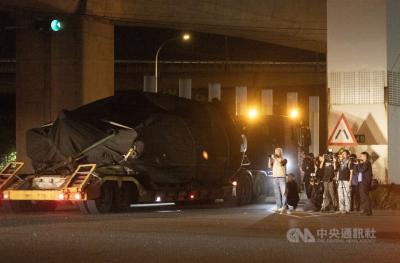
The final batch of 28 M1A2T Abrams tanks purchased from the US arrived at Taipei Port last night and were transported to the Armor Training Command in Hsinchu County’s Hukou Township (湖口), completing the military’s multi-year procurement of 108 of the tanks. Starting at 12:10am today, reporters observed more than a dozen civilian flatbed trailers departing from Taipei Port, each carrying an M1A2T tank covered with black waterproof tarps. Escorted by military vehicles, the convoy traveled via the West Coast Expressway to the Armor Training Command, with police implementing traffic control. The army operates about 1,000 tanks, including CM-11 Brave Tiger
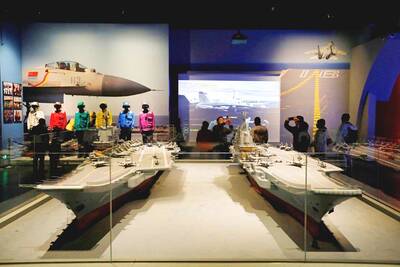
China on Wednesday teased in a video an aircraft carrier that could be its fourth, and the first using nuclear power, while making an allusion to Taiwan and vowing to further build up its islands, as it looks to boost maritime power, secure resources and bolster territorial claims. The video, issued on the eve of the 77th founding anniversary of the Chinese People’s Liberation Army Navy, featured fictional officers with names that are homophones of three commissioned aircraft carriers, the Liaoning (遼寧), Shandong (山東) and Fujian (福建). Titled Into the Deep, it showed a 19-year-old named “Hejian” (何劍) joining the group, sparking

BIG YEAR: The company said it would also release its A12 chip the same year to keep a ‘reliable stream of new silicon technologies’ flowing to its customers Taiwan Semiconductor Manufacturing Co (TSMC, 台積電) yesterday said its newest A13 chip is to enter volume production in 2029 as the chipmaker seeks to hold onto its tech leadership and demand for next-generation chips used in artificial intelligence (AI), high-performance-computing (HPC) and mobile applications. TSMC, the world’s biggest contract chipmaker, also unveiled its A12 chip at its annual technology symposium in Santa Clara, California. The A12 chip, which features TSMC’s super-power-rail technology to provide backside power delivery for AI and HPC applications, is also to enter volume production in 2029, a year after the scheduled release of the A14 chip. The technology moves


 RSS
RSS